Liberian National Museum
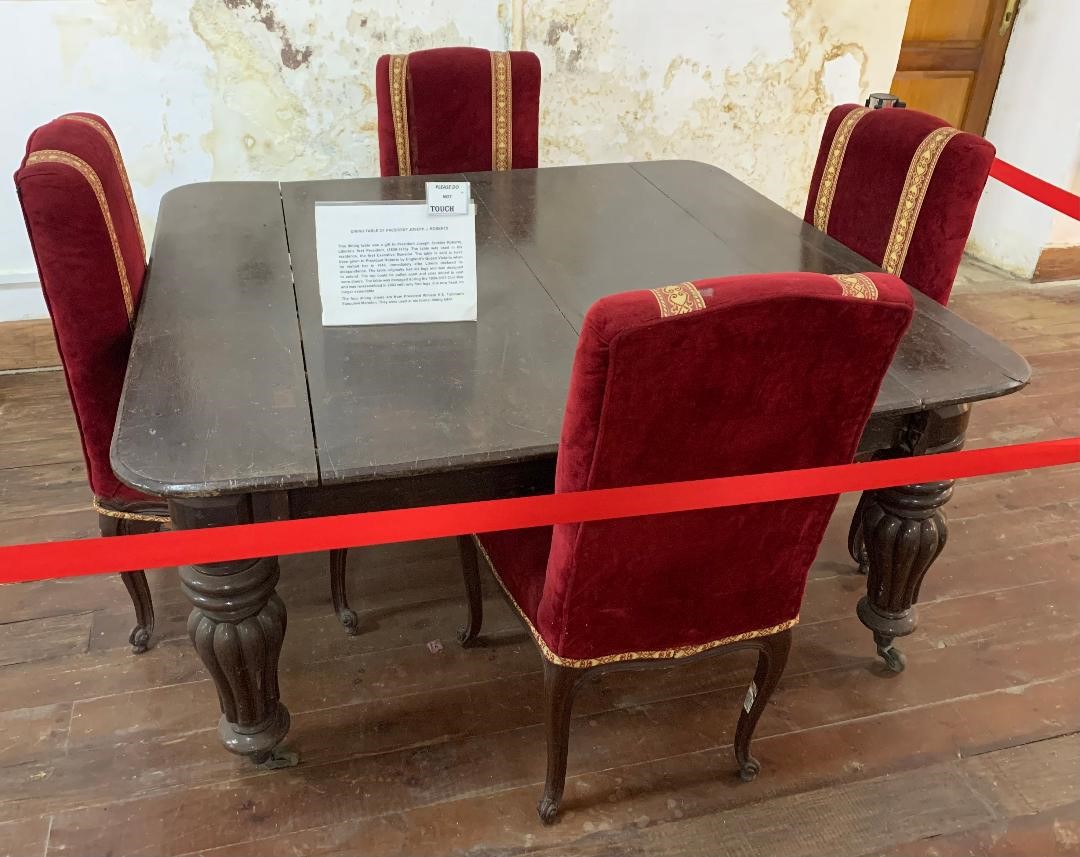
Of the roughly five thousand artifacts that once filled its galleries, fewer than one hundred survive. The National Museum of Liberia, tucked inside the old Supreme Court building in downtown Monrovia, tells the story of a country through what it managed to keep and what it lost. A 250-year-old dining table, gifted by Queen Victoria to Liberia's first president, Joseph Jenkins Roberts, still stands among the remaining pieces. That a single piece of furniture outlasted fourteen years of civil war says something about luck, about the devotion of the people who hid it, and about how much else was not so fortunate.
A Nation's Memory, Relocated
The museum has never stayed in one place for long. Established in 1958 under President William V.S. Tubman, it was first housed in the old Executive Mansion on Ashmun Street, partly funded by UNESCO. In 1972, it moved to Providence Island, the small landmass in the Mesurado River where Liberia's founding settlers had first come ashore in 1822. But the island could not hold it; four years later, the building was demolished to make way for the People's Bridge. The museum drifted through bureaucratic reshuffling, passing between the Department of Public Instructions, the Department of Information, and the National Bureau of Culture and Tourism before finally settling into the Old Supreme Court building. Vice President Harry F. Moniba formally reopened it there on July 25, 1987. By then, the institution had changed hands and addresses more times than some of its artifacts had changed owners.
Three Floors of Heritage
The ground floor holds the histographical gallery: presidential papers, private documents, and photographs of Liberia's heads of state. The nation's first flag, dating to August 1847, when Liberia declared independence, hangs here alongside postage stamps and pages from the Liberia Herald, the country's daily newspaper. Traditional household furniture and utensils fill the surrounding space. One floor up, the Ethnographical Gallery houses masks, musical instruments, and crafts that represent the country's indigenous cultures. The top floor is the contemporary arts gallery, where commissioned works from Liberian art colleges and institutions rotate through. Outside on the museum grounds, two presidential limousines sit in the open air, one used by President Tubman and the other by President Samuel Doe, their chrome dulled but their silhouettes unmistakable.
What Fourteen Years Took Away
The First Liberian Civil War began in 1989. The second followed in 1999. Together, they consumed fourteen years and hollowed out the museum's collection. According to director Caesar Harris, approximately five thousand artifacts were looted. Fighters and fleeing civilians sold pieces to expatriates headed for the airport. Rebels shelled the building during attacks in 2003. What had taken decades to assemble vanished in months. The museum's loss mirrors the broader devastation of Monrovia during the wars, a city that saw its infrastructure, institutions, and social fabric torn apart. Yet the larger artifacts, too heavy or too awkward to carry off, remained. Queen Victoria's table, which she had given to Roberts when Liberia was barely a decade old, stayed put through all of it.
Surviving as Evidence
The museum today is as much about absence as presence. Gaps in the collection serve as a kind of testimony, documenting what the wars cost Liberia's cultural memory. But the institution has also turned the conflict itself into an exhibit. Items recovered from the war years now sit alongside the prewar collection, making the museum a place where Liberian history does not politely end before the difficult chapters. Cassette recordings of oral traditions, slides of ceremonial dances, and video archives of mask-making still exist in the facility. The craft shop on the ground floor, operated by African Arts and Crafts Inc., sells contemporary work that connects the museum to the living culture outside its walls. The building endures, patched and stubborn, in a city that has had to rebuild more than once.
From the Air
Located at 6.317N, 10.804W in downtown Monrovia, on the south bank of the Mesurado River near Providence Island. The museum building is not individually visible from altitude, but the downtown Monrovia waterfront and river confluence are clear landmarks. Nearest airport is Roberts International Airport (GLRB), approximately 56 km southeast. Spriggs Payne Airport (GLSP) is much closer, about 3 km east on the coast. Recommended viewing altitude: 2,000-3,000 feet for the downtown district. Tropical climate with heavy rainfall June through October.