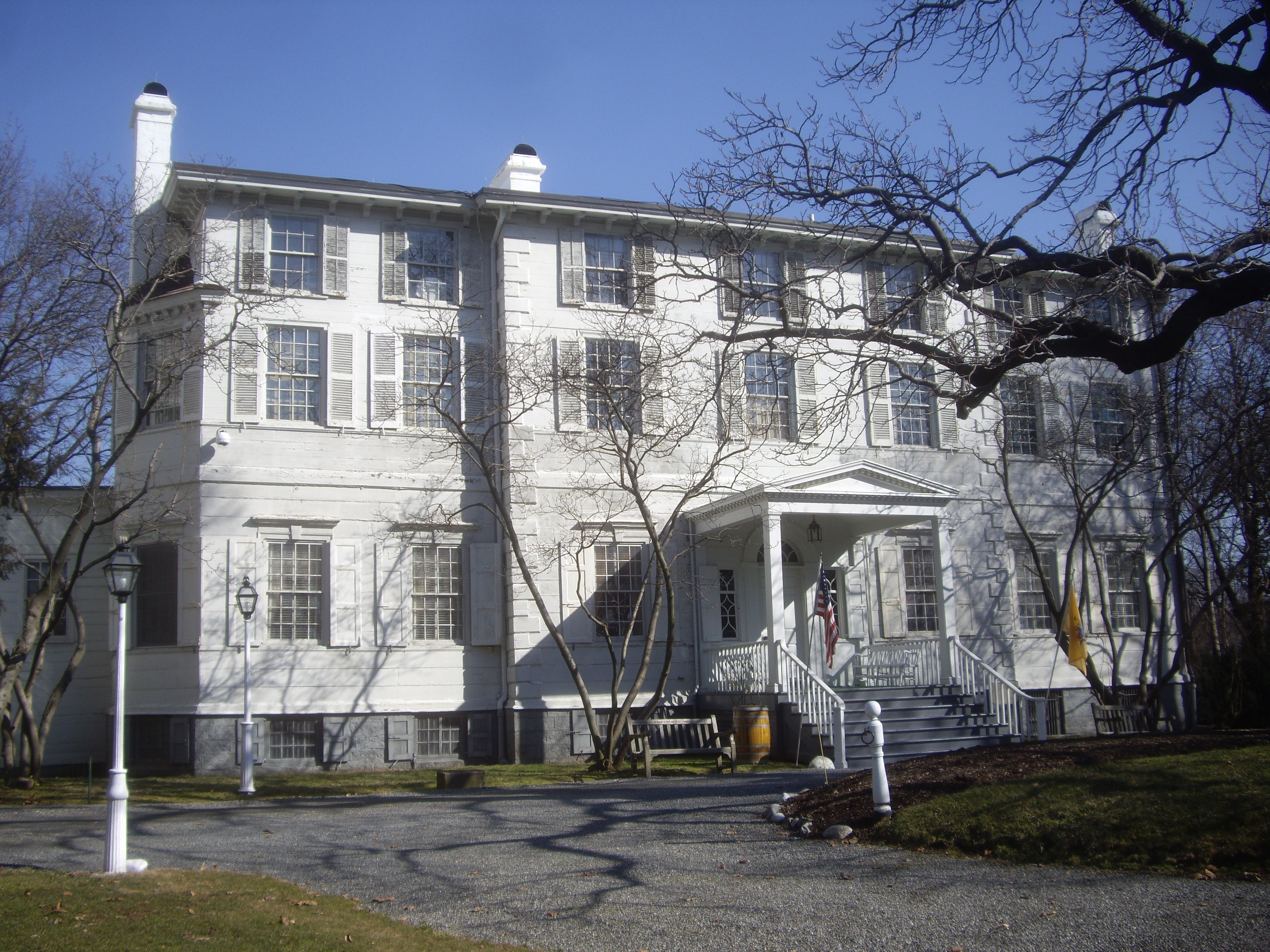
Liberty Hall (New Jersey)
Alexander Hamilton was a teenager when he moved in. The year was 1773, and the young Caribbean immigrant had come to live with William Livingston at his new country house in Elizabethtown, New Jersey -- a 14-room Georgian home on 120 acres that Livingston had named Liberty Hall. Within three years, Livingston would become the first Governor of New Jersey, and Hamilton would begin the trajectory that ended on a dueling ground in Weehawken. The house outlasted both men. Over 250 years, it grew from 14 rooms to 50, sheltered a Supreme Court justice and a political dynasty, survived damage from both American and British troops, and accumulated enough artifacts -- including a signed letter from George Washington and an invitation to Abraham Lincoln's inaugural -- to fill a museum.
The Governor's Rebellious Parlor
William Livingston bought the land in 1760 while still a New York lawyer, drawn by its proximity to the city and the genteel prospect of country life. He built the house in 1772 and moved his family in the following year. But country life did not stay genteel for long. Livingston became a delegate to both the First and Second Continental Congresses, signed the Constitution, and served as New Jersey's first governor from 1776 until his death in 1790. During the Revolutionary War, the house took damage from both sides of the conflict. Among its guests: George and Martha Washington, the Marquis de Lafayette, Elias Boudinot, and John Jay, who married one of Livingston's daughters in the parlor -- making Liberty Hall the wedding venue for the man who would become the first Chief Justice of the United States Supreme Court.
A House Passed Hand to Hand
After Livingston's death, his son Henry Brockholst Livingston -- who would serve on the United States Supreme Court -- inherited the property. In 1798 it passed to George Belasise, Lord Bolingbroke, and his wife Isabella, who continued the Livingstons' tradition of agricultural improvement. Then, in 1811, Peter Kean purchased the house in trust for his mother, Susan Livingston Kean Niemcewicz, a niece of the governor. Women could not own property in their own name in the United States at that time, so the legal fiction of a trust was necessary. Susan's life was a novel in itself: her first husband, Continental Congress delegate John Kean of South Carolina, died at thirty-nine from a respiratory disease contracted during his imprisonment in the Revolution. Her second husband was Count Julian Niemcewicz, a Polish exile who renamed the house "Ursino" after his estate back home.
From Fourteen Rooms to Fifty
The Kean family would hold Liberty Hall for the next two centuries, and Colonel John Kean II left the deepest physical mark. Living in the house for 60 years, he expanded it from its original Georgian footprint into a 50-room Victorian Italianate mansion -- primarily to accommodate his large family. He added a third story to the west wing and central section in 1870, built a tower at the northwest corner, and introduced running water, gravity hot-air heating, and gas lighting. The gambrel roof of the original 1772 house was absorbed into the larger structure, though the south-facing front elevation preserved much of its colonial appearance: the pedimented porch, the fanlight over the paneled door, the shutters louvered on the upper floor and paneled on the first.
The Kean Dynasty's Long Residency
The house became a seat of political power. John Kean -- the oldest son of Colonel John Kean II -- served as a two-term Congressman and Senator from New Jersey, hosting political affairs at Liberty Hall when home from Washington. His nephew, Captain John Kean, son of Senator Hamilton Fish Kean, inherited the property and lived there with his wife, Mary Alice Barney, after 1932. Mary Alice Kean became the house's final private resident and its most devoted champion. She researched the Kean family history, motivated the restoration of Liberty Hall and other historic homes, and in 1949 began the process of transforming the residence into a museum. In 1974, she restored the original name, displacing "Ursino" after more than 150 years.
A Living Archive on Morris Avenue
Today Liberty Hall Museum sits on the campus of Kean University in Union, New Jersey, between the main campus and the east campus in Hillside. Its collections span 250 years of American life: furniture, clothing, manuscripts, portraits, and oddities accumulated by seven generations of a single family line. A signed letter from George Washington. A pre-census population count. An invitation to Lincoln's first inaugural. The building itself is the most telling artifact -- its flushboarded exterior walls, its dentiled cornices, its 18th-century floor plan still intact within the Victorian shell. Designated a National Historic Landmark in 1972, Liberty Hall is less a house museum than a physical argument that American history is not something that happened elsewhere. It happened here, in a house where a teenage immigrant once studied and a governor once governed.
From the Air
Located at 40.6785N, 74.2287W on the Kean University campus along Morris Avenue in Union Township, New Jersey. Newark Liberty International Airport (KEWR) is approximately 5 miles northeast. The Garden State Parkway runs nearby to the east. Best viewed at 1,500-2,500 feet AGL. The mansion's Victorian roofline and surrounding grounds are distinguishable from the university buildings.