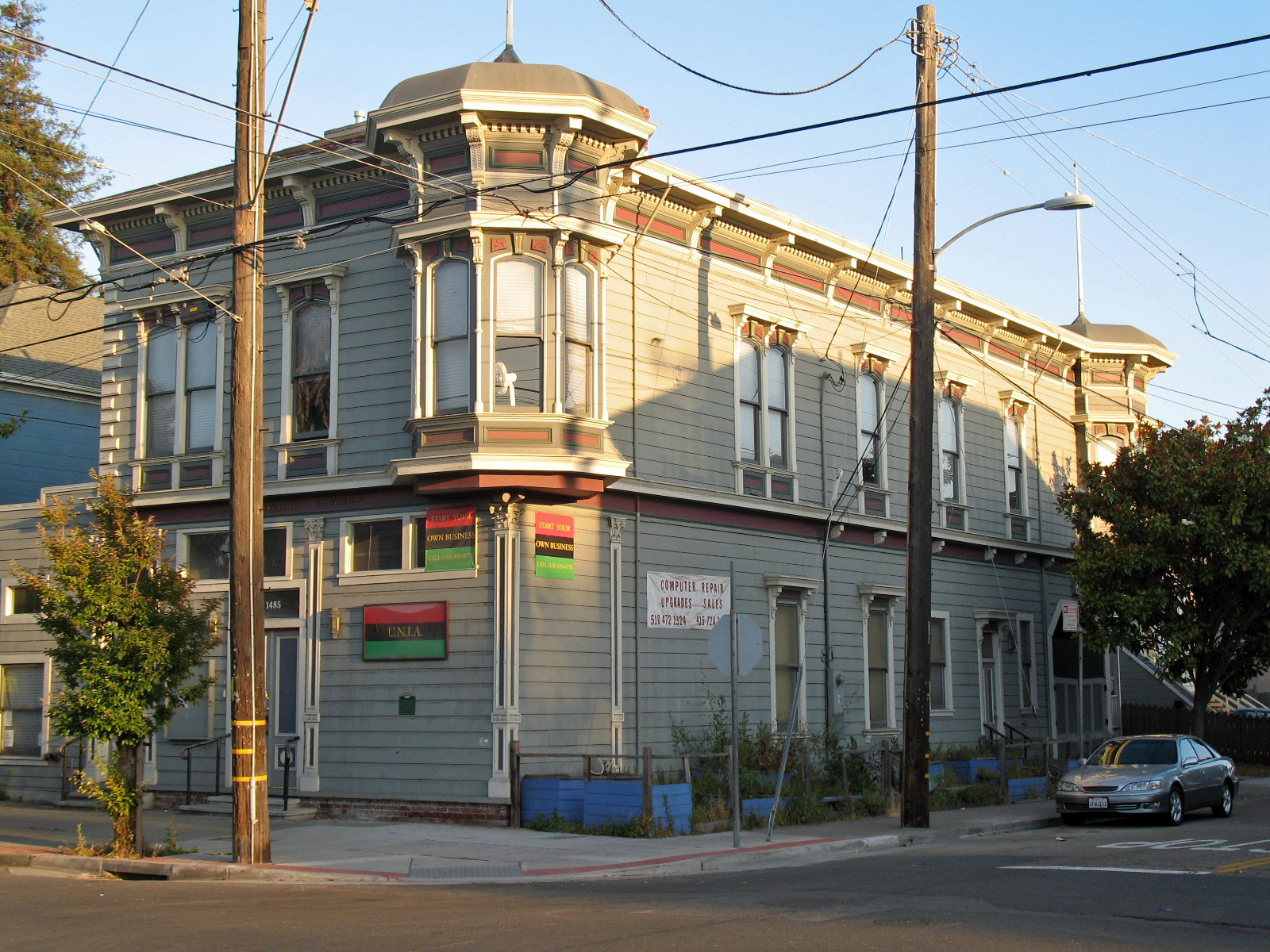
Liberty Hall (Oakland, California)
The brackets are still there. Look up at the corner of 8th and Chester Streets in Oakland's Lower Bottoms neighborhood, and you can see them: two rows of overlapping rings stamped into the cornice of a two-story Italianate building, weathered but intact, holding their pattern since 1877. This building has been a corner store, a residence, a fraternal hall, a church, and a television studio. It has served meat from a smokehouse in back and hosted banquets for the faithful during the Great Depression. Through nearly a century and a half of reinvention, the ornamental details have outlasted every tenant, a quiet argument that craft endures even when purpose shifts.
A Store Becomes a Movement
Liberty Hall began as commerce, not cause. Built in 1877 as a corner store and flat, the building originally anchored a modest stretch of West Oakland where Chester Street met 8th. Historical Sanborn maps reveal a smokehouse and fry kettle at the rear, accessible through a drive-through bay on Chester Street where wagons once pulled in to reach a stable. It was a practical building for a practical neighborhood. That changed in 1925 when Local 188 of the Universal Negro Improvement Association purchased the property for its headquarters. Founded in 1920, Local 188 was the largest UNIA chapter in Northern California, part of the Pan-African movement that Marcus Garvey had built into one of the most significant Black organizations of the early twentieth century. The chapter renamed the building Liberty Hall, the standard name for every UNIA meeting hall worldwide, and the corner store became a center of political and cultural life.
Garvey Days and Lincoln's Birthday
During its years as a UNIA hall, the building hosted meetings, community activities, and holiday celebrations including Lincoln's Birthday and Garvey Day. The UNIA's vision was expansive: economic self-sufficiency, racial pride, and a connection to the African diaspora that reached far beyond Oakland. But the chapter's time in the building proved brief. A fire damaged the roof in 1931, and afterward the UNIA's activism in Oakland declined. The organization sold the building in 1933, just eight years after purchasing it. What the chapter left behind was a name that stuck to the walls. Whatever else happened inside, the building remained Liberty Hall.
Father Divine's Table
After the UNIA departed, one of Oakland's chapters of the International Peace Mission movement took over the space. The Peace Mission was led by Father Divine, an African-American preacher from New York whose followers considered him the Second Coming. During the Great Depression, Father Divine became famous for hosting elaborate free banquets at his homes and churches, feeding anyone who walked through the door regardless of race. His movement drew both devotion and skepticism in equal measure, but for the people who gathered at Liberty Hall through the 1930s and into the 1940s, the building offered something concrete: community and sustenance during the hardest years of the century. The Peace Mission's presence faded by the 1950s, but the building had proven its ability to absorb one community's purpose and hold it until the next arrived.
Broken Windows, Unbroken Character
Walk past Liberty Hall today and you see a building in disrepair. Windows are broken. Exterior surfaces have weathered hard. A false-front addition from 1932 extends the frontage on 8th Street, and a utilitarian annex stretches thirty feet wide and fifty-one feet deep behind the original structure. But look past the damage and the architecture tells its own story. The original double-hung windows still carry their molded hoods on decorative brackets. Each upper-story window opening is slightly arched, with raised panels displaying stylized floral motifs between the brackets. Corner bay windows project from the second floor under umbrella-like roofs, and colonnettes frame their five windows each. The truncated hip roof still holds two small dormers. The National Register of Historic Places recognized what these details represent, adding Liberty Hall to its rolls on March 30, 1989.
Studio, Chapel, and What Comes Next
Liberty Hall's most recent chapter began when a group of community nonprofits acquired the building. The lead organization, Overcomers With Hope Studios, runs a broadcast and media arts training program that provides television studio space for youth, veterans, and community members building new skills. The Jack London Square Chapel, a local Church of God in Christ congregation, also uses the space. It is a pairing that would have puzzled the building's original owner but not its history: Liberty Hall has always been a place where people come to organize, worship, learn, or simply find a room large enough to gather in. Near the West Oakland BART station, the Italianate cornice still wraps the building's two stories, its dentils and crown molding catching the afternoon light. The brackets remain. They have outlasted a corner store, a political movement, a religious revival, and a century of Oakland itself.
From the Air
Located at 37.806N, 122.294W in the Lower Bottoms neighborhood of West Oakland, near the intersection of 8th and Chester Streets. The building sits close to the West Oakland BART station. From the air, look for the dense grid of West Oakland streets between the 880 freeway and the railroad tracks. Nearby airports include Oakland International (KOAK, 5 nm south) and San Francisco International (KSFO, 16 nm southwest). Best viewed at 1,500-3,000 ft AGL. The building is a small two-story Italianate structure and may be difficult to distinguish from altitude without reference to the street grid.