Liberty Square (Taipei)
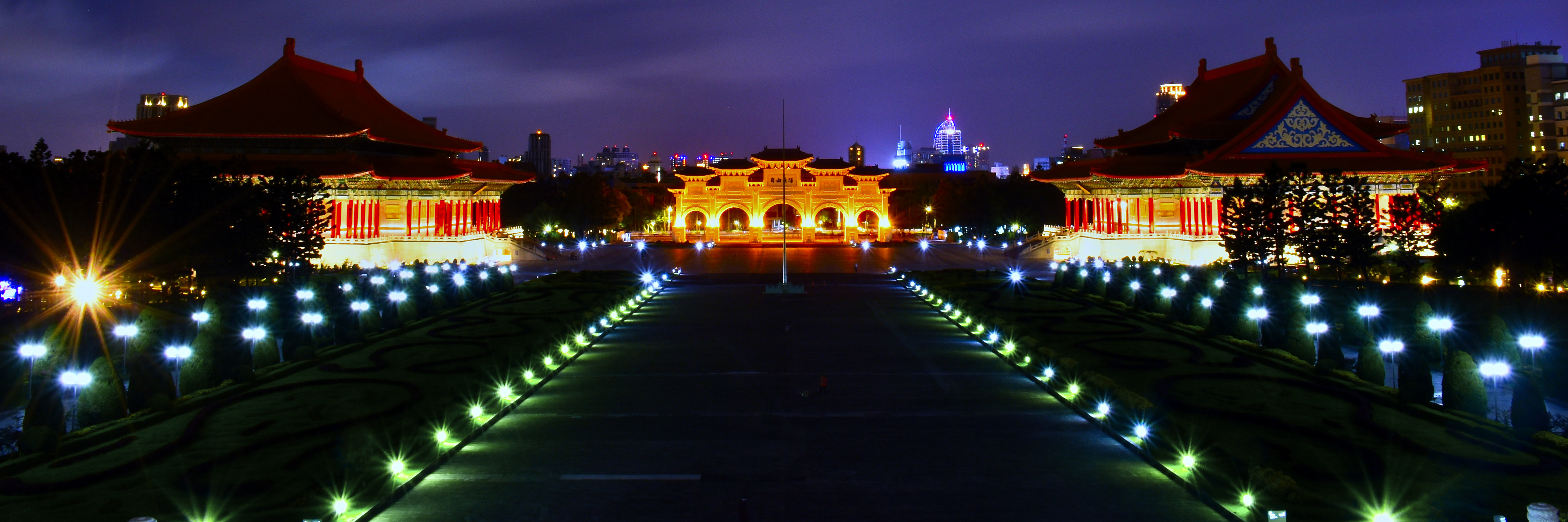
The gate reads "Liberty Square" in characters that recall the calligraphic style of Wang Xizhi, the fourth-century master whose brushwork is celebrated for its vitality and freedom. The characters run left to right, following modern practice -- a deliberate break from the right-to-left classical order that once adorned the site. Everything about Liberty Square is a deliberate break. The 240,000-square-meter plaza in Taipei's Zhongzheng District was designed as a monument to authoritarian power. It became, instead, the place where Taiwan learned to talk back.
A Memorial to Control
Architect Yang Cho-cheng designed the square in the 1970s as part of a grand memorial to Chiang Kai-shek, the president who relocated the Republic of China to Taiwan after losing the Chinese Civil War. Taiwan was still under martial law, still under one-party Kuomintang rule, and the square was conceived accordingly. Yang assigned civic virtues to each element: the main Gate of Integrity at the western end on Zhongshan South Road, the Gate of Loyalty to the north on Xinyi Road, the Gate of Piety to the south on Aiguo East Road. A Boulevard of Homage, bordered by manicured bushes, connected the gate to the National Chiang Kai-shek Memorial Hall at the eastern end. The National Concert Hall flanked the square to the north, the National Theater to the south. The architecture drew on traditional Chinese forms and echoed earlier Kuomintang monuments in Republican China. After Chiang's death in 1975, the square opened as Chiang Kai-shek Memorial Square. It was meant to project permanence.
The Wild Lilies Bloom
Almost immediately, the square became something its designers had not intended: a gathering place for people with their own ideas. Through the 1980s and into the 1990s, as Taiwan's democracy movement gained momentum, the square hosted demonstration after demonstration. The most consequential was the Wild Lily student movement of March 1990, when thousands of students occupied the plaza to demand democratic reforms, including direct presidential elections and the dissolution of the National Assembly. The movement galvanized public opinion and provided the impetus for President Lee Teng-hui's sweeping political reforms, which culminated in Taiwan's first direct presidential election in 1996. A square built to honor the man who had imposed one-party rule became the stage for the movement that ended it.
What's in a Name
In 2007, President Chen Shui-bian rededicated the plaza as Liberty Square. The renaming was controversial -- officials in the Pan-Blue camp initially objected -- but the name eventually gained acceptance across the political spectrum. The shift was more than symbolic. Within weeks of the rededication, the square hosted demonstrations supporting Tibetan freedom. Later that year, the Wild Strawberry student movement rallied there for speech and assembly rights. In February 2017, Taiwan's Ministry of Culture announced plans to transform the Chiang Kai-shek Memorial Hall itself into a center for "facing history, recognizing agony, and respecting human rights." The memorial and its square have been on a decades-long journey from veneration to reckoning, and the process is not finished.
A Living Room for a City
On any given day, Liberty Square functions less as a political monument and more as Taipei's communal living room. Students practice dance routines. Elderly men hunch over Go boards in the shade. Tai chi practitioners move through their forms in the early morning, while soldiers rehearse drill formations nearby. The ponds around the memorial are stocked with colorful koi, and the surrounding parks offer lawns, trees, and winding pathways. The National Theater and Concert Hall host over 800 events annually, their traditional Chinese rooflines providing a theatrical backdrop for everything from the Taipei Lantern Festival to red-carpet ceremonies for visiting dignitaries. Marching bands play holiday concerts. Children chase each other across the flagstones. The square absorbs all of it -- protest and pageantry, grief and celebration -- with the same indifferent openness that characterizes all great public spaces.
The View from Above
From the air, Liberty Square reads as an unmistakable rectangle of open space in one of Asia's densest cities, the white octagonal roof of the memorial hall gleaming at its eastern end. The symmetry of the original design remains intact: the twin performance halls flanking the central axis, the formal gate at the west. But the meaning of that symmetry has inverted. What was designed to enforce reverence now enables gathering. What was built to honor a single man now belongs to everyone who shows up. The square sits within sight of the Presidential Office Building, a proximity that has always made it dangerous for the powerful and useful for the powerless. Taiwan's democracy did not begin here, but some of its most important chapters were written on these stones.
From the Air
Located at 25.035N, 121.522E in Taipei's Zhongzheng District. The square is one of the most recognizable features from the air in central Taipei: a large rectangular plaza with the white octagonal Chiang Kai-shek Memorial Hall at its eastern end and the matching National Theater and Concert Hall flanking the north and south sides. The formal Gate of Integrity stands at the western edge on Zhongshan South Road. Accessible via Chiang Kai-shek Memorial Hall Station on the Taipei Metro. Taipei Songshan Airport (RCSS) is about 5 km northeast; Taiwan Taoyuan International Airport (RCTP) is approximately 35 km west.