Library of Parliament
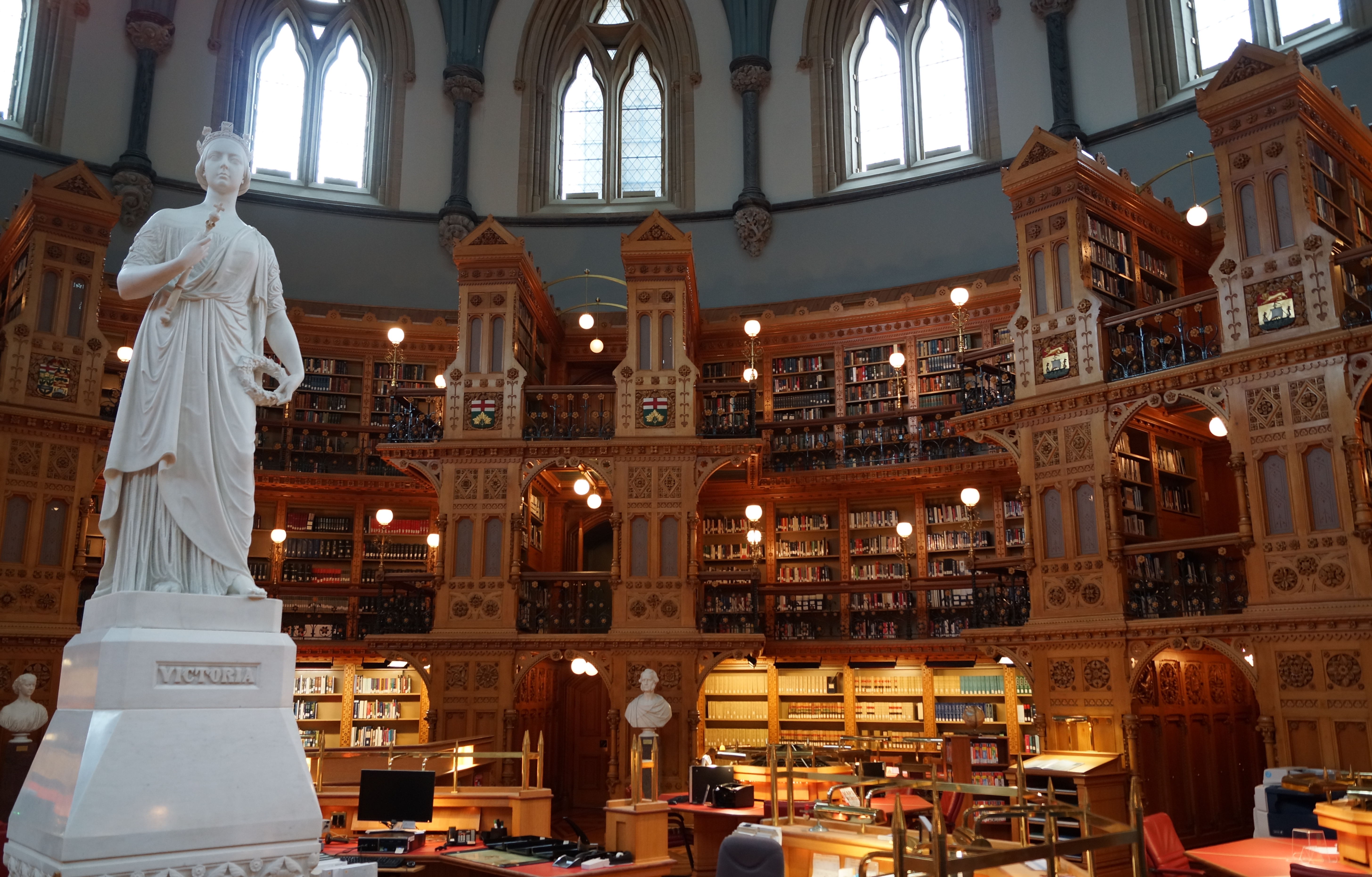
On February 3, 1916, fire consumed Canada's Centre Block on Parliament Hill. Flames raced through the heart of the nation's government, destroying everything in their path. Everything except the library. A quick-thinking clerk slammed shut the heavy iron doors separating the Library of Parliament from the main building, and the fire stopped there. The library survived intact - its vaulted ceilings, its carved white pine panelling, its marble statue of Queen Victoria, and its 650,000 volumes all spared. It was the kind of save that feels providential, as if the building itself refused to burn. Designed by Thomas Fuller and Chilion Jones and modelled after the British Museum Reading Room, the Library of Parliament had been built to be extraordinary. It just had to survive its first forty years to prove it.
A Dome from Manchester
Construction of the library began in 1859, halted in 1861, and didn't finish until 1876 - a seventeen-year project stretching across the birth of the Dominion of Canada itself. The building's roots go deeper still: the library's collection traces back to the 1790s, when Upper and Lower Canada maintained separate legislative libraries. The collections were combined in 1841 and followed the provincial capital as it migrated between Kingston, Montreal, Toronto, and Quebec City before Queen Victoria chose Ottawa as the seat of her crown in 1858. Around 1869, builders discovered they lacked the technical knowledge to construct the building's domed roof. Thomas Fairbairn Engineering of Manchester was contracted to provide a prefabricated wrought-iron dome, giving the Library of Parliament the distinction of being the first building in North America with a state-of-the-art wrought-iron roof. The 47,000 initial volumes - including several donated by Queen Victoria herself - were installed in 1876.
Stone, Pine, and Polychromy
The library is a masterwork of Victorian High Gothic architecture. Shaped as a chapter house and separated from the Centre Block by a corridor, the building's walls are loadbearing double-wythe masonry supported by a ring of 16 flying buttresses. The exterior layers grey Gloucester limestone with Nepean sandstone, red Potsdam, and buff Ohio stone in a polychromatic pattern accented by purple and green slate banding. Inside, the main reading room rises to a vaulted ceiling. White pine panelling lines the walls and book stacks, carved into an intricate world of textures, flowers, masks, and mythical creatures. In the galleries, the coats of arms of the seven provinces that existed in 1876 are displayed alongside the arms of the Dominion of Canada. At the center of the room stands a white marble statue of Queen Victoria, sculpted by Marshall Wood in 1871 - a silent guardian presiding over the collection.
Tornado, Gas Lamps, and Copper
The building endured remarkable tribulations in its early decades. In 1883, its 300 gas lamps were converted to electricity - an early adoption of the technology. Then in 1888, a tornado struck Parliament Hill and stripped every slate shingle from the library's roof. The roof was rebuilt and clad in copper, which it retains today. The 2002-2006 renovation was the most extensive: crews fixed leaking roofs and crumbling mortar on the exterior, repaired woodwork and plaster inside, and installed modern climate control. They excavated nine metres of bedrock beneath the building to create storage space and mechanical areas. The project - managed, fittingly, by the Thomas Fuller Construction Company, operated by the original architect's great-grandsons - used laser measurement and early computer-aided design technology. It also produced a $21 million lawsuit against the Crown for cost overruns.
The Ten-Dollar Icon
Today the Library of Parliament appears on the obverse of the Canadian ten-dollar bill, a recognition of its place as a national symbol. Its collection has grown to 650,000 items tended by a staff of 300, serving primarily parliamentarians but available to the public by request. The main branch on Parliament Hill is the central hub of a network extending into other parliamentary buildings. Since 2017, while the Centre Block undergoes extensive renovations, the library's Sparks Branch - housed in a 1924 Doric-style building originally constructed as the Bank of Nova Scotia at 125 Sparks Street - has served as the interim main branch. That building participates in Doors Open Ottawa, offering the public a chance to step inside. The library has been led by a succession of parliamentary librarians since Alpheus Todd first held the post in 1867, the same man whose input shaped the building's original design.
From the Air
Located at 45.43°N, 75.70°W, the Library of Parliament sits at the rear (north side) of Centre Block on Parliament Hill, overlooking the Ottawa River. From altitude, the library's distinctive circular chapter house shape with its copper-clad dome is visible extending from the back of the Centre Block - though current renovations may alter the surrounding structures' appearance. The Peace Tower (92.2 m) marks the front of Centre Block and serves as the primary aerial landmark. Ottawa/Macdonald-Cartier International Airport (CYOW) is approximately 10 km to the south. The Rideau Canal locks are visible just east of Parliament Hill where they descend to the Ottawa River.