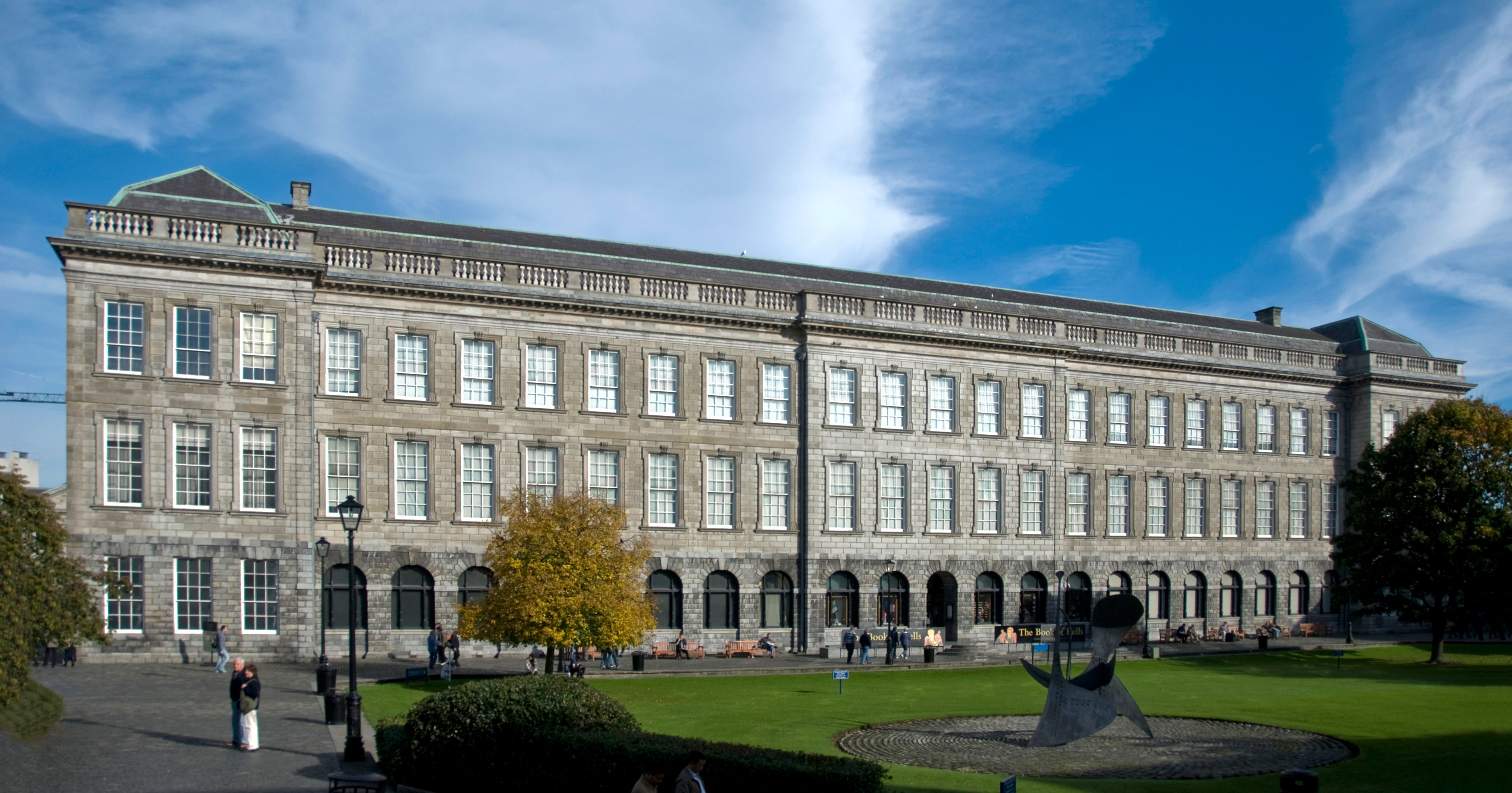
Library of Trinity College Dublin
The Long Room takes your breath before your eyes adjust. Sixty-five metres of barrel-vaulted ceiling, darkened oak shelves climbing two stories, 200,000 of the oldest books in Ireland receding into a vanishing point of accumulated knowledge. Marble busts of philosophers and writers line the central aisle like sentries. Somewhere in this room is a 15th-century harp made of oak and willow -- the oldest of its kind in Ireland, its image now the national symbol on Irish coins and the Guinness label. And downstairs, in a climate-controlled treasury, lies the Book of Kells, an illuminated manuscript that monks created on a Scottish island over 1,200 years ago. Trinity College Library has been collecting Ireland's written memory since 1592, and the weight of it is palpable.
Fool's Gold in the Foundations
Construction of the Old Library began in 1712 under the architect Thomas Burgh and took twenty years to complete. The building's lower story is constructed from Calp Limestone quarried at Palmerstown, eight kilometres to the west -- a muddy, well-bedded stone that, on close inspection, reveals tiny cubic crystals of iron pyrites, or fool's gold, embedded in its surface. The upper stories were originally faced with white St Bees Sandstone from Cumbria in England, but this disintegrated quickly and was replaced with grey Ballyknockan Granite. The resulting color contrast -- warm brownish limestone below, cool grey granite above -- gives the Old Library its distinctive layered appearance. When completed in 1732, the building towered over both the university and the city.
A Room That Outgrew Itself
The Long Room was not always the cathedral of books it appears today. Originally it had a flat ceiling, shelving only on the lower level, and an open gallery above. Then, in 1801, the library was granted legal deposit rights -- the power to claim a free copy of every book published in Ireland and Britain. The shelves began to fill relentlessly. By the 1850s, the room had run out of space. In 1860, the roof was raised and an upper gallery added to accommodate the growing collection, transforming the Long Room into the dramatically vaulted space visitors see today. The marble bust collection was started when the college acquired fourteen works by the sculptor Peter Scheemakers, including a portrait of Jonathan Swift by Louis Francois Roubiliac that is considered the finest bust in the collection.
The Treasure Downstairs
The Book of Kells, presented to Trinity in 1661 by Henry Jones, Bishop of Meath, is an illuminated manuscript of the four Gospels created around 800 AD, likely begun on the island of Iona off the Scottish coast before being brought to Kells in County Meath to escape Viking raids. Its pages are dense with interlace patterns, fantastical animals, and human figures rendered in pigments that have survived twelve centuries. A display case installed in 2020 now allows all pages to be shown, including many that had not been seen in public for decades. Alongside the Book of Kells, the library holds the Book of Durrow, the Garland of Howth, and one of the last remaining copies of the 1916 Proclamation of the Irish Republic, read by Patrick Pearse outside the General Post Office on April 24, 1916.
Jedi Archives and a Ninety-Million-Euro Rescue
The Long Room's visual power has attracted attention far beyond academia. The Jedi archives in Star Wars: Episode II bear a striking resemblance to the space, a likeness that caused controversy when Lucasfilm denied using the Long Room as inspiration. Apple TV's Foundation series used it as a stand-in for a reading room on the imperial planet Trantor. But the room's most dramatic recent chapter is not cinematic -- it is structural. Beginning in 2022, a ninety-million-euro restoration project has been underway, partly funded by twenty-five million euros from the Irish government. The project took on urgency after the catastrophic fire at Notre-Dame de Paris in 2019, prioritizing modern environmental controls and fire protection. In 2023, a large illuminated globe by the artist Luke Jerram, titled 'Gaia,' was hung in the Long Room -- a planet floating above centuries of human thought.
The Largest Library in Ireland
Trinity's library system extends well beyond the Old Library and the Long Room. The campus houses several constituent buildings, including the Eavan Boland Library -- a Brutalist structure opened in 1967 and renamed in 2024 after the Irish poet, following a decision to remove the name of George Berkeley due to his ownership of enslaved people in Rhode Island. As a legal deposit library, Trinity receives a copy of every work published in Ireland, and remains the only Irish library entitled to claim works published in the United Kingdom as well. The collection stretches across millions of volumes housed in buildings ranging from the 18th century to the 21st, from medieval manuscripts to electronic databases. The library that began with the founding of a college in 1592 has never stopped growing.
From the Air
The Library of Trinity College Dublin is located at 53.3438N, 6.2546W in the heart of Dublin city center, within the Trinity College campus south of the River Liffey. From altitude, the Old Library building is visible as a large rectangular structure within the college grounds, adjacent to Fellows' Square. Nearest airport: Dublin Airport (EIDW) approximately 10km north. The campus is bounded by Nassau Street, Pearse Street, and College Green.