Libyan Civil War (2011)
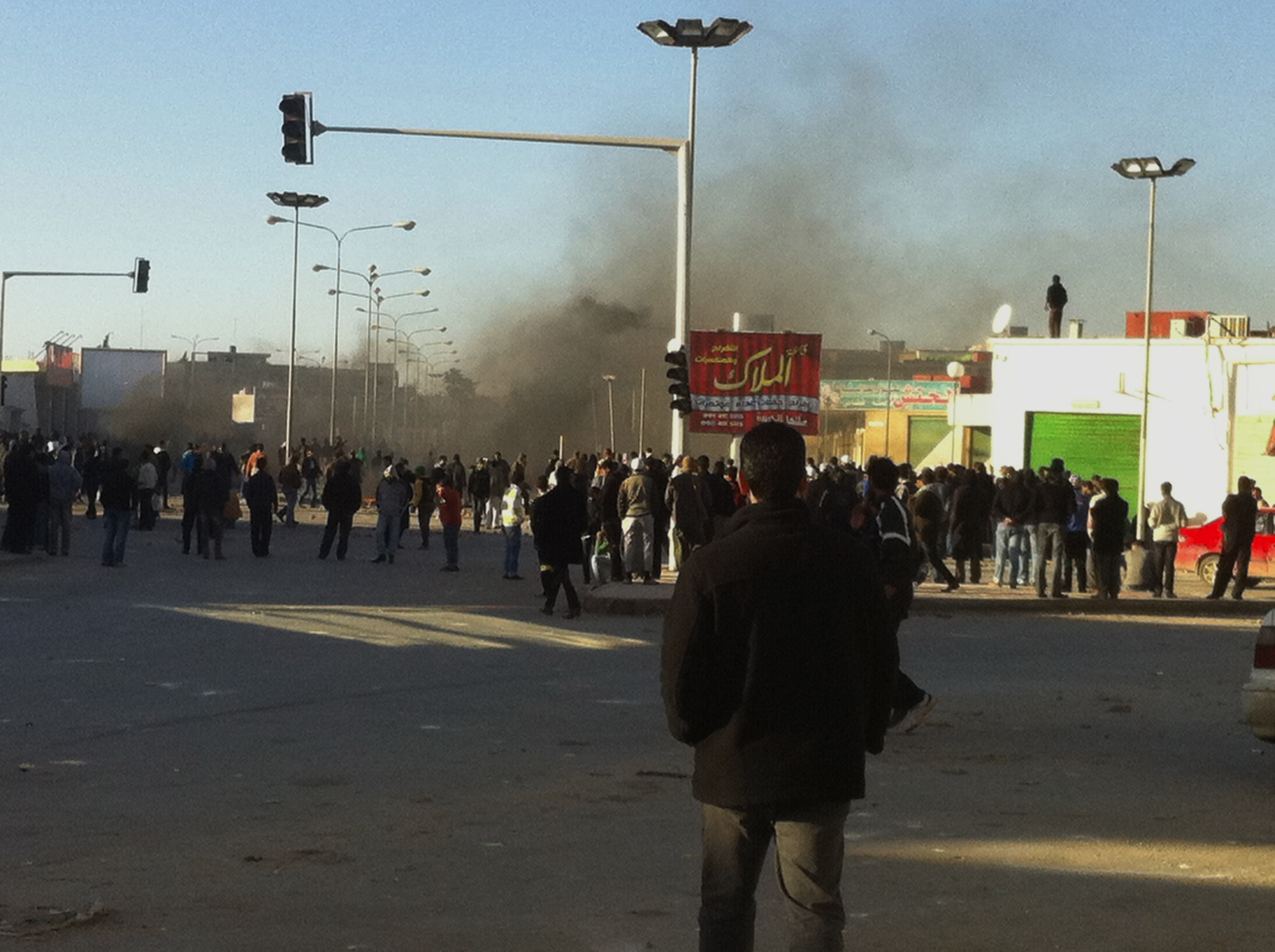
On the evening of 15 February 2011, between 500 and 600 demonstrators gathered outside Benghazi's police headquarters to demand the release of human rights lawyer Fathi Terbil. Police responded with tear gas, water cannon, and rubber bullets. Within days, the protest had become an armed uprising. Within months, NATO warplanes were bombing Libyan military targets. By October, the man who had controlled this North African nation since 1969 was dead in a drainage pipe. Libya's revolution happened fast -- faster than nearly anyone, including Gaddafi himself, seemed to believe possible.
The Green Book's Last Chapter
Muammar Gaddafi seized power in a bloodless coup in 1969, deposing King Idris I. For the next four decades, he governed through a system he called direct democracy, outlined in his manifesto, The Green Book, while maintaining what amounted to personal authoritarian control. The Freedom of the Press Index rated Libya the most censored state in the Middle East and North Africa in both 2009 and 2011. Political dissent carried severe consequences. Yet a UN Human Rights Council report from January 2011, released just a month before the uprising began, praised certain aspects of Libya's human rights record. The contradictions ran deep. Standards of living and literacy had improved dramatically in the early years of Gaddafi's rule, but decades of repression, corruption, and the suppression of tribal and regional grievances had built pressure that needed only a spark.
From Housing Protests to Revolution
The spark came not as a grand political gesture but as frustration over unfinished apartments. Between 13 and 16 January 2011, protesters in Bayda, Derna, and Benghazi broke into and occupied government housing projects stalled by corruption and delays. The government responded with a 20 billion euro investment fund -- a gesture that satisfied no one. Inspired by the revolutions already sweeping Tunisia and Egypt, the protests escalated. Writer Jamal al-Hajji called online for demonstrations supporting greater freedoms; he was arrested within days. On 17 February, broader protests erupted across the country. Security forces opened fire on demonstrators in Benghazi, killing several. By 23 February, the opposition had seized control of Misrata and much of the east. Gaddafi appeared on state television, vowing to hunt down protesters "house by house." The rhetoric only hardened the opposition's resolve, and rebel groups established the National Transitional Council as an interim government.
The World Intervenes
The international community moved with unusual speed. On 26 February, the UN Security Council froze Gaddafi's assets, restricted his inner circle's travel, and referred the matter to the International Criminal Court. But Gaddafi's forces rallied. In early March, loyalist troops pushed eastward, recapturing coastal cities and advancing toward Benghazi. On 17 March, a further UN resolution authorized member states to enforce a no-fly zone and use "all necessary measures" to protect civilians. What followed went well beyond a no-fly zone. NATO aircraft struck military installations, armored columns, and command centers across the country. Gaddafi announced ceasefires that never materialized. The African Union attempted to broker peace, but rebel leaders rejected any plan that left Gaddafi in power. Over the following months, the conflict settled into a grinding war, with the besieged city of Misrata becoming its bloodiest front.
The Fall of a Capital
By August, the balance had tipped decisively. Rebel forces, supported by continuing NATO airstrikes, launched an offensive on Tripoli. The capital fell rapidly, with Gaddafi and his family fleeing on the day Tripoli was overrun. The regime's remaining loyalists retreated to two strongholds: Bani Walid and Sirte, Gaddafi's hometown on the Gulf of Sidra. Weeks of brutal urban combat followed. NTC forces estimated that at least 30,000 people died during the entire conflict, though precise numbers remain disputed. Thousands more were detained, and human rights organizations documented abuses committed by both sides. The war's final act came on 20 October, when Gaddafi was captured and killed outside Sirte. Three days later, the NTC declared Libya liberated in a ceremony at Benghazi.
Liberation Without Peace
The declaration of liberation marked an end to the first civil war but not to Libya's suffering. The NTC announced plans for a democratic state, yet the country had no functioning institutions, no unified military, and no tradition of multi-party governance. Militias that had fought together against Gaddafi turned on each other. Weapons looted from government arsenals flooded across North Africa. By 2014, Libya had descended into a second civil war. The 2011 revolution succeeded in removing Gaddafi, but the question of what would replace him proved far harder to answer. Along the coast from Benghazi to Tripoli, the scars of 2011 remain visible -- damaged buildings, abandoned military hardware, and a population that traded one form of instability for another. The revolution's promises echo in those empty streets, still waiting to be fulfilled.
From the Air
Centered at 31.20N, 16.52E near Sirte, but the conflict spanned Libya's entire Mediterranean coast from Benghazi (HLLB) in the east to Tripoli (HLLT) in the west, roughly 1,000 km. Key locations visible from the air include Misrata (HLMS), Sirte on the Gulf of Sidra, and Benghazi. The flat coastal plain and desert terrain make these cities clearly distinguishable from altitude. Best viewed at 10,000-15,000 feet to appreciate the vast distances the conflict covered.