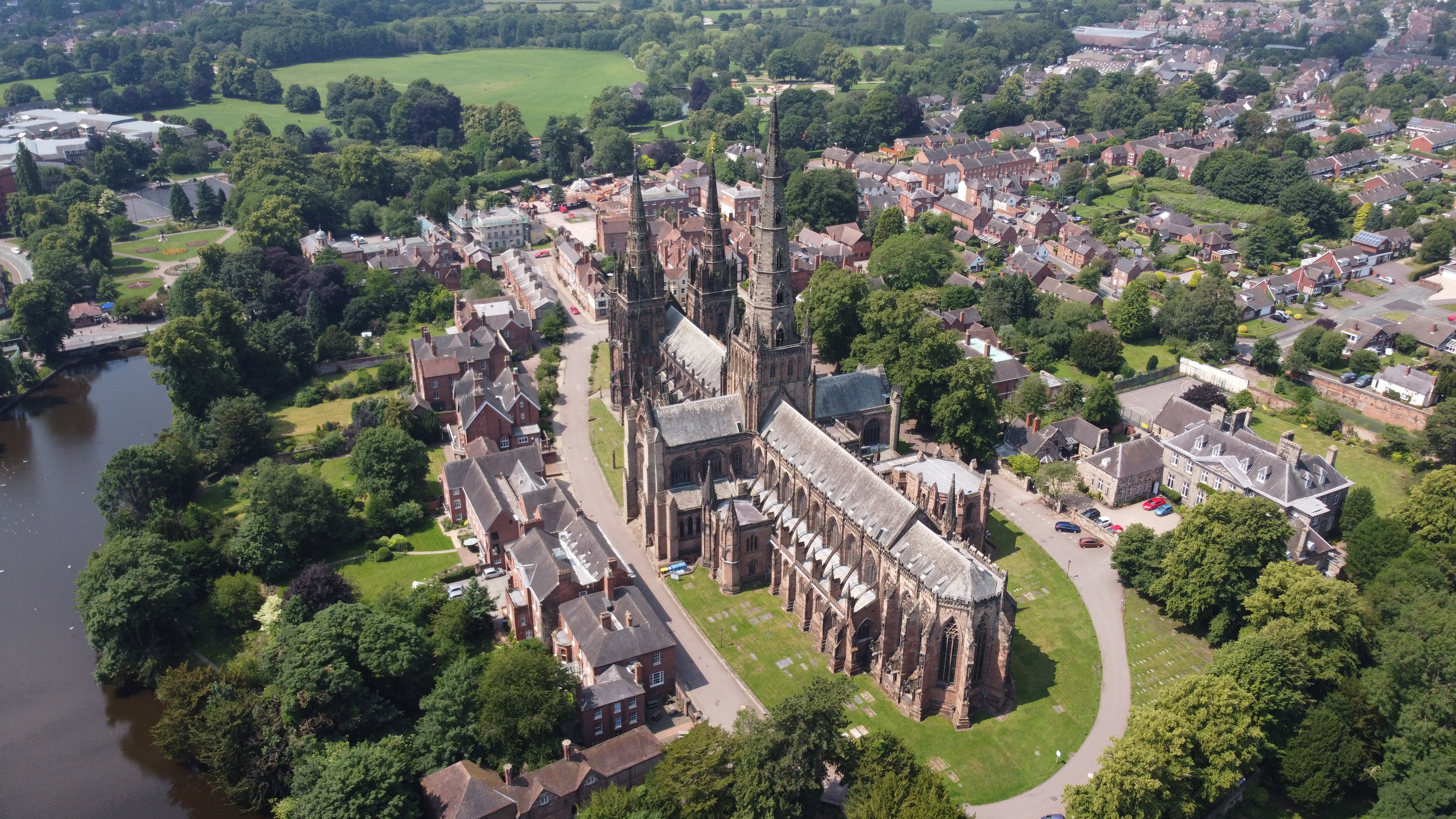
Lichfield Cathedral
Three spires. No other medieval English cathedral has them. Lichfield's trio -- known locally as the Ladies of the Vale -- rise above the Staffordshire countryside like stone needles, visible for miles across the flat Midlands landscape. The central spire reaches 252 feet, flanked by its slightly shorter companions on the west front. This architectural distinction alone would make Lichfield remarkable, but the cathedral's story stretches back to 700 AD, when a church was first consecrated on this site to house the relics of Chad, the Bishop of Mercia who died in 672. Those relics are gone, seized during the English Reformation in 1538. The spires, against considerable odds, remain.
From Chad to Cathedral
The diocese of Mercia was established in 656, and Bishop Chad -- later Saint Chad -- became its fifth bishop before his death in 672. His bones drew pilgrims, and a cathedral was consecrated on the present hilltop site in 700 to house them. The site has been in continuous religious use for over thirteen centuries. In 1075, the seat of the diocese was moved to Chester, and then to Coventry, but Lichfield regained co-cathedral status in 1148. When Coventry's St Mary's Priory was dissolved in 1539 and the new diocese of Chester carved out in 1541, Lichfield became the sole cathedral of its diocese. The building visible today was constructed between the early 13th century and the mid-14th century in the Decorated Gothic style, the work progressing from the choir at the east end westward through the transepts, chapter house, nave, and towers.
Three Sieges and a Ruin
The English Civil War devastated Lichfield Cathedral more thoroughly than any other English cathedral. The Cathedral Close was besieged three times between 1643 and 1646 as control of the fortified precinct passed back and forth between Royalist and Parliamentarian forces. The central spire was destroyed by cannon fire. Every window of medieval stained glass was shattered. Monuments and tombs were smashed. Parliamentary soldiers stabled horses in the nave and used the font as a pig trough. By the war's end, the cathedral was a shell. The scale of destruction makes Lichfield's survival all the more improbable. Bishop John Hacket, appointed after the Restoration, spent the last eight years of his life and much of his personal fortune rebuilding. He died in 1670, the work still incomplete.
Restorations and the West Front
The cathedral's most celebrated feature is its west front, a vast screen of carved stone populated with more than one hundred statues. The original medieval sculptures were destroyed during the Civil War, and the niches stood empty for two centuries. In the 1870s and 1880s, the Victorian architect George Gilbert Scott directed a comprehensive restoration that included filling the west front with new statuary. James Wyatt had carried out an earlier, controversial restoration in the 1780s and 1790s, removing the choir screen and much medieval detail in pursuit of a unified interior -- changes that were themselves later reversed. The Lichfield Angel, a carved limestone panel from the 8th century showing the Archangel Gabriel, was discovered during excavations in 2003 and is now displayed in the cathedral. It is one of the finest examples of Anglo-Saxon stone carving in existence.
The Herkenrode Glass
What the Civil War destroyed in glass, the 19th century partly replaced through a remarkable acquisition. In 1803, Lichfield purchased a set of 16th-century painted glass windows from the dissolved Abbey of Herkenrode in Belgium. These Flemish windows, installed in the Lady Chapel, are among the finest Renaissance glass in any English church -- richly colored panels depicting scenes from the life of the Virgin Mary that glow with a warmth and sophistication no Victorian glazier could have matched. They survive as a consequence of one dissolution rescuing the art of another. The cathedral also holds the Lichfield Gospels, an 8th-century illuminated manuscript of immense value, displayed in the Chapter House. Between the Herkenrode glass, the Lichfield Angel, and the Gospels, the cathedral contains artistic treasures that span twelve centuries -- each rescued from a different catastrophe, each finding refuge under those three improbable spires.
From the Air
Located at 52.68N, 1.83W in Lichfield, Staffordshire. The three spires are a unique and highly distinctive landmark, visible for miles across the flat surrounding countryside. Nearest airports: EGBO (Wolverhampton Halfpenny Green, 20nm SW), EGBB (Birmingham, 15nm S). Best viewed at 2,000-3,000 ft AGL for the full three-spire silhouette.