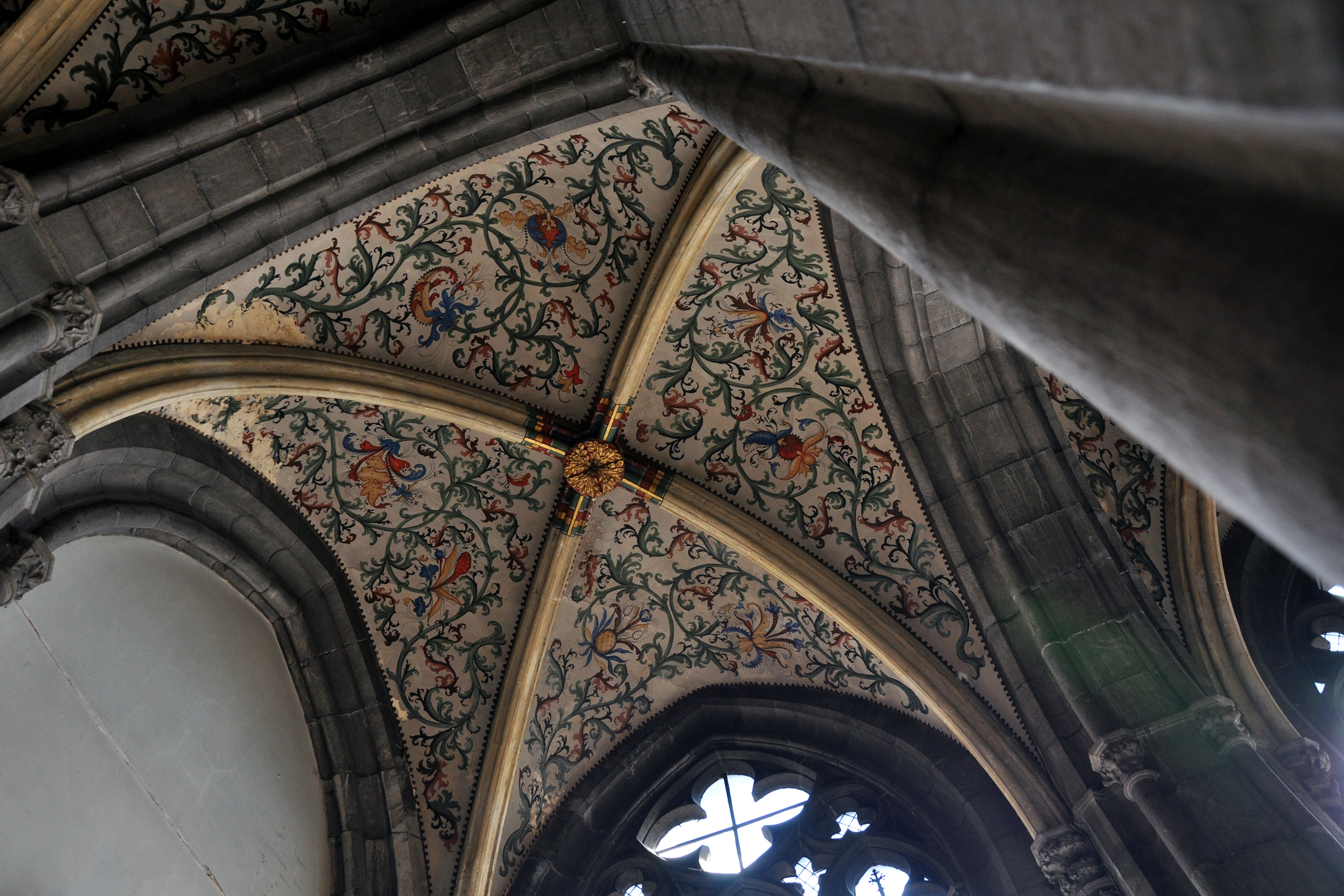
Liège Cathedral
St. Paul's was never supposed to be the cathedral. For eight hundred years it was a respectable collegiate church, one of the seven that ringed the great medieval cathedral of Saint Lambert at the heart of Liège. Then came the French Revolution, and the revolutionaries hated Saint Lambert's so much they pulled it down stone by stone in 1795. Liège lost its cathedral. What survived of the treasury, the relics, the bells, the bishop's authority itself, needed a new home. In 1802 the city promoted the collegiate church of St. Paul to take Saint Lambert's place. The substitute has held the title now for more than two centuries.
Foundations on an island
Bishop Eraclus began the original basilica in 967, on an island in the Meuse where a small chapel to Germanus of Auxerre had stood. He died with the walls only as high as the windows. His successor Notger finished the building and consecrated it on 7 May 972, dedicating it to Paul the Apostle. The chapter of canons grew, absorbed displaced priests from a destroyed fortress nearby, and settled in for a long medieval career. The present Gothic structure rose later. The choir, transept, and naves date to the 13th century, the apse to the 14th in the radiant Rayonnant style, and the building was substantially complete in 1289 when the consecration took place under two visiting suffragan bishops. A Latin Cross of brick and stone, 84 meters long, 33 across, vaulted 24 meters high.
The waters keep coming back
Liège sits in a bowl. Centuries of coal mining beneath the medieval town turned the surrounding land into a basin, and the Meuse has flooded the cathedral over and over again. On 4 January 1374 the river rose so high that the chapter could only enter the church by boat. In 1408 the flood damaged books and jewellery stored in the crypt, forcing the rebuilding of the bookshop floor on a higher base. In 1464 the canons had time only to dam the door before the water came in, then bought a boat to row to matins. A chronogram carved on a pillar near the jubé records the high-water mark of 7 February 1571, when the river rose 6.4 meters above the streets. Another chronogram, dated 15 January 1643, marks the flood that swept away the Pont des Arches. Modern sewers finally tamed the river. The pillars still wear the records of every soaking they survived.
When the cathedral became a slaughterhouse
The French Revolution arrived in Liège after the Battle of Jemappes in 1792. Revolutionary forces stripped St. Paul's of its metals, smashed its great stained-glass windows to melt the lead into musket balls, auctioned the furniture, and installed a butcher's shop in the nave. The cloisters were converted into stables. The greater cathedral of Saint Lambert, target of older resentments against the prince-bishops who had ruled Liège for centuries, was demolished outright between 1794 and 1827. Its treasure was crated up and shipped to Hamburg, then sold by a French commissioner to fund the Republic's navy. Six boxes of relics eventually came back. On 1 January 1804, to the sound of every bell in the city, Bishop Zaepffel translated the bust of Saint Lambert into St. Paul's. The collegiate church had already been formally elevated to cathedral status in 1802, following the Concordat of 1801; the translation ceremony completed the symbolic transfer. In 1812, at Napoleon's request, workers raised the bell tower one floor and added a 90-meter spire, partly built from sandstone salvaged from the demolished Saint Lambert's. The new cathedral carried the bones of the old one in its walls.
A devil in the pulpit
Of the artworks now housed inside, the most famous is also the most controversial. In 1848, the sculptor Guillaume Geefs installed Le Génie du Mal at the base of the pulpit's twin staircases: a chained, weeping Lucifer in white marble, replacing an earlier version by his younger brother Joseph that the cathedral had removed for being too sensual. The story of the two brothers carving rival devils for the same niche has nearly eclipsed the rest of the building's art collection. It shouldn't. The cathedral holds works by Jean Del Cour, including a 1696 white marble Christ gisant and a bronze Christ above the main gate that once stood on the fortified Pont des Arches. Paintings by Gérard de Lairesse, Gérard Seghers, Bertholet Flémal, and Otto van Veen line the chapels. The Sedes Sapientiae, a 13th-century seated Madonna rescued from a demolished neighborhood church, presides at the front of the choir. The cathedral inherited not just Saint Lambert's title but the artistic refugees of half a dozen other suppressed churches as well.
Cloister and aftermath
The cloister, on three sides of a long courtyard, dates mostly to the late 15th and early 16th centuries. The west gallery is the oldest and the most ornate. From it, a Renaissance porch opens onto St. Paul's Square through a stone gate carved with the Conversion of Paul the Apostle, flanked by reliefs of the Nativity and the Resurrection. Twelve bas-reliefs of fantastic ornament line the framework, and seven empty niches still wait for the statues that were never replaced. Inside the chapter hall, a richly carved oak door, salvaged from another vanished church, depicts the Perron of Liège, the medieval column that has long stood as a symbol of the city's hard-won liberties. The cathedral has been many things: a 10th-century chapel, a Gothic collegiate church, a Napoleonic-era butcher shop, and finally the seat of a diocese whose original cathedral no longer exists. The substitute has outlasted the original by more than two centuries.
From the Air
Liège Cathedral sits at 50.6403 N, 5.5717 E, in central Liège on the Meuse River in eastern Belgium. Best viewed from 2,000 to 4,000 feet. The 90-meter spire is a recognizable landmark. Nearest airport is Liège Airport (EBLG), 8 km west. Brussels Airport (EBBR) lies 80 km west, Maastricht Aachen Airport (EHBK) 30 km north, Cologne Bonn (EDDK) 100 km east. The cathedral marks the heart of historic Liège on the river's left bank.