Liège
There is a French phrase Liege has earned and refuses to give up: la cite ardente, the fervent city. It was first used around 1905 to remember the city's rebellions against the Dukes of Burgundy, when Charles the Bold sacked the place in 1468 and the chronicles called it a martyr. The phrase outlived its origin. It carried Liege through the iron-and-steel boom of the nineteenth century, the twelve days of fortress defense that delayed the German army in 1914, the bitter strikes of 1950 and 1961, and the long industrial decline that followed. Today Liege is the third largest urban area in Belgium and still ardent: a French-speaking river city in Wallonia, capital of its province, the place where the Meuse meets the Ourthe and where Simenon was born.
The bishop who built a city
Liege did not exist as a city until a bishop made it one. Around 705 Saint Lambert of Maastricht was murdered in what was then a small settlement called Vicus Leudicus. His successor Hubert, later Saint Hubert, built a basilica to hold his relics, and around that basilica a town grew. In the 970s the prince-bishop Notker, the first true ruler of what became the Prince-Bishopric of Liege, turned the modest settlement into one of Europe's intellectual centers. By the eleventh century the schools of Liege were so respected that the city was called the Athens of the North. They produced two popes (Stephen IX and Nicholas II), the mystical theologian William of Saint-Thierry, and the great scholastic Godfrey of Fontaines. Notker laid out the first cathedral of Saint Lambert, the Bishop's Palace, and four other churches. He also was one of the first churchmen to spread the feast of All Souls' Day.
Sacked, occupied, defiant
Liege's medieval politics ran on the opposite engine of most European cities. Where elsewhere kings and bishops grew stronger, in Liege the citizens did. In 1345 the guilds rebelled against their prince-bishop and won. The 32 guilds of Liege then took control of city government, with each guild's voice equal and every registered member eligible to vote. The chronicler of Brabant called it the most democratic system the Low Countries had ever known. It spread to Utrecht. It did not last forever. In 1468 Charles the Bold of Burgundy sacked Liege after a desperate siege and the rebellion ended in fire. The democratic spirit survived in folk memory and in the city's puppet character Tchantchès, a hard-headed Walloon boy from the Outremeuse quarter who refuses to bow to anyone. Tchantchès is still everywhere in Liege, on statues and in the patter of the 15 August folk festival, which fills the narrow streets of Outremeuse with peket and pears and music until dawn.
Twelve forts and twelve days
The Industrial Revolution made Liege one of the first cities of continental Europe to manufacture steel on a large scale. John Cockerill, the English founder of a vast iron and steel works at nearby Seraing, started in 1817; for a time Cockerill's complex was one of the largest industrial sites in the world. The city forged guns too, and still does: FN Herstal is headquartered in the suburb of Herstal. To protect this concentration of industry, the engineer Henri Alexis Brialmont rebuilt the city's defenses in the 1880s as a ring of twelve modern forts. In August 1914 those forts faced the Imperial German Army's Schlieffen Plan, which required a fast advance through the Meuse valley. The forts held for twelve days against 100,000 men, until German howitzers including two 42-centimeter Big Berthas pounded them into submission. The delay cost the German campaign in France dearly. Liege received the Legion d'Honneur in 1914 for its resistance.
Simenon and the rusting valleys
Georges Simenon was born in Liege in 1903, in a working-class house on the Rue Leopold, and the city haunts his work even when its streets are not named. He wrote his first newspaper articles for the Gazette de Liege as a teenager and went on to publish nearly 200 novels under his own name, including the 75 Inspector Maigret mysteries that made him one of the most translated authors of the twentieth century. The city he grew up in was an industrial giant. The city he left behind began declining in the 1960s. Coal mines closed, then steel mills. The 1960-61 winter general strike turned violent in Liege; soldiers had to wade through caltrops and overturned cars to take the central railway station Guillemins. Seventy-five people were injured in seven hours of street fighting on 6 January 1961. The decades that followed were hard, with high unemployment, the unsolved 1991 assassination of the Socialist leader Andre Cools, and tragic shootings on Place Saint-Lambert and Boulevard d'Avroy in the years after.
A new station, an old market
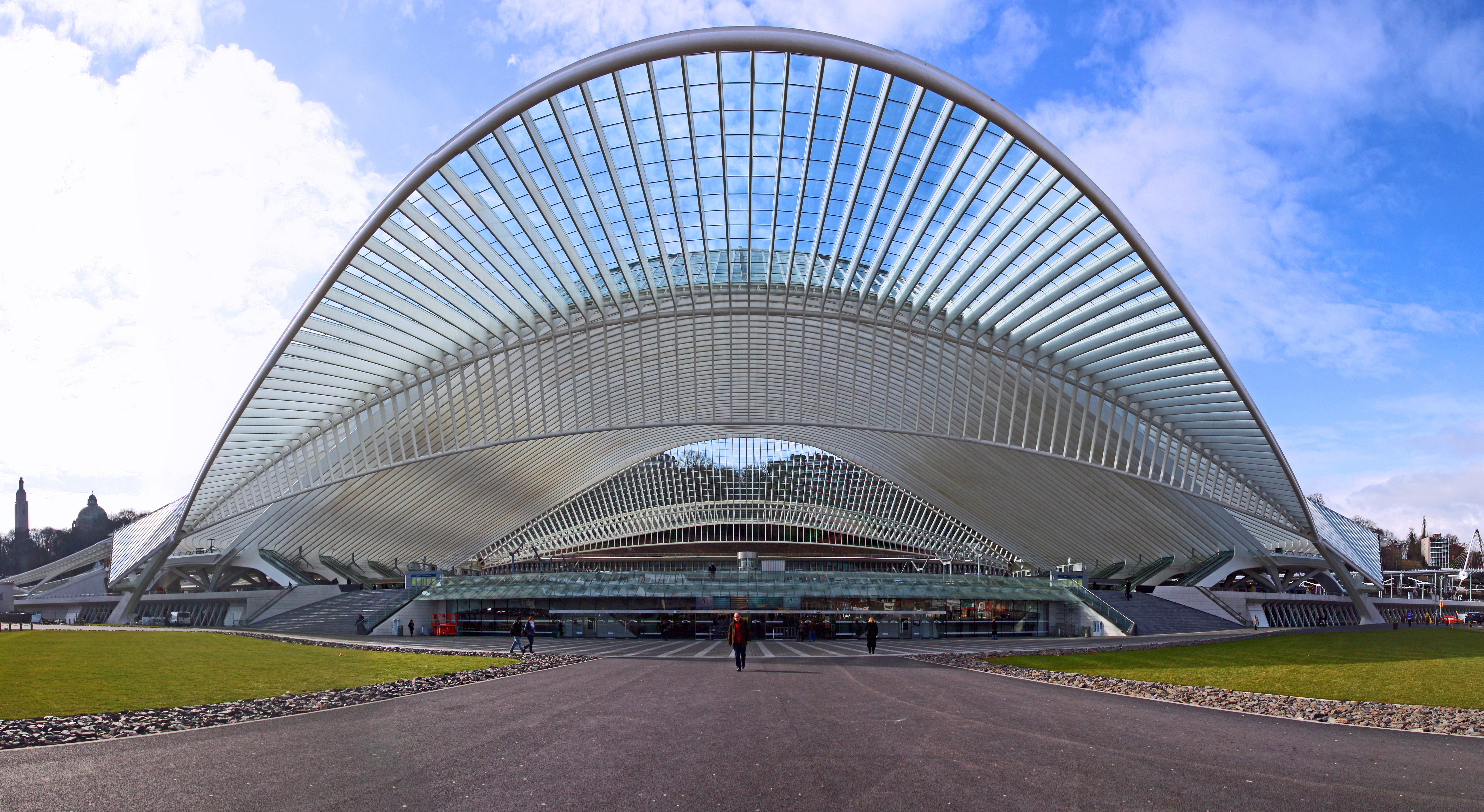
Liege today is rebuilding, slowly and stubbornly. The Spanish architect Santiago Calatrava designed a new Liege-Guillemins railway station on the site of the one the strikers wrecked in 1961, and it opened in 2009: a vault of white steel and glass with no front facade, deliberately open to both sides of the city. The Mediacite shopping mall on the Meuse was designed by Ron Arad. A new tramway, debated for half a century and built in fits and starts, finally opened on 28 April 2025. The Sunday market called La Batte has been running along the Meuse quay every Sunday morning for centuries. The 374 steps of the Montagne de Bueren still climb from Hors-Chateau to the citadel. Le Carre, the square city block of pubs behind the Opera House, still stays open until the last customer leaves, usually around six in the morning. And the city in spring is still the start and finish of Liege-Bastogne-Liege, the oldest of cycling's monument races, the rolling Ardennes hills filled every April with crowds in the rain.
From the Air
Liege sits at 50.63 N, 5.57 E, in the Meuse valley of eastern Belgium near the borders with the Netherlands and Germany. Best viewed from 3,000 to 5,000 feet, where the loop of the Meuse around the historic center, the Calatrava station at Guillemins, and the industrial valley running south toward Seraing are all clearly visible. Maastricht is 33 km north, Aachen 53 km northeast. Nearest airport is Liege Airport (EBLG), 8 km west, one of Europe's busiest cargo hubs. Brussels (EBBR) lies 80 km west, Maastricht Aachen (EHBK) 25 km north, and Cologne Bonn (EDDK) 95 km east. The dozen ruined and surviving forts of the Brialmont ring are scattered around the city.