Liepaja Massacres
The telegram sent from Liepaja on July 22, 1941, contained bureaucratic language that masked its true meaning. German naval commandant Hans Kawelmacher requested 100 SS men and fifty police for the "quick implementation" of the "Jewish problem." By "quick implementation," Kawelmacher meant accelerated killing. What followed in this Latvian port city became one of the most thoroughly documented mass murders of the Holocaust, captured on film and photograph by perpetrators and bystanders alike. Today, the beach at Skede north of Liepaja stands as a memorial to the thousands who died here, and the visual records seized by a brave electrician serve as permanent evidence of what human beings proved capable of doing to one another.
The Summer of Systematic Murder
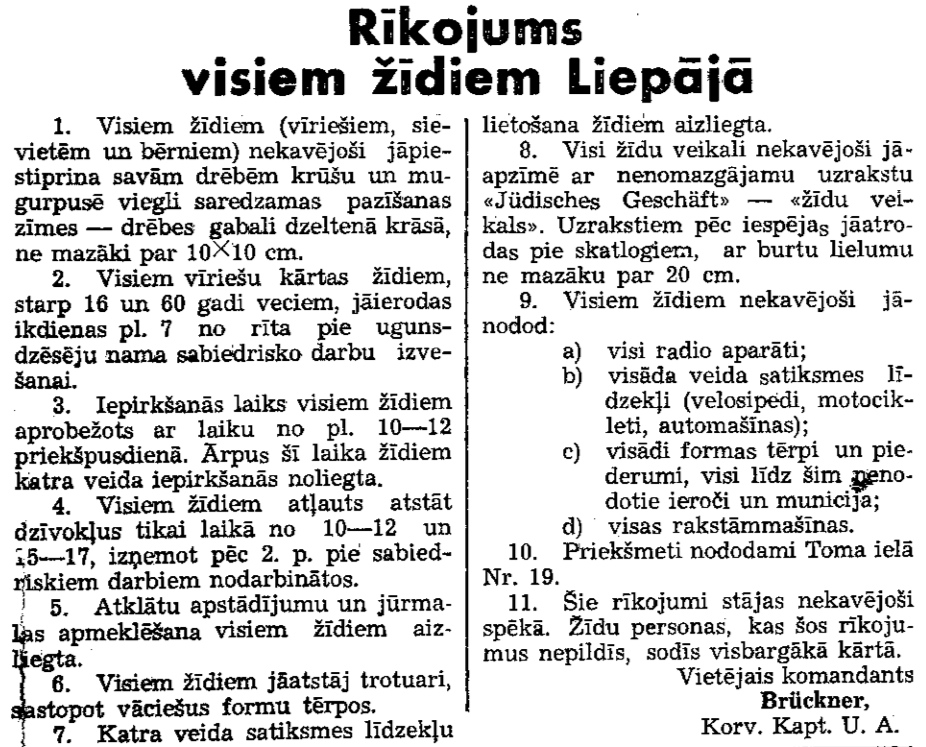
Liepaja fell to German forces on June 29, 1941, and the Kriegsmarine immediately took control of this strategic naval base. Within days, restrictions on Jews appeared in the local newspaper: mandatory yellow stars, limited shopping hours, prohibition from sidewalks when encountering German uniforms. The first mass killings came in early July when Einsatzgruppe A commander Franz Walter Stahlecker accused local Nazi official Erhard Grauel of not executing people fast enough. On July 8, 9, and 10, German and Latvian squads shot 100 people each day, nearly all Jews, transported from the Women's Prison in groups of twenty. A boatswain's mate named Schulz later testified that on a day in August 1941, he heard continuous rifle fire from across the harbor. He rowed over with a colleague and watched from a bunker as trucks brought victims to a trench, where squads shot them in the head.
Witnesses and Cameras
The killings at Liepaja were not hidden. Scholars who studied the perpetrators later concluded that the public executions became "in many ways a festival," with German soldiers traveling considerable distances to secure the best viewing positions. This grim spectacle produced something unprecedented: documentary evidence. Reinhard Wiener, a German naval sergeant on leave, brought his 8mm camera to a July or August execution and filmed what he saw, noting "German soldiers standing as spectators all around." This footage, the only known surviving film of Einsatzgruppen mass executions, is today housed at the US Holocaust Memorial Museum and appears in countless documentaries. In December 1941, SS photographer Karl-Emil Strott captured the shootings at Skede beach. These became the most widely recognized images of the murder of Latvian Jews, showing women forced to undress before execution on the winter sand.
The Film That Survived
The December photographs might have vanished with their photographer if not for David Zivcon. Working as an electrician at the SD office in Liepaja, Zivcon discovered four rolls of film while repairing wiring in a German officer's apartment. He stole the film, had prints made, returned the originals before anyone noticed their absence, placed the prints in a metal box, and buried them. After the Germans retreated from Latvia, Zivcon retrieved his buried evidence. Those photographs would later appear in war crimes trials and museums around the world, forcing future generations to confront what had been done. The images show only Latvian collaborators as executioners, but German records, testimony, and Wiener's film establish the full chain of command that organized and ordered the murders.
Ghetto and Aftermath
By June 1942, when the Nazis established the Liepaja ghetto, only 814 Jews remained alive in the city. The ghetto consisted of just eleven houses on four streets, guarded by Latvians in black uniforms. Food was scarce, conditions brutal. On October 8, 1943, the holiest day of the Jewish calendar, Yom Kippur, the survivors were loaded into cattle cars and transported to Riga. Only three Jews remained in Liepaja, kept barely alive because their skills as shoemakers and goldsmiths still served the occupiers. Justice came slowly and incompletely. Some perpetrators, like Einsatzgruppe A commander Stahlecker, died before trial. Others, like Arajs Kommando leader Viktors Arajs, evaded capture for decades before finally facing conviction. In 1971, a West German court convicted seven participants in the Liepaja massacres, with sentences ranging from eighteen months to eight years. Memorials now stand at Skede beach and at Liepaja Central Cemetery, marking ground where thousands met their end.
From the Air
Located at 56.48N, 21.01E on the western coast of Latvia, facing the Baltic Sea. Liepaja is Latvia's third-largest city and a major port. The massacre site at Skede lies approximately 10 kilometers north of the city center along the coastal beach. The city's harbor and naval facilities are prominent visual features from altitude. Liepaja International Airport (EVLA) lies approximately 7 kilometers east of the city center. The flat coastal terrain of western Latvia provides clear visibility. Memorials at Skede and the central cemetery are not visible from flight altitude but are located at the documented coordinates. This is a site of Holocaust remembrance; the landscape below witnessed some of the most thoroughly documented atrocities of the Nazi genocide.