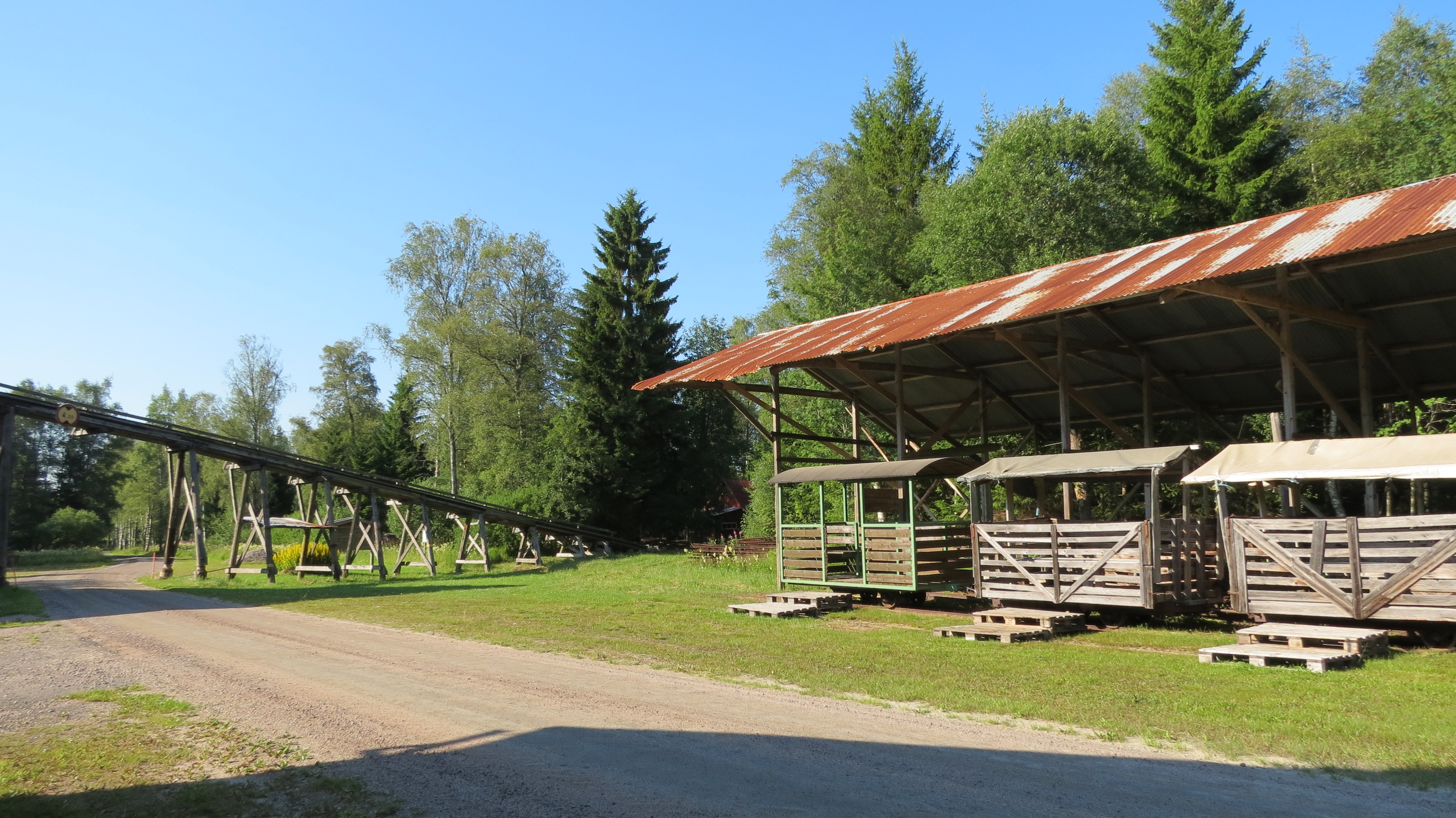
Light Railway of the Ryttaren Peat Factory
Engineer Mans Hartelius had a problem. The electric locomotive at his family's peat factory could not haul loads the full distance from the remote Ljunghem and Ekelund bogs. So in 1954, he designed a solution: a custom-built locomotive with a diesel-electric hybrid drivetrain, individual wheel suspension, and chain-driven axles. Working for Volvo in Gothenburg on military vehicle development by day, he applied the same engineering rigor to this tiny 600mm gauge railway threading through the Swedish wetlands. Today, the Harteliusloket locomotive and the entire factory complex stand protected as an industrial monument, one of Sweden's best-preserved examples of peat industry heritage.
From Bog to Bale
The Ryttaren Peat Factory came to life in the spring of 1906, built by agricultural scientist Nils Hartelius beside the railway line between Falkoping and Nassjo. The location was strategic: the Ryttaren moor held vast deposits of peat, and the mainline railway offered immediate access to markets across Sweden. Three balers worked continuously, producing 75,000 bales annually. The peat served practical purposes that seem quaint today: animal bedding, dry toilet material, and fruit packaging. During peak season, up to 200 workers harvested and processed the dark organic material from the bog. Foreman Notary Karlsson ran the operation from its founding until his retirement in 1938, a remarkable 32-year tenure overseeing the transformation of wetland vegetation into industrial product.
Tracks Across the Moor
The light railway grew with the factory's appetite for peat. The first line stretched northeast from the factory buildings, branching into parallel tracks to reach the northern bog. By 1947, the original 5 kg/m rails had been replaced with heavier 7 kg/m track, reflecting the increased traffic. The network reached its maximum extent in 1954 after extensions to the Ljunghem and Ekelund bogs. Motive power evolved continuously: horses pulled the first cars from 1906 to 1913, returning during World War I when fuel was scarce. A parade of locomotives followed, including an 8-horsepower kerosene engine in 1918, an Austro-Daimler petrol locomotive from Vienna in 1924, and an experimental battery-electric conversion in 1941. The track embankments were reinforced with gravel so horses could walk alongside the rails, a practical detail that speaks to the improvised nature of industrial railways.
The Engineer's Solution
When Hasselfors Bruks AB purchased the factory in 1964 to produce horticultural peat, they found a railway system unlike any other. The crown jewel was the Harteliusloket, Mans Hartelius's 1954 creation. Its steel-frame chassis rode on individual wheel suspension that tracked the rails precisely, eliminating the derailments that plagued narrow-gauge operations. The two-cylinder Penta engine drove a generator, which powered an electric motor, which turned chains connected to the axles. This diesel-electric arrangement provided smooth starts and stepless speed changes, technology that Hartelius would have recognized from his work on Volvo military vehicles. Tubes running from the driver's cab allowed the operator to lubricate the drive chains and sand all wheels without leaving his seat. In 1968, the original engine gave way to a 60-horsepower Volvo B16, but the elegant drivetrain remained.
A Railway Preserved
Peat cutting at Ljunghemsmossen ended in 1995, and production ceased entirely in 1997, closing a chapter that had begun nearly a century earlier. But the story did not end there. In 2012, Swedish authorities recognized the factory and its railway as a Byggnadsminne, an industrial heritage monument protected under the Cultural Heritage Act. The Harteliusloket locomotive received the same designation, acknowledging both its historical significance and its engineering ingenuity. Today, more than three kilometers of track remain in good condition. The museum opens on summer weekends in July and August, and for the annual Torvens dag celebration in September. Visitors can ride behind locomotives that once hauled peat from the same bogs their ancestors worked, experiencing a form of industrial heritage that the Swedish countryside once knew well.
From the Air
Located at 58.02N, 13.74E near Kattilstorp in Falkoping Municipality. The factory and railway sit beside the main railway line between Falkoping and Nassjo in Vastergotland. From the air, look for the linear track alignments stretching northeast into the bog lands. Nearest airport is Falkoping/Axvall (ESGQ) approximately 15km northwest, or Jonkoping Airport (ESGJ) 45km east. The preserved railway is best visible during summer months when the museum operates.