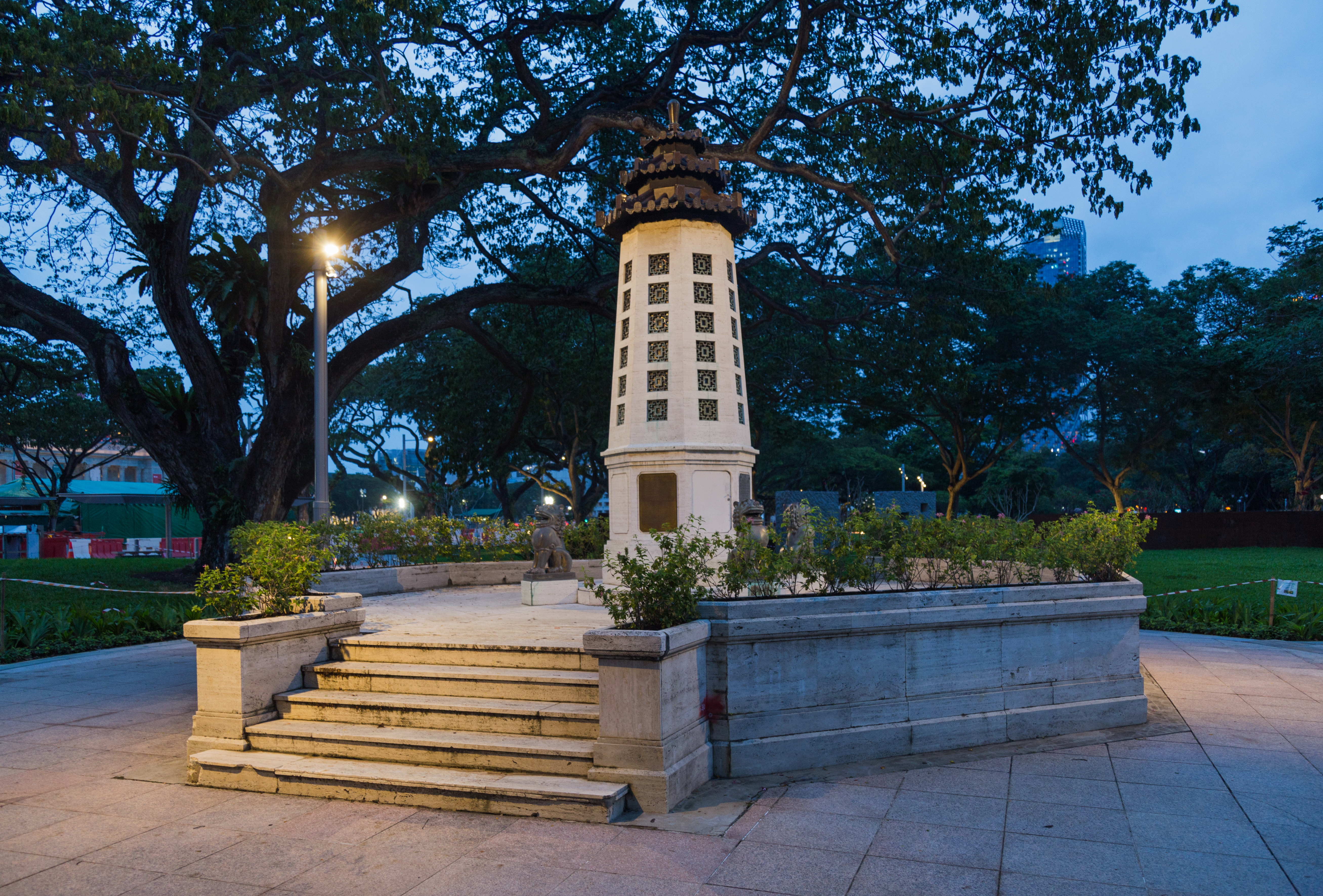
Lim Bo Seng Memorial
Six plans. The Lim Bo Seng Memorial Committee submitted six plans to the colonial government between 1946 and 1952 before one was finally approved. Five were rejected or trimmed beyond recognition - including a memorial park at MacRitchie Reservoir, where Lim had spent time with his family. The committee's secretary, Chuang Hui Tsuan, declared publicly that "the delay is a painful blow to the Chinese community. Our efforts and time have been wasted." The frustration was understandable. Lim Bo Seng had died under Japanese torture on June 29, 1944, refusing to reveal the operations of Force 136, the British covert intelligence unit he had joined to fight the occupation of his adopted homeland. He was 35 years old. The white marble pagoda that finally rose in Esplanade Park in 1954 is the only structure in Singapore dedicated to an individual's efforts in World War II. That it took nearly a decade to build says something about the politics of commemoration. That it was built at all says something about the man it honors.
From Fujian to the Front Lines
Lim Bo Seng was born on April 27, 1909, in Fujian, China, and moved to Singapore at age sixteen. His resistance began years before the Japanese reached Southeast Asia. When Japan invaded China in 1937, Lim organized boycotts of Japanese goods in Singapore and raised funds for the Chinese war effort - acts of defiance in a city that was still a British colony, where such organizing carried risk. When it became clear that Singapore itself would fall, Lim fled to British-controlled India in February 1942, just before the Japanese captured the city. In India, he joined Force 136, a covert unit of the Special Operations Executive tasked with intelligence gathering and sabotage behind enemy lines. The work suited his temperament: Lim was a businessman turned organizer turned underground operative, each transformation driven by the same refusal to accept what was happening to his world.
Behind Enemy Lines
In May 1943, Lim Bo Seng and several Force 136 members landed in Japanese-occupied Malaya. Their mission was to establish an intelligence network in preparation for Operation Zipper, the planned British reconquest of the peninsula. The work required moving through hostile territory, recruiting local agents, and maintaining communication with British command in India - all while the Japanese military police, the Kempeitai, hunted resistance operatives with systematic brutality. The network Lim helped build represented one of the most ambitious Allied intelligence efforts in Southeast Asia, connecting scattered resistance cells into a coordinated system capable of gathering military information and preparing the ground for an eventual Allied landing. How long he operated before capture is not precisely documented, but the intelligence he helped gather contributed to Allied understanding of Japanese positions across Malaya.
The Death That Made a Hero
Lim Bo Seng was eventually captured by the Japanese. What followed was interrogation and torture - the Japanese wanted the names and locations of Force 136's network. Lim refused to talk. He gave up nothing about the organization's operations, its agents, or its plans. The cost of that silence was his life. Weakened by torture and imprisonment, Lim died on June 29, 1944, in Batu Gajah Jail in Perak, on the Malay Peninsula. He was far from Singapore, far from his family, and far from any certainty that the war would end as he hoped. His death was not the dramatic last stand of battlefield legend. It was the quiet, grinding kind - a man who held information that could have bought his survival, and chose not to use it. In the calculus of wartime sacrifice, that kind of courage is harder to romanticize and harder to dismiss.
The Pagoda in the Park
The memorial that finally materialized is a 12-foot-high octagonal pagoda of white marble with a three-tier bronze roof, set on a marble and concrete pedestal guarded by four bronze lions. Designed by Ng Keng Siang and modeled after the nationalist-built Victory Memorial in Nanjing, China, its bronze and marble features were imported from Hong Kong. The site, donated by the colonial government, measures 100 by 80 feet near the Padang, the open field that has served as Singapore's ceremonial center since colonial times. Construction began on September 8, 1953, with British Commissioner-General Malcolm MacDonald laying the foundation stone on November 3. Rain delayed the project through early 1954, but the memorial was unveiled on June 29 - the tenth anniversary of Lim's death - by Sir Charles Loewen, Commander-in-Chief of the Far East Land Forces. Lim's widow and children were in the audience. So were surviving members of Force 136.
Four Languages, One Legacy
Four bronze plaques on the pedestal tell Lim Bo Seng's story in English, Chinese, Tamil, and Jawi - the four official languages of Singapore, each script representing a community that the memorial asks to remember the same man for the same reasons. The memorial was the site of commemorations on the 15th and 50th anniversaries of his death, in 1959 and 1994 respectively. On December 28, 2010, the Lim Bo Seng Memorial was gazetted as a National Monument alongside the Cenotaph and Tan Kim Seng Fountain, collectively designated as the "Esplanade Park Memorials" by the Preservation of Monuments Board. The citation noted that these structures "honoured individuals for their contributions to the community." In a nation that prizes collective achievement and system-building, the memorial to Lim Bo Seng stands as a counterpoint: a reminder that sometimes history turns on the stubbornness of one person who simply would not break.
From the Air
The Lim Bo Seng Memorial (1.289°N, 103.853°E) stands in Esplanade Park along the southern waterfront of Singapore's civic district, near Connaught Drive and the Padang. From the air, the Padang is an unmistakable rectangle of green between the colonial-era buildings (now the National Gallery Singapore) and the waterfront. The memorial is a small white structure on the park's eastern side, difficult to distinguish at altitude but situated within one of Singapore's most historically dense corridors - the Cenotaph, Victoria Theatre, and Fullerton Hotel are all within a few hundred metres. Singapore Changi Airport (WSSS) is 15km east. Seletar Airport (WSSL) is 14km north. Approach from the south over Marina Bay provides the best view of the Esplanade Park area. Standard equatorial weather applies - afternoon thunderstorms common, humidity persistent.