Limahuli Garden and Preserve
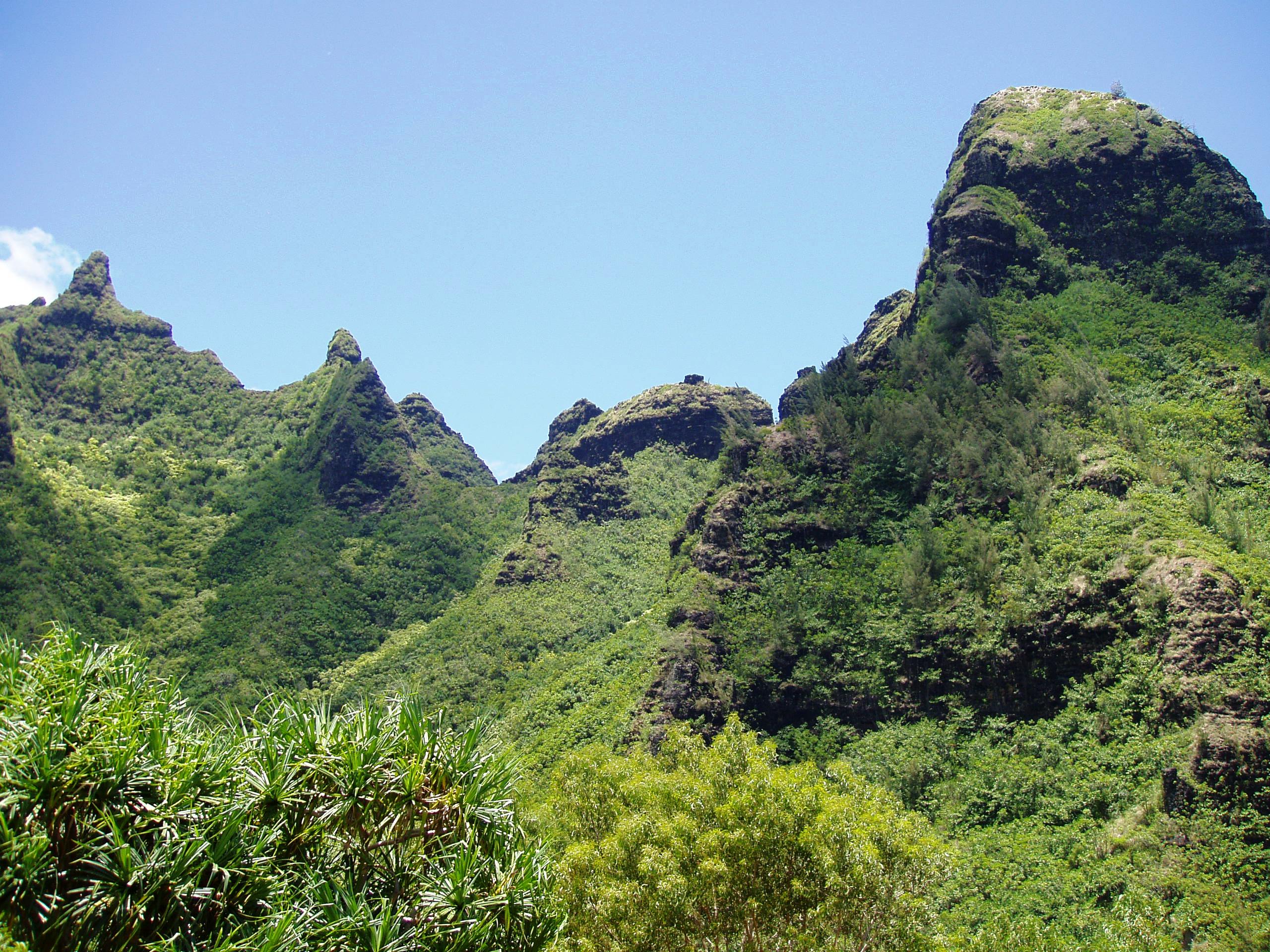
The name means "turned hand" in Hawaiian, and the valley of Limahuli does seem to cup itself around its treasures. On Kauai's north shore, where the road ends and the Na Pali coast begins, a 17-acre garden and 985-acre preserve climb from sea level into a tropical valley so rich in rare plants that the American Horticultural Society named it the best natural botanical garden in the United States in 1997. Above it all rises Makana Mountain, the peak that served as the visual inspiration for Bali Ha'i in the 1958 film South Pacific. The movie crew had to look no further than this valley to find paradise.
Three Worlds in One Valley
Limahuli occupies three distinct ecological zones within a single valley, from coastal strand to montane forest. The Makana Mountain ridge looms behind the garden, and the Limahuli Stream descends from the valley's upper reaches at 3,330 feet through an 800-foot waterfall to sea level just below the cultivated area. This vertical compression of habitats means that within a short walk, visitors move through radically different plant communities. The garden contains both native Hawaiian species and plants introduced by Polynesian voyagers: kukui, banana, breadfruit, taro, sugarcane, kava, and ginger grow alongside species that exist nowhere else. The preserve harbors critically endangered plants including the alula, a cabbage-on-a-stick oddity that clings to cliff faces, and a species of hibiscus once thought extinct until it was rediscovered in the back of the preserve. Several species bear the valley's name, including the fan palm Pritchardia limahuliensis.
The Ancient System
Terraced into the lower slopes of the valley are taro paddies -- loi kalo -- that date back to early Polynesian arrivals on Kauai. These terraces are not museum pieces. They are remnants of the ahupuaa, a sophisticated land management system that divided Hawaiian territory into wedge-shaped sections running from mountain to sea. Each ahupuaa was designed to be self-sustaining, with freshwater, agricultural land, forest resources, and ocean access all contained within a single watershed. The system managed water flow, nutrient cycling, and food production with an elegance that modern permaculture has only recently begun to appreciate. At Limahuli, the taro terraces demonstrate how the ahupuaa worked in practice: stream water was diverted through a network of channels to flood the paddies in sequence, with each terrace filtering the water before it reached the one below.
The Rice Family Legacy
The preserve exists because of one family's devotion to the valley. Juliet Rice Wichman donated the initial land in 1967, establishing the core of what would become part of the National Tropical Botanical Garden's network of five gardens across Hawaii and Florida. Her grandson, Charles "Chipper" Rice Wichman, extended the preserve significantly. The family descended from William Hyde Rice, a businessman, and William Harrison Rice, a missionary -- two men whose separate arrivals on Kauai in the nineteenth century launched a lineage deeply intertwined with the island's history. The garden is now open to visitors, though the larger preserve area remains closed to the public to protect its most fragile ecosystems. In 2007, the Hawaii Tourism Authority awarded Limahuli its top "Keep It Hawaii" honor for supporting Hawaiian culture through preservation of natural resources, research, and educational programs.
Where the Road Ends
Limahuli sits near the western terminus of Route 560, just inland from Haena State Park and Ke'e Beach, where the paved road gives way to the Na Pali coast's impassable cliffs. This location at the literal end of the road gives the garden a feeling of finality, of arriving at the last cultivated place before the wilderness takes over completely. Mount Makana rises above the valley with the kind of dramatic vertical presence that made it irresistible to Hollywood's location scouts. When Rodgers and Hammerstein needed a mountain to embody the mysterious allure of Bali Ha'i, Makana required no set dressing. The valley below it -- lush, vertical, streaked with waterfalls, dense with plants that evolution spent millions of years perfecting for this specific combination of rainfall, soil, and light -- needed no embellishment either. Limahuli is what Hawaii looked like before anyone arrived to change it, preserved through the deliberate effort of people who understood what would be lost if no one intervened.
From the Air
Located at 22.22°N, 159.58°W on Kauai's north shore near the end of Route 560, at the gateway to the Na Pali coast. The valley is dramatic from the air, with Makana Mountain (the Bali Ha'i peak) rising steeply above dense tropical vegetation. Best viewed at 1,500-2,000 feet AGL approaching from the east along the north shore. Nearby airport: Lihue Airport (PHLI), approximately 18 nm southeast. Caution: steep terrain rises immediately south of the coastline, and wind shear along the Na Pali cliffs can be severe. The Na Pali coast to the west is one of the most spectacular aerial views in Hawaii.