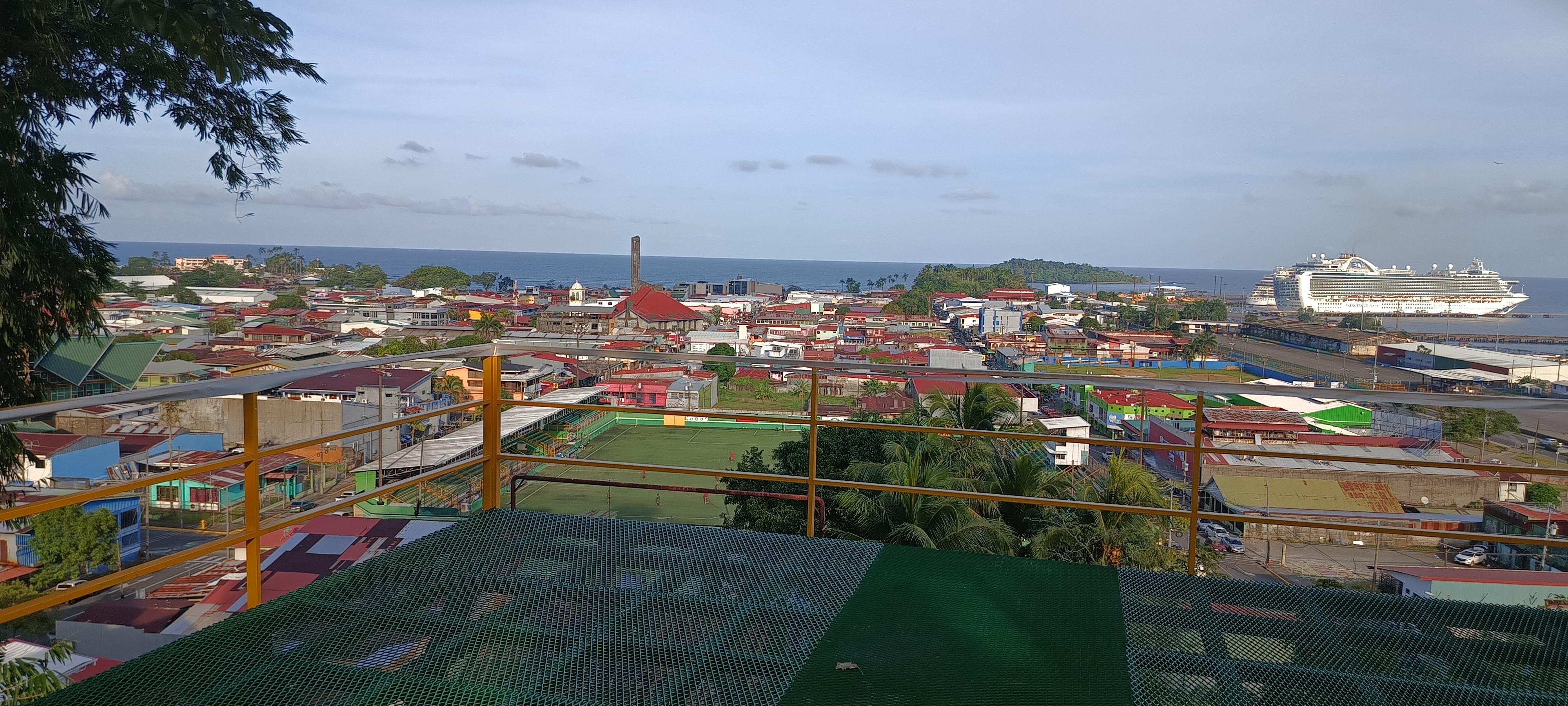
Limon
On June 12, 1990, Juan Cayasso scored the only goal in Costa Rica's first-ever World Cup match, a shock victory over Scotland. Cayasso was from Limon, and the fact barely surprised anyone who knew the city. This Caribbean port, founded in 1854, has produced a disproportionate share of Costa Rica's athletes, musicians, and writers - drawn from a population whose roots reach to Jamaica, Barbados, West Africa, and the Chibchan-speaking peoples who were here long before any of them. Nearly 90% of the country's imports and exports move through the harbors at nearby Moin, making Limon the economic engine that most Costa Ricans never visit. The city's identity runs on a different frequency from the rest of the country: Caribbean rather than Central American, English-accented as much as Spanish-speaking, calypso and mento over marimba.
Two Waves of African Heritage
The African presence in Limon arrived in two distinct chapters. The first came with the Spanish conquest, when enslaved people were brought from the Gambia, Guinea, Ghana, Benin, and Sudan - communities selected for their perceived robustness and forced into labor across the colony. After emancipation in 1824, this early population mixed with indigenous and European groups over generations. The second wave was entirely different. In the latter half of the nineteenth century, Jamaican workers arrived as hired laborers, with smaller groups from Barbados and Trinidad and Tobago, recruited to build the railroad and work the banana plantations. This is why the majority of Afro-Costa Ricans today carry English surnames and speak English with a Jamaican lilt. In 1910, a young Marcus Garvey worked as a timekeeper for the United Fruit Company in Puerto Limon, observing firsthand the poor conditions that would fuel his pan-African movement.
Mekatelyu and The Little Prince
Walk through certain neighborhoods in Limon and you'll hear a language that isn't Spanish and isn't quite English. Mekatelyu, an English-based creole considered a dialect of Jamaican Patois, has been spoken here for over a century. For most of that time, the language received less government support than far smaller indigenous languages, a neglect that linguist Juan Diego Quesada Pacheco worked to correct. His project to document the grammar of Central American creole and indigenous languages earned a Ministry of Culture award in 2017, and his research became the foundation for a Mekatelyu translation of The Little Prince - Di Likl Prins - published in 2021 by translators Kheomara Cunningham and Rene Zuniga. The book was more than a literary curiosity; it was a statement that Mekatelyu belongs in print.
Carnival on the Caribbean
Every October, during the week surrounding the twelfth, Limon erupts into carnival. The tradition began in 1949, organized by community leader Alfred Josiah Henry Smith - known as Mister King - and it has grown into the most exuberant celebration in a country not generally known for Caribbean-style street festivals. The event stretches across two weekends: parades wind through the streets, food vendors fill the sidewalks, and the final night brings a headline concert in Balvanero Vargas park. Damian Marley has played here. So have El Gran Combo de Puerto Rico and Eddy Herrera. The carnival hasn't always been smooth - a dengue outbreak cancelled the 2007 edition, and municipal trash-removal failures shut down 2008's - but the tradition persists, as much a declaration of Limon's distinct cultural identity as a party.
Port, Earthquake, and Reinvention
Limon's economic life revolves around the docks. The Moin Container Terminal handles the vast majority of goods entering and leaving Costa Rica, and Route 32 connects the port to San Jose and the rest of the country. An international airport with an 1,800-meter strip serves the city from the coast just south of downtown. But the built environment carries scars. The 1991 Limon earthquake damaged much of the city's older architecture - Victorian-Caribbean wooden structures built by or in the style of the United Fruit Company, along with Art Nouveau-ornamented public buildings and Art Deco-influenced facades like the House of Culture and City Theater. In the decades since, contemporary concrete and steel have replaced what wood and ornament once defined. The Limon Ciudad-Puerto project has restored some landmarks, including the House of Culture, which now hosts art exhibitions, dance workshops, and conferences.
Writers, Athletes, and a Football Debut
The city's cultural output belies its size. Joaquin Gutierrez wrote Cocori here, a novella still taught in Costa Rican schools despite ongoing controversy over its racial portrayals. Quince Duncan, raised nearby in Estrada, devoted his career to the identity of Afro-Costa Ricans and the racism they face. Carlos Luis Fallas set Mamita Yunai in the banana plantations surrounding Limon, denouncing the brutal working conditions under the United Fruit Company. On the athletic side, Sherman Guity became the first Costa Rican to win a Paralympic medal - a silver and a gold at the 2020 Tokyo Games. And after Cayasso's 1990 World Cup goal, three more Limon natives scored for Costa Rica on football's biggest stage: Winston Parks in 2002, Keysher Fuller and Yeltsin Tejeda in 2022. For a city often overlooked by its own country, the record speaks loudly.
From the Air
Located at 10.00N, 83.08W on Costa Rica's Caribbean coast. Limon International Airport (MRLM/LIO) has an 1,800m runway at 2m elevation, just south of the city along the coast. The port facilities at Moin are visible north of the city center. Route 32 runs east-west connecting to San Jose. From the air, the city appears as an urban area on a small coastal promontory, with the Moin Container Terminal visible as a large industrial facility to the north. Juan Santamaria International Airport (MROC/SJO) is approximately 160km to the west.