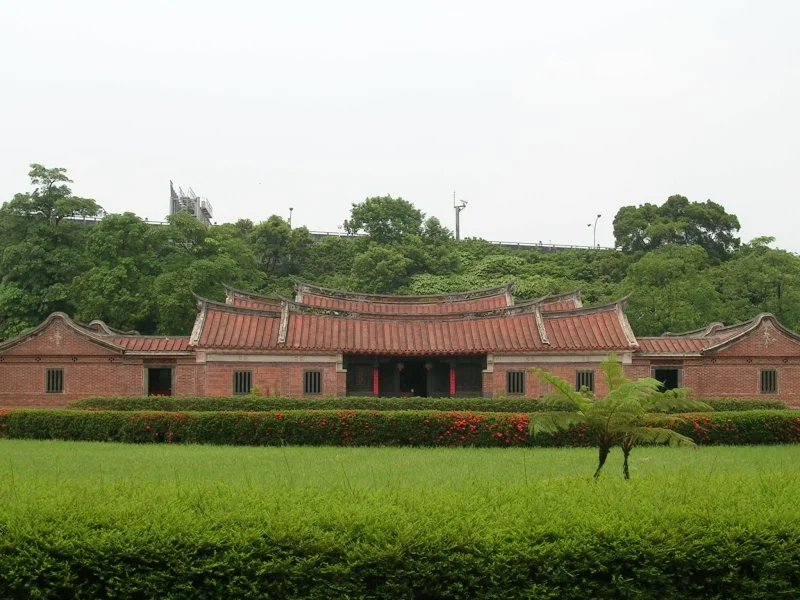

Lin An Tai Historical House and Museum
The rocks in the front yard came from the bottom of ships. Mainland merchants sailing to Taiwan in the eighteenth and nineteenth centuries used stones as ballast — dead weight to stabilize their vessels in open water. When they arrived and unloaded their cargo, the ballast stones came out too, and over time they accumulated in the hands of people who found uses for them on land. The Lin family, who had migrated to Taiwan from the mainland, used these stones to cover the front yard of their home. That home is now the Lin An Tai Historical House and Museum in Taipei's Zhongshan District, and those ballast stones are still there — a quiet record of the journeys that brought this family and its material culture to Taiwan in the first place.
A Family from Fujian
The Lin family built their home in the eighteenth century, after migrating from mainland China to Taiwan. The house follows the southern Fujian style of courtyard architecture, the building tradition of the Minnan-speaking communities who formed the majority of Taiwan's early Han settler population. Southern Fujian courtyard houses are organized around a series of interconnected spaces — main halls, side wings, courtyards, and a pond in front — that reflect both the social organization of extended family life and the practical requirements of managing water, ventilation, and security in a hot, humid climate. The pond at Lin An Tai served multiple purposes: it was a source of water, a fire-suppression resource, and a defensive element that made direct approach to the main gate more difficult. The layout encodes the assumptions and experiences of the community that developed it, adapted for Taiwan's particular conditions.
Almost Lost
By 1978, the Lin An Tai house had been standing for perhaps two centuries, long enough to accumulate the kind of disrepair that comes from age and changing circumstances. It was located on Siwei Road in Da'an District, and the Taipei city government had plans to widen Dunhua South Road — a major expansion project that would require demolishing structures in its path. The Lin An Tai house had not been formally registered as a historical site, which meant it had no legal protection from redevelopment. Without registration, it was simply an old building in the way of a road project. Scholars and experts petitioned the city government, arguing that the house was irreplaceable — the kind of structure that, once demolished, simply ceases to exist. The government agreed. Rather than clearing the site, Taipei managed something considerably more difficult: relocating the building.
Moved, Rebuilt, and Preserved
Relocating a historic Fujian-style courtyard house is not a simple undertaking. The structure had to be carefully dismantled, documented, transported, and reassembled in a new location without losing the relationships between its parts that made it architecturally coherent. The city moved the house to its current site in Zhongshan District, near the Taipei Fine Arts Museum and the Grand Hotel. Reconstruction took years. The building was opened to the public as a museum in May 2000, making its accumulated history — the southern Fujian tradition, the merchant ballast stones, the centuries of use by the Lin family — accessible to visitors who could walk through the courtyards and understand something about how early settlers lived in Taiwan. In 2010 the courtyard underwent further extension, adding to the site's capacity to represent the original architecture in its fuller form.
What the House Contains
Walking through Lin An Tai is an exercise in understanding material culture. The main halls, with their traditional roof lines, dark timber, and careful proportions, show the formal aesthetic of Fujian domestic architecture at a high level of craft. The side wings and connecting passageways reveal how large households managed the logic of multiple generations under one roof. The front pond, framed by the ballast stones, is the element that most directly connects the building to the world that produced it — those stones are not decoration but evidence, brought by sea from somewhere else and repurposed into the foundation of a settled life. The museum is reachable on foot from Yuanshan Station on the Taipei Metro, a short walk from one of the city's oldest surviving private homes, which was saved from a road project by people who understood that some things, once gone, are simply gone.
From the Air
The Lin An Tai Historical House and Museum is located at approximately 25.072°N, 121.530°E in Zhongshan District, Taipei, near the Kelung River and the Taipei Fine Arts Museum. From the air at 3,000 feet, the area is identifiable by the distinctive red-roofed Grand Hotel Taipei to the north and the green parkland along the riverside. The traditional roof forms of the Lin An Tai compound are visible within the museum grounds and contrast clearly with the modern urban fabric around them. Taipei Songshan Airport (RCSS) lies approximately 3 km to the east, making this one of the closest historic sites to the airport. Taoyuan International Airport (RCTP) is roughly 36 km to the southwest.
Nearby Stories
- Dapu Incident 9.3 km away
- Shuanglianpi Wetland 18 km away
- Toufen 41 km away
- North Jiangsu Main Irrigation Canal 980 km away
- General Cliff Rock Paintings 1050 km away
- Sinking of MV Sewol 1061 km away
- Yellow Sea 1111 km away
- Twin Forts of Romblon 1358 km away