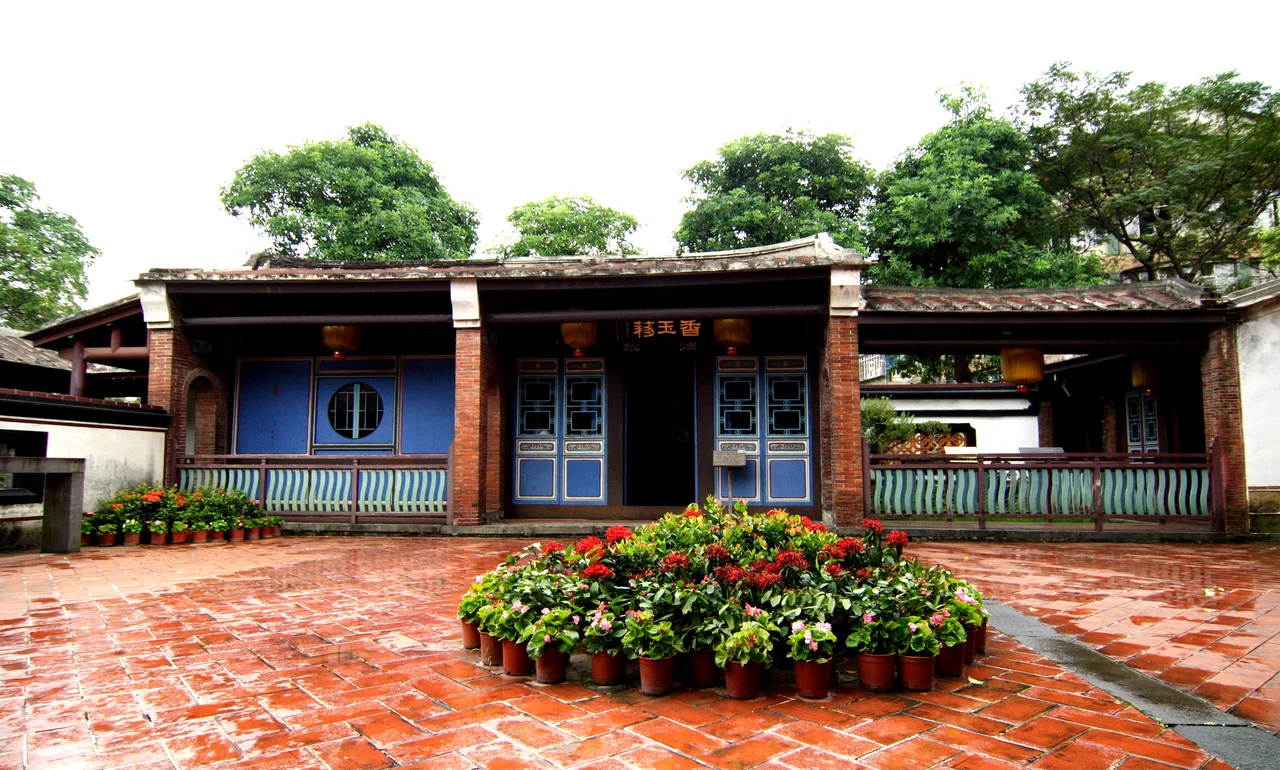

Lin Family Mansion and Garden
Inside the paper furnace at the edge of the great banyan pond, the Lin family burned every sheet of paper that had been written on. Not as waste, but as reverence. The practice -- "Treasuring the Written Word" -- reflected a family that took culture as seriously as commerce. The Lin Ben Yuan Family Mansion and Garden in Banqiao District, New Taipei City, is Taiwan's most complete surviving example of traditional Chinese garden architecture, one of the island's Four Great Gardens, and the physical record of a family that arrived with nothing and built something extraordinary.
From Rice to Riches
The story begins in 1778, when Lin Yingyin crossed the Taiwan Strait from mainland China and settled in the Xinzhuang area. His son, Lin Pinghou, sold rice to make a living -- and made it spectacularly well. He bought vast tracts of arable land and established the fortune that would sustain the Lin Ben Yuan family for generations. Between 1846 and 1848, Lin Pinghou's sons built a modest structure in the Banqiao area as a "rent house" for collecting crop payments from tenants. By 1851, the family had moved to Banqiao entirely and constructed the Three-Courtyard Mansion as their residence. The timing was turbulent. Immigrants from the Chinese cities of Zhangzhou and Quanzhou were fighting each other in Taiwan, and the wealthy Lin family, aligned with the Zhangzhou faction, fortified their mansion with defensive designs and stationed several hundred militiamen as guards. The compound remained a military headquarters until the Japanese occupation began in 1895.
A Garden of Hidden Meanings
The garden that grew around the mansion is an encyclopedia written in stone, water, and wood. Every element carries meaning. The Laiqingge tower, built entirely of cedar and birch, is crowned with upturned eaves and intricate carvings that make it the architectural jewel of the compound. From its top, the Lin family's guests once looked out over green fields stretching to Mount Guanyin, the distant peaks giving the tower its name: "Comes Green." The Guanjialou, the farmland-viewing tower, features fruit-shaped openwork windows -- pomegranates for fortune, pumpkins for emolument, immortality peaches for longevity, and persimmons for happiness. The Dingjingtang banquet hall, named after a passage in the Confucian classic "The Great Learning," could seat more than a hundred diners. Butterflies and bats carved into its walls represent bestowed fortune. Everywhere, the garden speaks in symbols to those who know how to read them.
Books, Water, and Moonlight
The Jigushuwu study hall, an imitation Ming dynasty building, was named for the seventeenth-century book collector Mao Zijin. It once held thousands of scrolls, including rare volumes from the Song and Yuan dynasties. The Lin boys studied here, surrounded by lattice doors and flower pots filled with exotic flora. Nearby, the Yuboshuixie -- the Moon Tide Water Pavilion -- extends from the surface of the great pond on a small bridge, its double-caltrop shape reflecting in the water below. Its rooftop platform was designed for moon-watching: because the moon's reflection danced in the pond, the building's name writes a poem about the relationship between light and water. The Rongyindachi, the largest pond in the garden, is edged with old banyan trees and stones brought from the family's ancestral village of Longxi in Zhangzhou. Pavilions of every shape -- octagonal, caltrop, rhombus -- surround the water, each positioned to create what the garden's designers called a "disorienting, meandering feeling."
Squatters, Soldiers, and Restoration
The garden's elegance did not protect it from history. After 1949, when the Kuomintang government retreated to Taiwan, the Lin family head lent the garden to house soldiers from the mainland. Over the following decades, squatters moved in. The gardens fell into disarray. In 1977, the family donated a portion of the property to the government of what was then Taipei County. It took years of city planning to relocate over 125 families before restoration could begin. The work, led by architectural historian Han Pao-teh, started in 1982. On January 1, 1987, the garden opened to the public for the first time, no longer a private world of coded symbolism but a shared one. Designated a Class-2 Historical Site, the 20,000-square-meter compound now falls under the joint care of multiple government agencies. The Three-Courtyard Mansion, still owned by the Lin Family Sacrificial Trade Association, requires a guide to enter -- a last remnant of the privacy the family once took for granted.
From the Air
Located at 25.010N, 121.456E in Banqiao District, New Taipei City. The garden compound covers approximately 20,000 square meters and is identifiable from low altitude as a cluster of traditional Chinese-style buildings with ornate rooflines surrounded by ponds and greenery, set amid the dense urban fabric of Banqiao. Taipei Songshan Airport (RCSS) is approximately 12 km to the northeast. Taiwan Taoyuan International Airport (RCTP) is about 25 km to the west. The nearby Banqiao railway station is a major transit hub.
Nearby Stories
- Dapu Incident 9.3 km away
- Shuanglianpi Wetland 18 km away
- Toufen 41 km away
- North Jiangsu Main Irrigation Canal 980 km away
- General Cliff Rock Paintings 1050 km away
- Sinking of MV Sewol 1061 km away
- Yellow Sea 1111 km away
- Twin Forts of Romblon 1358 km away