Lincoln Cathedral
For 238 years, Lincoln Cathedral was the tallest building on Earth. When its central spire was completed around 1311, the cathedral reached approximately 525 feet -- surpassing the Great Pyramid of Giza, which had held the record for nearly four millennia. No human structure had ever risen so high. The spire stood until 1548, when it collapsed in a storm, and the record passed elsewhere. But for more than two centuries, anyone approaching Lincoln from the flat Lincolnshire countryside would have seen what was, quite literally, the summit of human construction. John Ruskin, the Victorian critic not given to easy praise, declared Lincoln Cathedral 'out and out the most precious piece of architecture in the British Isles and roughly speaking worth any two other cathedrals we have.'
From Norman Foundation to Earthquake
The cathedral's story begins with a political relocation. In 1072, Bishop Remigius de Fecamp moved his episcopal seat from Dorchester on Thames to Lincoln, judging the hilltop city more central to a diocese that stretched from the Thames to the Humber. He began building immediately, and the cathedral was completed in 1092 -- though Remigius died two days before its consecration. The early Norman structure was damaged by fire in 1124 and rebuilt by Bishop Alexander. Then, on 15 April 1185, an earthquake struck -- one of the most significant seismic events in English history. The earthquake destroyed most of the cathedral, leaving only fragments of the Norman west front standing. What happened next would transform Lincoln from an important provincial church into one of the great architectural achievements of medieval Europe.
St Hugh and the Gothic Rebuilding
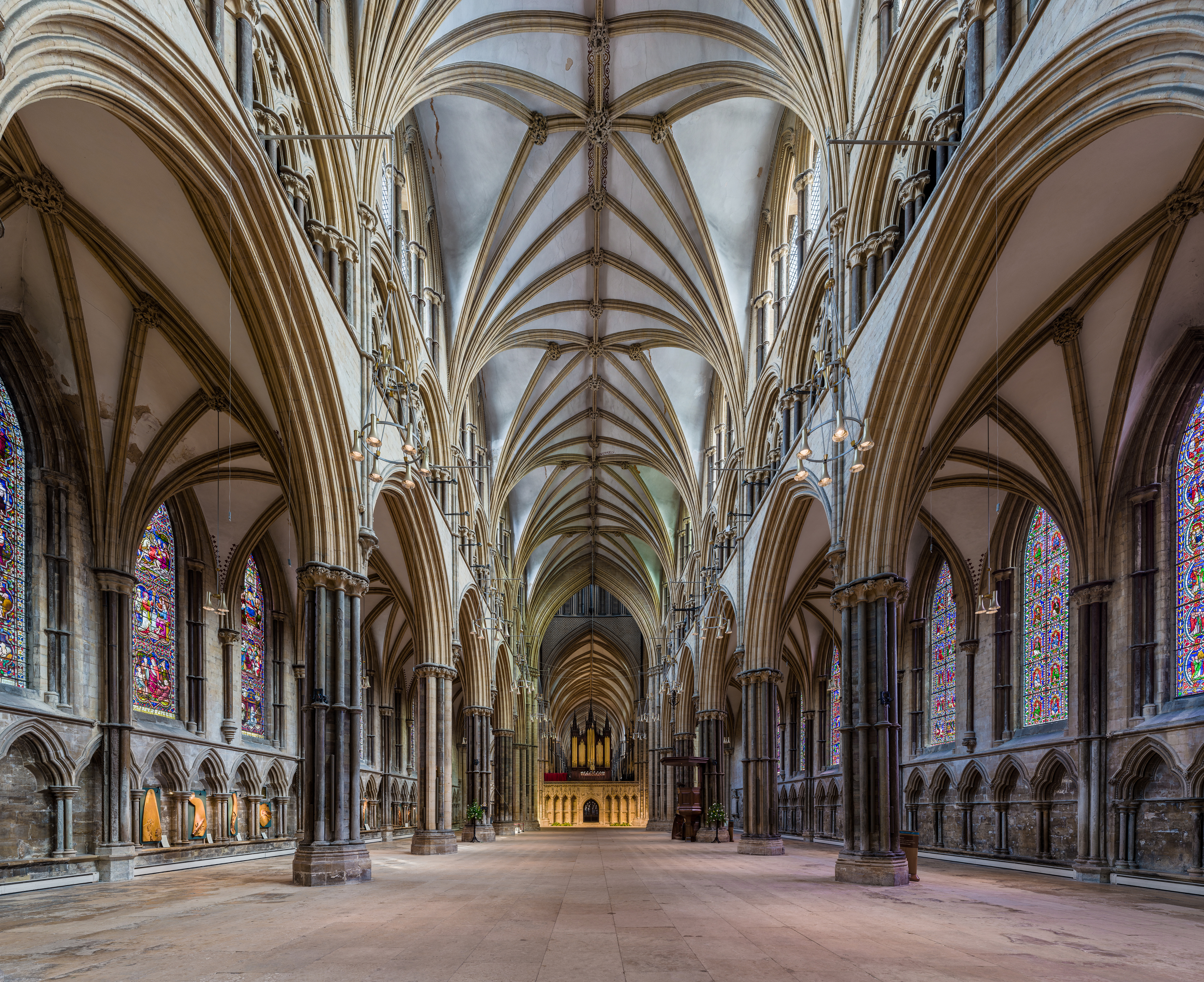
The man appointed to rebuild was Hugh de Burgundy, a Carthusian monk from Avalon in France, who became known as St Hugh of Lincoln. He began a massive reconstruction in the new Gothic style, appointing Geoffrey de Noiers as his master mason. The resulting building was revolutionary. The choir, completed in the early 13th century, introduced the 'crazy vaults' -- ribbed vaulting with asymmetric patterns that broke with the rigid geometry of earlier Gothic architecture. St Hugh's Choir was followed by the Angel Choir, completed around 1280, named for the carved angels that line the upper level -- twenty-eight figures, each different, including the famous Lincoln Imp, a small carved demon crouching among the stone foliage. Legend says the imp was turned to stone by angels after being sent by the devil to cause mischief in the cathedral. The building grew to encompass a nave of ten bays, two great transepts, and a chapter house that was, at the time, the largest in England. The chapter house served as the meeting place for early English parliaments under Edward I and Edward II.
The Tallest Building in the World
The central tower, originally topped with a lead-covered wooden spire, made Lincoln the tallest structure ever built when it reached its full height around 1311. The two western towers also carried spires, giving the cathedral a dramatic triple-spired silhouette visible for miles across the flatlands of Lincolnshire. The central spire survived for over two centuries before collapsing in a storm in 1548. The western spires were removed in 1807. Even without its spires, the cathedral remains an enormous presence -- the fourth largest in England by floor area, at approximately 5,000 square metres. The building contains one of the four surviving copies of the original 1215 Magna Carta, though this is now displayed in nearby Lincoln Castle. The medieval stained glass includes the Dean's Eye and Bishop's Eye rose windows in the great transepts, among the finest surviving examples of their kind in England.
Survival and Significance
The cathedral weathered the Reformation with less damage than many English churches, though it lost its monastic buildings and much of its medieval liturgical furnishing. During the English Civil War, Parliamentarian troops damaged the building and destroyed its cloisters. Subsequent centuries brought extensive restoration, including major campaigns in the 18th and 19th centuries. In 1922, a copy of the Wren Library was damaged by fire. Throughout, the essential structure that St Hugh began in the 1190s has endured. The cathedral stands on the same hilltop where the Romans built their fortress, across from the castle that William the Conqueror raised after Hastings. Together, the cathedral and castle form one of the most striking architectural pairings in England -- visible from twenty miles away on clear days, dominating the skyline of a city that has been continuously occupied for two thousand years. Ruskin was not wrong. The building earns its superlatives.
From the Air
Lincoln Cathedral sits at 53.23°N, 0.54°W on the hilltop in the centre of Lincoln, immediately adjacent to Lincoln Castle. The cathedral's massive twin-towered west front and central tower are prominent landmarks visible from considerable distances across the flat Lincolnshire terrain. RAF Waddington is approximately 4nm south and RAF Scampton approximately 5nm north. The cathedral is one of the most recognizable landmarks in eastern England from the air.