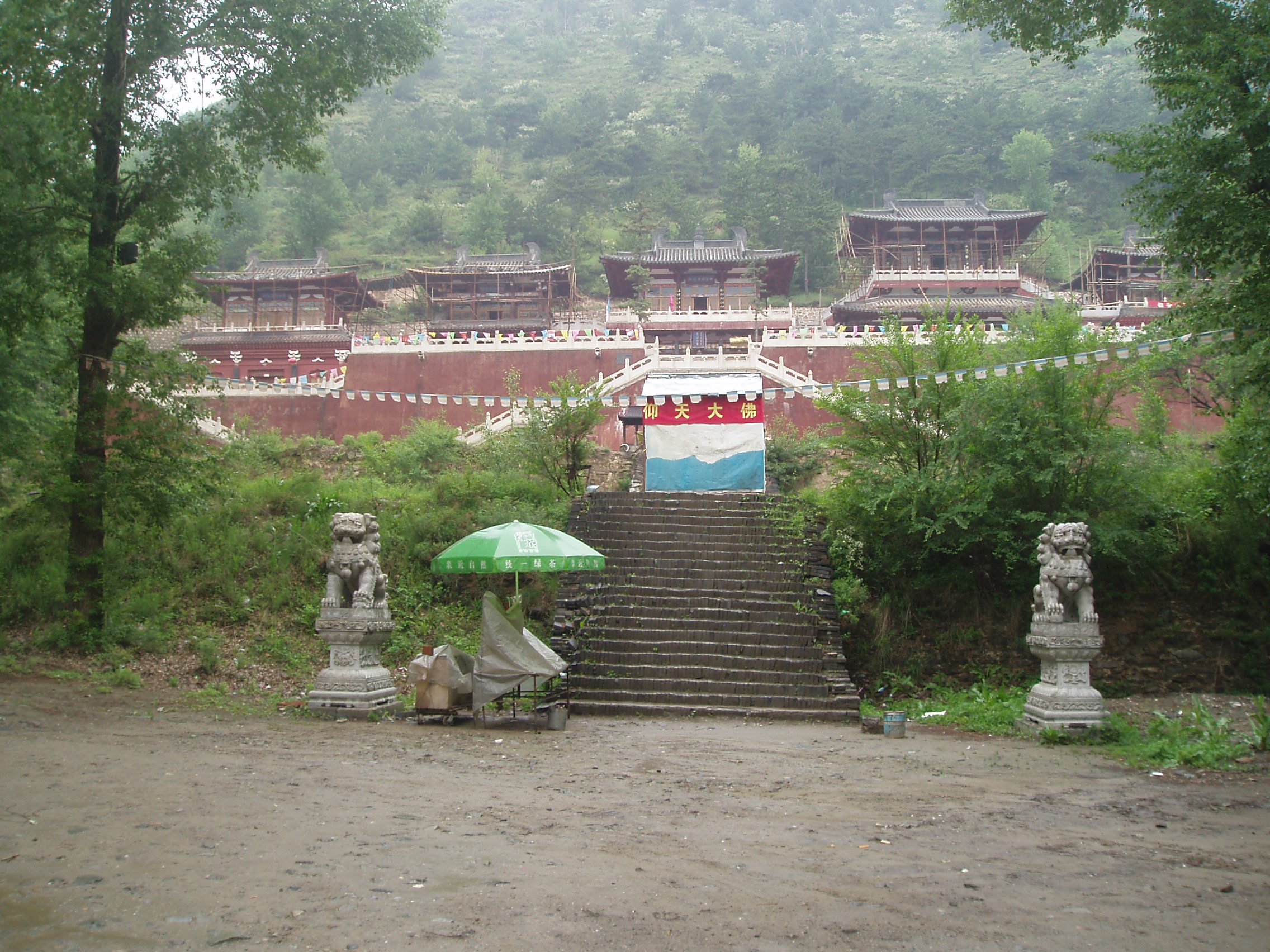
Lingfeng Temple
The octagonal stupa at Lingfeng Temple rises about 20 meters, built of brick held together with clay mortar. On its second floor, each of the eight sides carries three carved Buddha statues. On the third floor, one statue per side. On the sumeru throne at the base, patterns of the Eight Heavenly Kings -- also called the Eight Diamond Kings -- are engraved into the stone. The stupa is the oldest structure on the grounds, a survivor that has outlasted every other building here.
Three Lives of a Temple
Lingfeng Temple has been built three times. The first version rose during the Tang dynasty (618-907), an era of expansive Buddhist construction across China and particularly on Mount Wutai. It was rebuilt during the Chenghua period (1447-1487) of the Ming dynasty, likely after the original Tang structures had deteriorated beyond repair. That second incarnation lasted until 1975, when the temple was demolished because it had fallen into such disrepair that the buildings were deemed unsafe. For over two decades, the site lay empty. In 1998, construction began on the modern temple, the third Lingfeng Temple to stand on this spot. Only the brick stupa -- too solid and too significant to demolish -- survived all three incarnations.
Brick and Mortar, Stone and Marble
The current temple grounds feature a paifang gate built of white marble at the front entrance, a material that immediately signals the site's importance. White marble paifangs are architectural statements reserved for places of high status in Chinese Buddhist tradition. Behind the gate, the modern temple buildings are arranged in the traditional Chinese Buddhist layout, with halls progressing along a central axis from secular to increasingly sacred spaces. But the real draw remains the ancient stupa, standing apart from the newer construction like a geological formation -- something that belongs to a different timescale than the structures around it. Its five stories taper upward in the dense-eaved style, each level carved with devotional images that have weathered centuries of mountain winters.
A Mountain of Survivors
Lingfeng Temple's story of destruction and rebuilding is common on Mount Wutai. Across this Buddhist mountain complex in Shanxi Province, temples have been founded, abandoned, burned, demolished, and rebuilt in cycles that stretch back over fifteen hundred years. What makes Lingfeng notable is the survival of its stupa through all of these upheavals -- a single brick structure that has stood since at least the Ming dynasty while everything around it changed. The Eight Heavenly Kings carved on its base continue to guard the temple as they were meant to, indifferent to the question of which version of the temple they are guarding.
From the Air
Located at 39.00N, 113.59E in the Taihuai Town area of Mount Wutai, Shanxi Province, China. Elevation approximately 1,700 meters. The temple is part of the broader temple cluster visible from altitude. The octagonal stupa, while only 20 meters tall, is architecturally distinctive. Nearest airports: Wutai Mountain Airport (ZBWT) at roughly 50 km and Taiyuan Wusu International Airport (ZBYN) approximately 230 km southwest. Recommend 3,000-5,000 feet AGL for temple complex viewing.