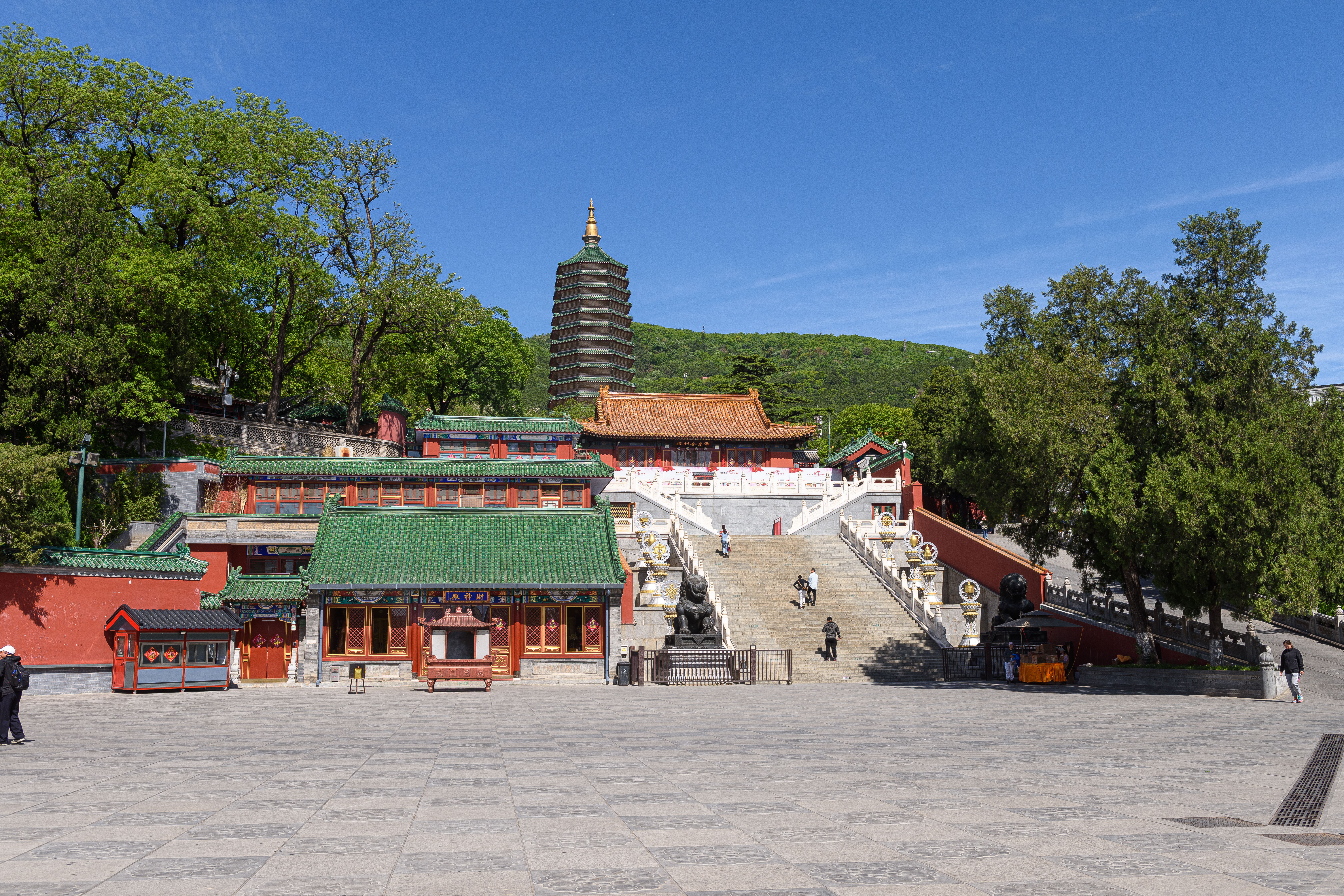
Lingguang Temple (Beijing)
Somewhere inside Lingguang Temple, behind walls that have been rebuilt many times across twelve centuries, rests a tooth relic attributed to the Buddha himself. The relic has made this temple on the east hillside of Mount Cuiwei one of the most significant Buddhist sites in Beijing, drawing pilgrims and diplomatic visitors alike. But the tooth has also made the temple a target. In 1900, soldiers of the Eight-Nation Alliance destroyed the Zhaoxian Pagoda that had sheltered the relic for over eight hundred years. What they left behind was a stone foundation and the challenge of starting over.
Origins on Mount Cuiwei
The temple was first built between 766 and 779 during the Tang dynasty, in what is now Beijing's Shijingshan District. Its original name was Longquan Temple -- Dragon Spring Temple -- a name that evokes the mountain setting where clear water once ran from rocky slopes. The Tang dynasty was the golden age of Chinese Buddhism, when monasteries received imperial patronage and monks traveled the Silk Road carrying sutras and relics. Longquan Temple was part of this flowering, one of hundreds of Buddhist establishments that dotted the hills around what was then a regional capital, centuries before Beijing became the seat of empire.
The Thousand Buddha Pagoda
In 1071, during the Liao dynasty, Lady Zheng -- the mother of the prime minister Yelv Renxian -- commissioned the construction of the Zhaoxian Pagoda to enshrine the tooth relic. The pagoda became known as the Thousand Buddha Pagoda because more than a thousand exquisite niches, each containing a small Buddha statue, were carved into its exterior. For over eight centuries, the pagoda stood as the temple's defining feature and the guardian of its most sacred object. Then came 1900. The Eight-Nation Alliance -- forces from Britain, France, Germany, Russia, the United States, Japan, Italy, and Austria-Hungary -- marched on Beijing to suppress the Boxer Rebellion. In the destruction that followed, the Zhaoxian Pagoda was completely destroyed. Only its stone foundation survived.
Rebuilding Across Centuries
Lingguang Temple has been rebuilt and renamed multiple times. The present temple complex reflects successive waves of construction and restoration. The Jade Buddha Hall, established in 2000 by the Buddhist Association of China, enshrines the Three Life Buddha: Sakyamuni, Amitabha, and Bhaisajyaguru. The statue of Bhaisajyaguru was a diplomatic gift from Myanmar's Than Shwe. The Great Compassion Temple houses a wood-carved Thousand Armed and Eyed Guanyin, with a statue of the warrior deity Guan Yu at its back -- an unusual pairing that reflects the syncretic nature of Chinese Buddhism, where Buddhist and folk religious figures coexist. In the Reclining Buddha Hall, a carved wooden Buddha rests on its side, the work of Ito Shinjo, founder of the Japanese Buddhist denomination Shinnyo-en.
A Living Place of Devotion
Unlike many of Beijing's Buddhist sites, which function primarily as museums or tourist attractions, Lingguang Temple remains an active place of worship. The tooth relic draws Buddhist delegations from across Asia, and the temple's position on Mount Cuiwei's hillside gives it a quality that urban temples in central Beijing cannot match -- a sense of removal from the city's density and noise. The hillside setting, with its trees and winding paths, preserves something of the landscape that attracted the Tang dynasty monks who built the original Longquan Temple more than twelve hundred years ago. The pagoda they knew is gone. The name has changed. But the mountain remains, and so does the impulse that placed a temple on its slope.
From the Air
Located at 39.96N, 116.18E on the east hillside of Mount Cuiwei in Beijing's Shijingshan District. The temple complex sits in the hills west of central Beijing, in the transition zone between the urban plain and the Western Hills. The pagoda structure may be visible from moderate altitudes. Beijing Capital International Airport (ZBAA) lies approximately 38 km to the northeast.