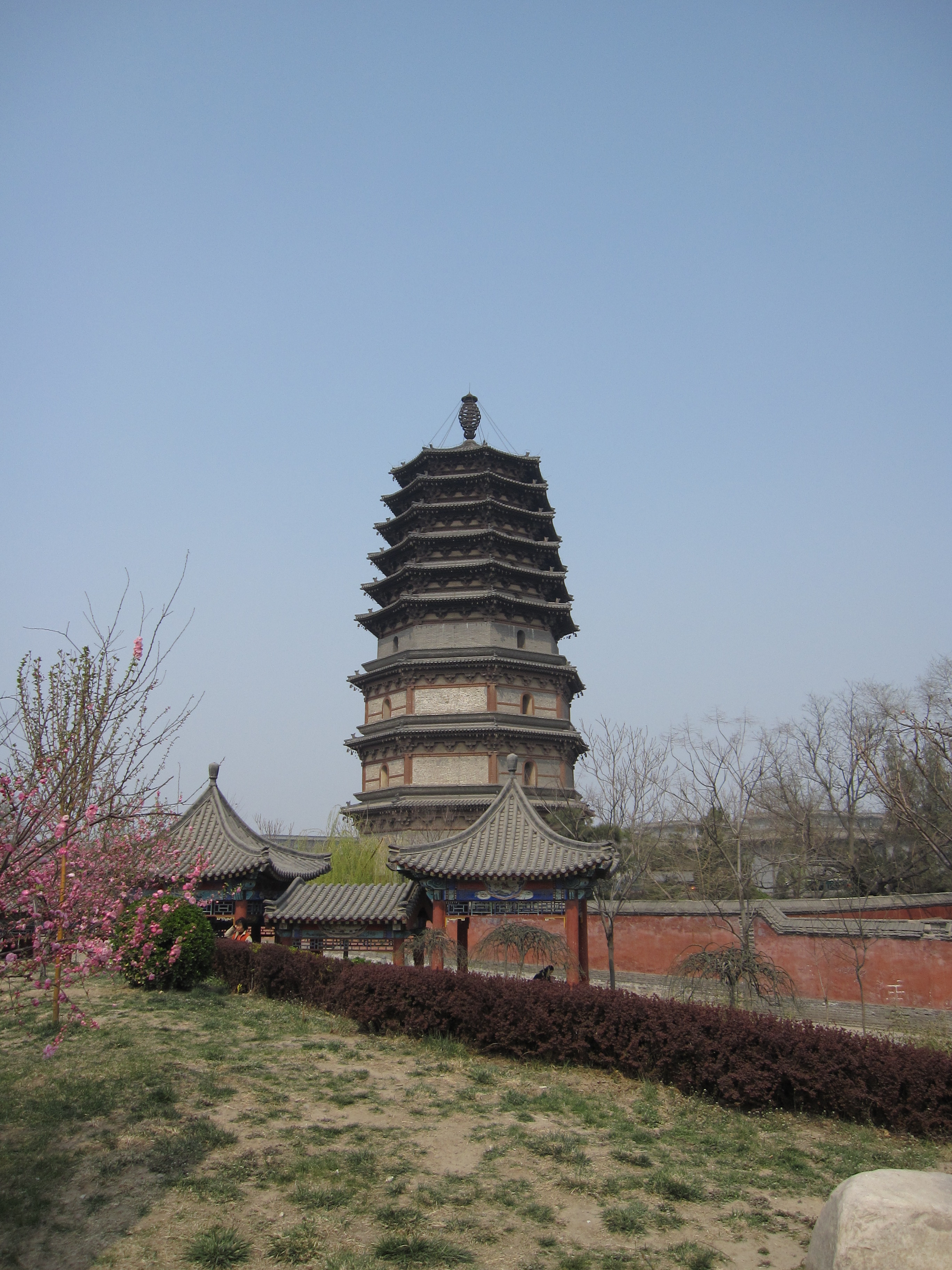
Lingxiao Pagoda
Halfway up the Lingxiao Pagoda, the building material changes. The first four stories are brick, solid and load-bearing, anchored to the earth with the weight of fired clay. From the fifth floor upward, the structure turns entirely to wood, rising toward a cast-iron spire that crowns the tower at 42 meters. This hybrid construction, rare in Chinese architecture, has stood since 1045 AD, surviving earthquakes, dynastic collapses, and the disappearance of the monastery it once served.
Two Pagodas in One
The original structure on this site was known simply as the Wooden Pagoda, built in 860 AD during the Tang dynasty. When it was rebuilt in 1045 during the reign of Emperor Renzong of the Song dynasty, the architects made a structural choice that would define the pagoda's character: they kept the lower stories in brick while preserving the wooden construction above. The result is a nine-story tower with nine wooden tiers of eaves encircling its octagonal frame. At the center stands a large wooden column, a feature of traditional Chinese pagoda architecture that was abandoned sometime after the Song and Yuan periods. Built just a decade later in 1055, the Liaodi Pagoda, China's tallest pre-modern pagoda, also features an inner column, suggesting this was standard practice during the Song dynasty. Inside the Lingxiao Pagoda, a wooden staircase spirals upward to the fourth floor, offering progressively wider views of the surrounding countryside.
The Monastery That Vanished
The Lingxiao Pagoda was originally part of the Tianning Monastery, a temple complex that once surrounded it. The monastery no longer exists, its buildings lost to the accumulated attrition of centuries. Yet the pagoda remains, a monument that has outlasted its own institutional context. This is not unusual in Chinese architectural history. Pagodas, built of more durable materials and carrying greater spiritual significance as reliquaries or markers, frequently survived while the wooden halls around them burned or decayed. The Lingxiao Pagoda was renovated during the Yuan, Ming, and Qing dynasties, each restoration adding its own layer to the palimpsest. In 1966, an earthquake damaged the structure, but immediate repairs kept it standing and open to the public.
Martyrdom at the Pagoda's Foot
The Lingxiao Pagoda carries a darker twentieth-century history. At its base in 1937, during the Second Sino-Japanese War, Dutch bishop Monsignor Frans Schraven and several companions were killed by soldiers of the Japanese army. Schraven, born in 1873, had refused to hand over the Chinese women and girls who had taken refuge in his compound. His refusal cost him his life, but it saved theirs. The episode is one of countless acts of courage and cruelty that marked Japan's invasion of China, and Schraven's stand has been recognized by the Catholic Church. That a medieval Buddhist pagoda became the site of a Christian bishop's martyrdom speaks to the layered, often tragic way that history accumulates in a single place.
Stone, Brick, Wood, and Iron
To stand before the Lingxiao Pagoda today is to see nearly a millennium of Chinese construction in a single vertical composition. The stone foundations anchor the building to the Hebei plain. Brick carries the first four stories with their characteristic solidity. Wood takes over from the fifth floor, lighter and more flexible, allowing the upper stories to sway rather than crack in seismic events. And at the summit, a cast-iron spire points toward the sky. Each material represents a different engineering calculation, a different relationship between weight, flexibility, and ambition. Together they form a structure that has been called one of the finest examples of half-brick, half-wooden pagoda construction in China, a tower that looks as though it was designed to demonstrate what each material does best.
From the Air
The Lingxiao Pagoda is located at 38.142N, 114.570E in Zhengding, Hebei Province, approximately 15 km north of Shijiazhuang city center. Shijiazhuang Zhengding International Airport (ZBSJ) is nearby to the northeast. The 42-meter tower is one of several historic pagodas visible from the air in Zhengding. The terrain is flat North China Plain. Look for the octagonal tower with its distinctive iron spire among the low-rise buildings of the historic town.