
Linji Huguo Chan Temple
Governor Kodama Gentaro had a university classmate, a well-known monk in Osaka named Umeyama Genshu. In 1900, Kodama — then the Japanese Governor-General of Taiwan — wrote to his old friend and asked him to cross the sea. The commission: come to Taihoku, build a temple on land beside the newly erected Taiwan Grand Shrine, and plant Rinzai Zen Buddhism on the island. Genshu came. Construction began that same year, and when the last tile was set in 1911, the temple's original name — Chin'nanzan Gokoku-ji, meaning 'Protect the Southern Lands' — spelled out the colonial ambitions behind its founding. The statue of Sakyamuni was consecrated on June 21, 1912. Today, stripped of its imperial name, the temple is known as Linji Huguo Chan Temple, and the colonial origin story is less important than what it has quietly become: a living Zen sanctuary in the middle of one of Asia's busiest cities.
A Classmate's Commission
The founding of Linji Huguo Chan Temple is one of those moments where personal friendship and imperial policy happen to coincide. Kodama Gentaro was affiliated with Rinzai Zen Buddhism himself, and the sect had already spread a network of temples across Japan's home islands. Bringing Rinzai practice to Taiwan was both a spiritual gesture and a statement of permanence — the same impulse that drove the construction of the Grand Shrine nearby. Umeyama Genshu, the Osaka monk turned founding abbot, oversaw every detail of the construction. It took eleven years. When the temple finally opened in 1911, its double-eaved rooflines and pagoda already spoke a different architectural language than anything else in the colonial capital. The colonial chapter would eventually close, but the temple remained.
Stone, Tile, and the Song Dynasty
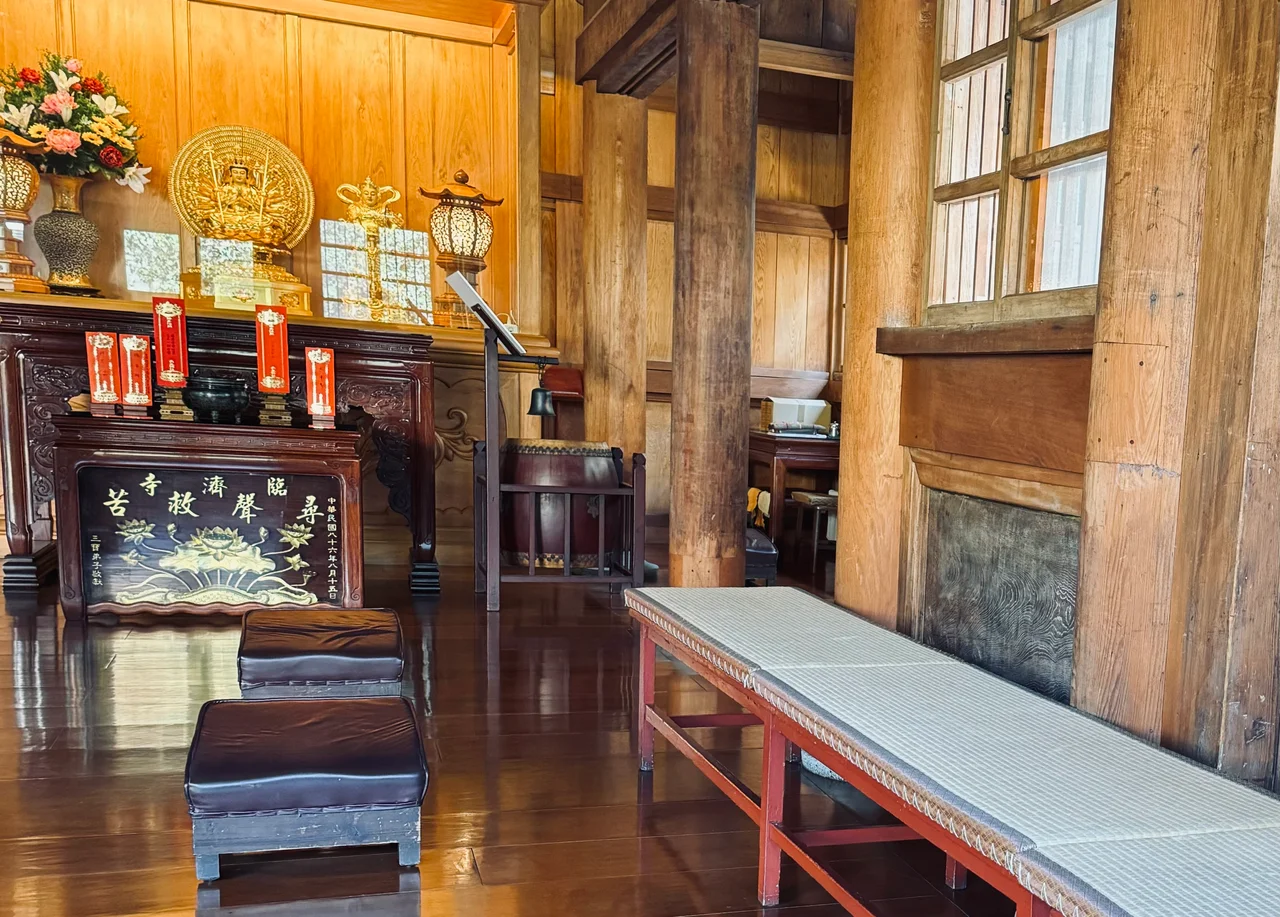
The Mahavira Hall is the heart of the complex, and its silhouette is immediately arresting. Built with double-eaves gable and hip roofs, it models the architectural style of China's Song dynasty — a tradition ten centuries old expressed in tile and timber in twentieth-century Taipei. On each ridge sits an onigawara, the Japanese demon-face tile that wards off evil and fire from the rooftop. Inside, three statues preside: Sakyamuni at center, Guanyin to the right, Ksitigarbha to the left. The full complex includes a Shanmen gate, a Four Heavenly Kings Hall, a Lotus Treasury Hall, a bell tower, a drum tower, and a pagoda. In 2007, the Taipei Municipal Government allocated NT$18.05 million for a reconstruction project, ensuring the architecture that Umeyama Genshu built would survive into another century.
Meditation on a Sunday Morning
On most Sunday mornings, the Mahavira Hall comes alive at 8:30 a.m. Practitioners gather for a meditation session lasting more than an hour — walking meditation along the tatami-covered benches, the kind of disciplined silence that Rinzai practice prizes. The session is principally for temple members and regular participants, though exceptions can be arranged through consultation with the supervising monk. Afterward, the group moves to tea. A dharma discussion follows, led jointly by the monk in charge and a tea expert, blending doctrine and ceremony in a way that feels thoroughly Japanese Zen. It is a rhythm maintained week after week, in a building that predates the Republic of China itself.
Between Two Worlds
What makes Linji Huguo Chan Temple unusual is precisely the tension it holds. It was built by Japanese colonial authority and carries the architectural grammar of Japanese Zen Buddhism — yet it has been claimed and sustained by the Taiwanese community for generations since. The Rinzai school traces its lineage back through centuries of Chinese Chan Buddhism before its Japanese reformulations, so the temple's heritage is layered rather than simply colonial. Today it sits a short distance from the Yuanshan area, near where the Grand Hotel's red-pillared bulk dominates the skyline. The temple is quieter, lower, greener, and easy to miss. Those who find it tend to stay a while. The sutra recitation in the Mahavira Hall, the smell of incense, the demon-face tiles keeping watch from the ridgeline — all of it has the quality of something that persists because it is genuinely used.
Finding the Temple
Linji Huguo Chan Temple occupies a low-key corner of Zhongshan District, not far from the bustle of Taipei's central neighborhoods. There are no crowds queuing for selfies, no trinket vendors at the gate. The Shanmen — the mountain gate — opens onto a compound that rewards slow attention. Visit on a Sunday morning if you want to witness the meditation session, though arriving unannounced and expecting admission to the class is unlikely to succeed; the temple's programs run on community trust built over time. Come instead to walk the grounds, to see the Song dynasty rooflines close up, to read the Japanese demon tiles against the Taipei sky. The temple has been here since 1911. It is patient.
From the Air
Linji Huguo Chan Temple sits at approximately 25.073°N, 121.521°E in Taipei's Zhongshan District, a few hundred meters southwest of Yuanshan. From the air at 3,000–5,000 feet, the compound's dark-tiled rooflines are visible among the dense urban fabric, close to the curve of the Keelung River. The towering red columns of the Grand Hotel (Yuanshan) just to the north serve as an unmistakable navigation landmark. The nearest in-city airport is Taipei Songshan (RCSS), roughly 2.5 km to the east; Taiwan Taoyuan International (RCTP) lies approximately 35 km to the west. Approach from the north over Yuanshan for the clearest sightline to the temple grounds on clear days.
Nearby Stories
- Dapu Incident 9.3 km away
- Shuanglianpi Wetland 18 km away
- Toufen 41 km away
- North Jiangsu Main Irrigation Canal 980 km away
- General Cliff Rock Paintings 1050 km away
- Sinking of MV Sewol 1061 km away
- Yellow Sea 1111 km away
- Twin Forts of Romblon 1358 km away