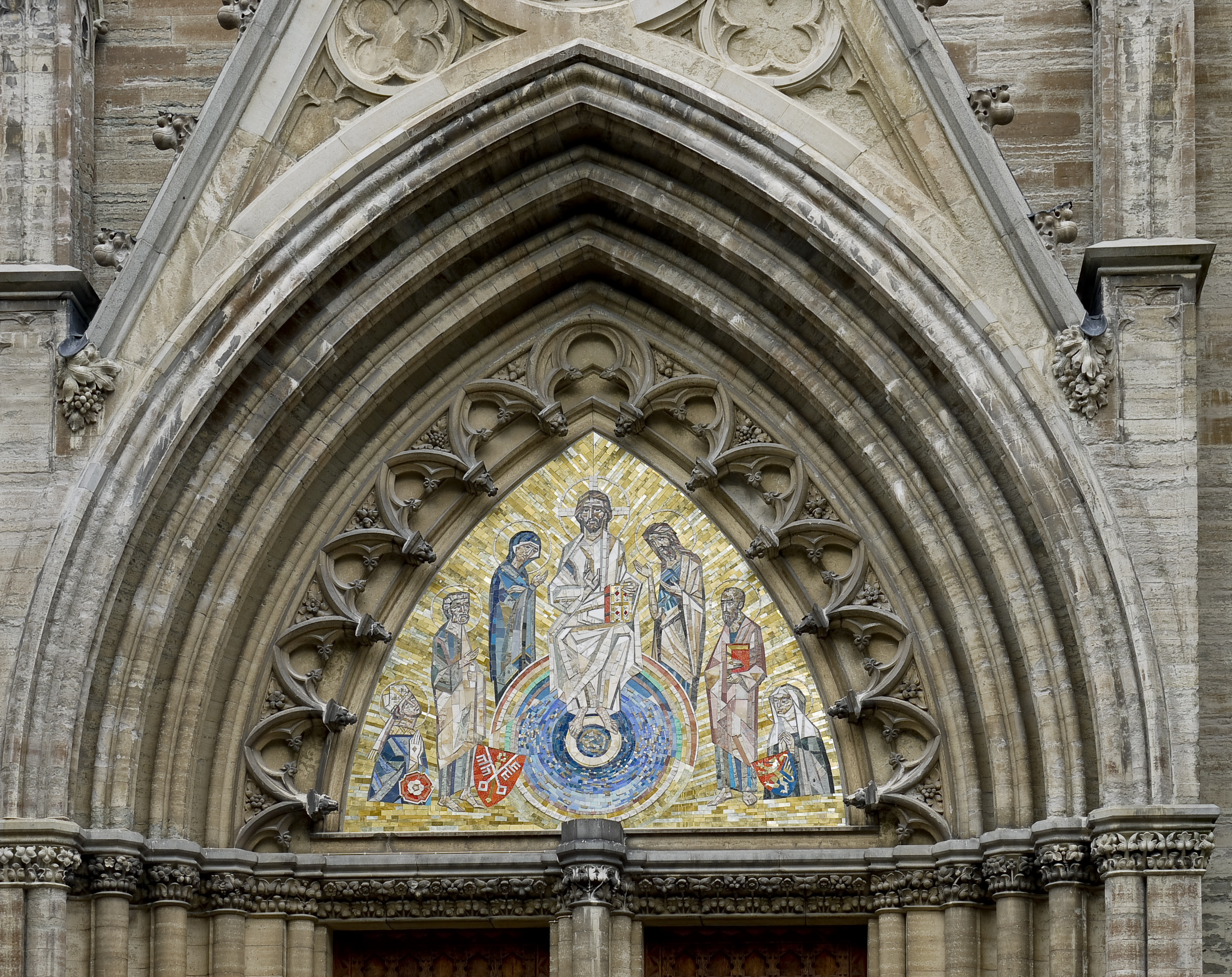
Linkoping Cathedral
The green men watch from the ceiling. Carved by English hands in the 1320s, these pagan forest spirits peer down from the roof bosses of Linkoping Cathedral, survivors from an age when British craftsmen traveled to Sweden bearing coins, tools, and the artistic traditions of High Gothic England. For eight hundred years, this cathedral has accumulated layers of history like sediment - wooden church to stone basilica to Gothic giant, fire damage and reconstruction, Catholic grandeur and Lutheran austerity, medieval sculpture and modern stained glass. Standing 107 meters long and opposite the town castle, it remains one of Scandinavia's largest and most artistically significant Gothic structures.
Eight Centuries of Stone
The site has held a church since the 11th century, beginning with a simple wooden structure that served the young Christian community of Linkoping. Around 1120, builders replaced wood with stone, constructing a basilica half the size of the current building. By 1230, the growing town demanded more space. Workers extended the church eastward, adding a new choir and transept that still form part of today's structure. The current altarpiece dates from this 13th-century expansion. Then came the coronation of King Valdemar in 1251, which prompted the major construction phase that gave the cathedral its present 110-meter length. The tower rises high above the city, its copper roof weathered to the distinctive green that marks so many Scandinavian church spires. Fire damaged the roof in 1546 and again in 1567, and the tower was rebuilt twice - first between 1747 and 1758, then again from 1877 to 1886 under architect Helgo Zettervall.
The English Touch
In 1320, a program of interior decoration transformed the nave. English and German craftsmen had been arriving since the early 14th century, bringing stylistic influences from the European High Gothic movement. The arcades received elaborate carvings, and the roof bosses took shape under sculptors who left their signature motifs - including those green men, the foliate faces common to British Isles folklore but rare in Scandinavian churches. Archaeologists have found English coins from this period on site, physical evidence of the international workforce. A decade later, in 1330, German artisans decorated the south portal's tympanum with relief scenes from the Nativity and Passion. Art historians have called the cathedral 'the only important centre for Gothic sculpture in the late 15th century,' a remarkable distinction for a Swedish church.
A Masterpiece in Exile
The cathedral's most celebrated artwork arrived as a refugee. Dutch Golden Age painter Maarten van Heemskerck created his monumental Crucifixion polyptych between 1538 and 1542 for Sint-Laurenskerk in Alkmaar, Netherlands. When the Reformation swept through the Low Countries, such elaborate Catholic imagery became dangerous. The church sold the altarpiece in 1581, and it eventually found its way to Linkoping, where it has remained for over four centuries. The irony is rich: a work created for Catholic devotion, sold to escape Protestant iconoclasm, now treasured in a Lutheran cathedral that itself converted from Catholicism. The Crucifixion remains a centerpiece of the interior, a reminder that art often outlives the conflicts that threaten it.
Gothic Chapels and Royal Tombs
Between 1408 and 1420, workers added the Gothic chapels that define much of the cathedral's character today. Large windows flood these spaces with light, while star-shaped vaults create intricate geometric patterns overhead. The chapels were dedicated to Saint Andrew (later rededicated to Saint Mary), Saint Nicolaus Hermanni, and Saint Thomas Becket - the English archbishop murdered in Canterbury Cathedral in 1170, whose cult spread rapidly across medieval Europe. The cathedral also serves as a burial place for Swedish nobility and royalty. Among those interred here are John, Duke of Ostergotland, and Bishop Kettil Karlsson Vasa, who served as Regent of Sweden from 1464 to 1465. Erik Sparre, the Lord High Chancellor executed in the Linkoping Bloodbath of 1600, was originally buried here before his remains were moved.
Living Light
The cathedral continues to evolve. In 2006, British artist Brian Clarke received a commission to design six stained glass windows for the north and south porches of the transept. Funded by the Bernhard Risberg Donation Fund, these contemporary lancet windows were installed in September 2010, continuing the tradition of international artists contributing to Linkoping's sacred space. In modern popular culture, the cathedral appeared on the cover of Opus Eponymous, the debut album by Swedish rock band Ghost, founded by Linkoping native Tobias Forge. From medieval green men to 21st-century stained glass to heavy metal album art, the building bridges centuries of human creativity. It remains an active Lutheran church, the episcopal seat of the Diocese of Linkoping, where services continue in spaces shaped by eight hundred years of faith, art, and history.
From the Air
Located at 58.41N, 15.62E in central Linkoping, Sweden. The cathedral stands opposite Linkoping Castle, making both structures visible landmarks from altitude. The distinctive copper-green spire rises prominently above the medieval town center. Nearest airport is Linkoping City Airport (ESSL), approximately 3km west. Best viewed at 1,500-2,500 feet AGL where the cathedral's cross-shaped floor plan becomes visible against the surrounding urban grid.