Linkoping University
In the foyer of the B building on Campus Valla sits a Cray X-MP/416 supercomputer. Once among the most powerful computing machines on Earth, it now serves as a bench. Visitors rest their bags on technology that cost millions, a fitting symbol for a university where cutting-edge becomes commonplace. Linkoping University houses Sweden's two fastest supercomputers, collaborates with Saab on next-generation fighter jets, operates the world's best dome theater for 3D imaging, and produced the inventor of the computer pointer. Founded in 1969 and granted full university status in 1975, it has grown into one of Sweden's largest academic institutions by consistently pushing boundaries between disciplines, industries, and possibilities.
Four Campuses, Three Cities
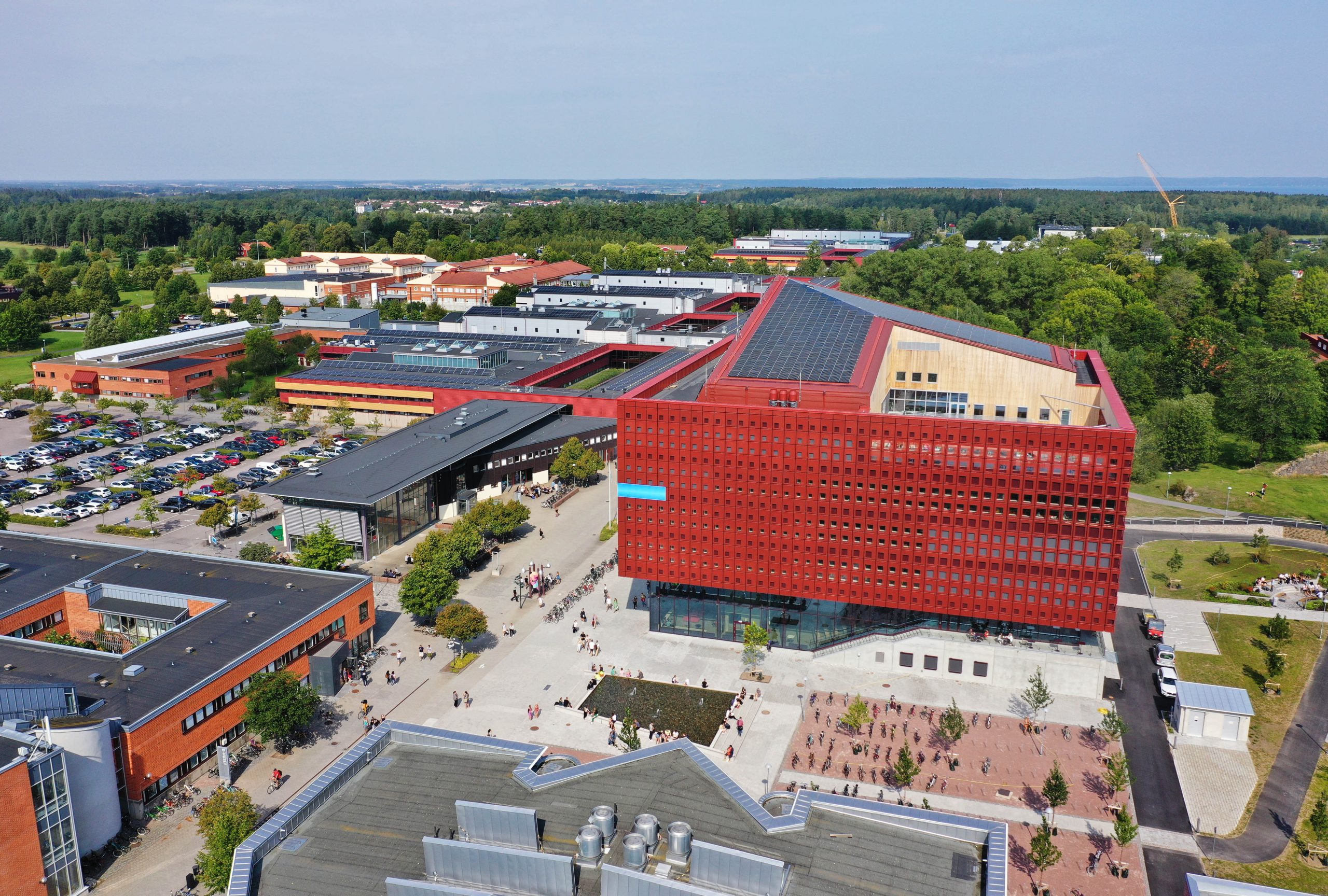
The university sprawls across an unusual geography. Campus Valla, three kilometers from Linkoping's city center, serves as the main hub where most students and researchers work. It sits sandwiched between Linkoping Science Park and a golf course on one side, and Valla Wood - a 200-acre nature reserve - on the other. Campus US clusters around Linkoping University Hospital, housing the Faculty of Medicine and Health Sciences just steps from the city center. Forty kilometers northeast, Campus Norrkoping occupies the historic Industrilandskapet district, where campus buildings straddle the Motala River and connect via footbridge. The fourth campus, in Lidingo near Stockholm, houses the Carl Malmsten School of Furniture, one of Scandinavia's premier furniture design programs, which has been part of the university since 2000.
The Interdisciplinary Instinct
Linkoping earned its reputation by refusing to stay in traditional academic lanes. In 1980, it became the first Swedish university to introduce interdisciplinary thematic research, deliberately mixing fields that other institutions kept separate. The Faculty of Medicine and Health Sciences pioneered problem-based learning in Swedish medical education starting in 1986. In 2000, the university joined MIT, Chalmers, and KTH Royal Institute of Technology to found the CDIO Initiative, a framework for engineering education that has since spread to universities worldwide. The results show in unusual combinations: programs that merge industrial management with engineering, medicine with technology, economics with law and languages. Students don't just study subjects - they study the spaces between them.
Supercomputers and Fighter Jets
The National Supercomputer Centre on Campus Valla houses Berzelius and Tetralith, Sweden's two most powerful computers. Berzelius, specialized for machine learning and artificial intelligence, ranked 102nd in the world's TOP500 supercomputers as of June 2022. Across campus, the Iron Bird - a full-scale aircraft systems test rig donated by Saab - supports aeronautical engineering research including work on fighter jets. Saab's main development and manufacturing facility, where engineers build the JAS 39 Gripen, sits adjacent to the university's Cavok District science park, and the company's Generic Future Fighter project - developing a fifth-generation stealth aircraft - operates in collaboration with Linkoping researchers. In Norrkoping, Visualiseringscenter C contains what was, as of 2019, the world's best dome theater for 3D image quality.
From Pointer to Professor
The university's faculty and alumni read like a roster of Swedish innovation. Harold Lawson, former professor of telecommunications and computer systems, invented the pointer - that fundamental concept in programming languages that allows software to reference memory locations. He was named an ACM Fellow for his contributions. Lennart Ljung pioneered system identification research and founded the Division of Automatic Control. Ingemar Lundstrom led global research in biosensors and chemical sensors, eventually chairing the Nobel Committee for Physics. Alumni include Carl-Henric Svanberg, who chaired both Volvo and BP while serving as CEO of Ericsson, and multiple Swedish ministers, university rectors, and members of both the Royal Swedish Academy of Sciences and the Chinese Academy of Sciences.
Where Industry Meets Innovation
Linkoping Science Park, adjacent to Campus Valla, hosts approximately 600 companies and 14,000 employees across four sites. Ericsson, IFS, Autoliv, and Toyota Industries maintain offices there. The university's business incubator, LEAD, was selected in 2023 as Sweden's incubator for NATO's Defence Innovation Accelerator for the North Atlantic. This integration of academy and industry defines modern Linkoping: students walk from lecture halls to startup offices to corporate research labs without leaving the science park perimeter. Self-driving minibuses shuttle between campuses. The retired Cray in the lobby is less an artifact than a promise - today's breakthrough becomes tomorrow's furniture, and the university keeps building what comes next.
From the Air
Located at 58.40N, 15.58E, Campus Valla is visible 3km south of Linkoping city center. Look for the large campus complex bordered by the golf course and Valla Wood nature reserve. Campus Norrkoping sits 40km northeast along the Motala River in central Norrkoping. Linkoping City Airport (ESSL) lies 4km west; Malmen Airbase (ESCF) is immediately adjacent to the science park. Saab's aerospace facilities are visible northeast of the main campus. Best viewed at 3,000-5,000 feet AGL to appreciate the campus-science park integration.