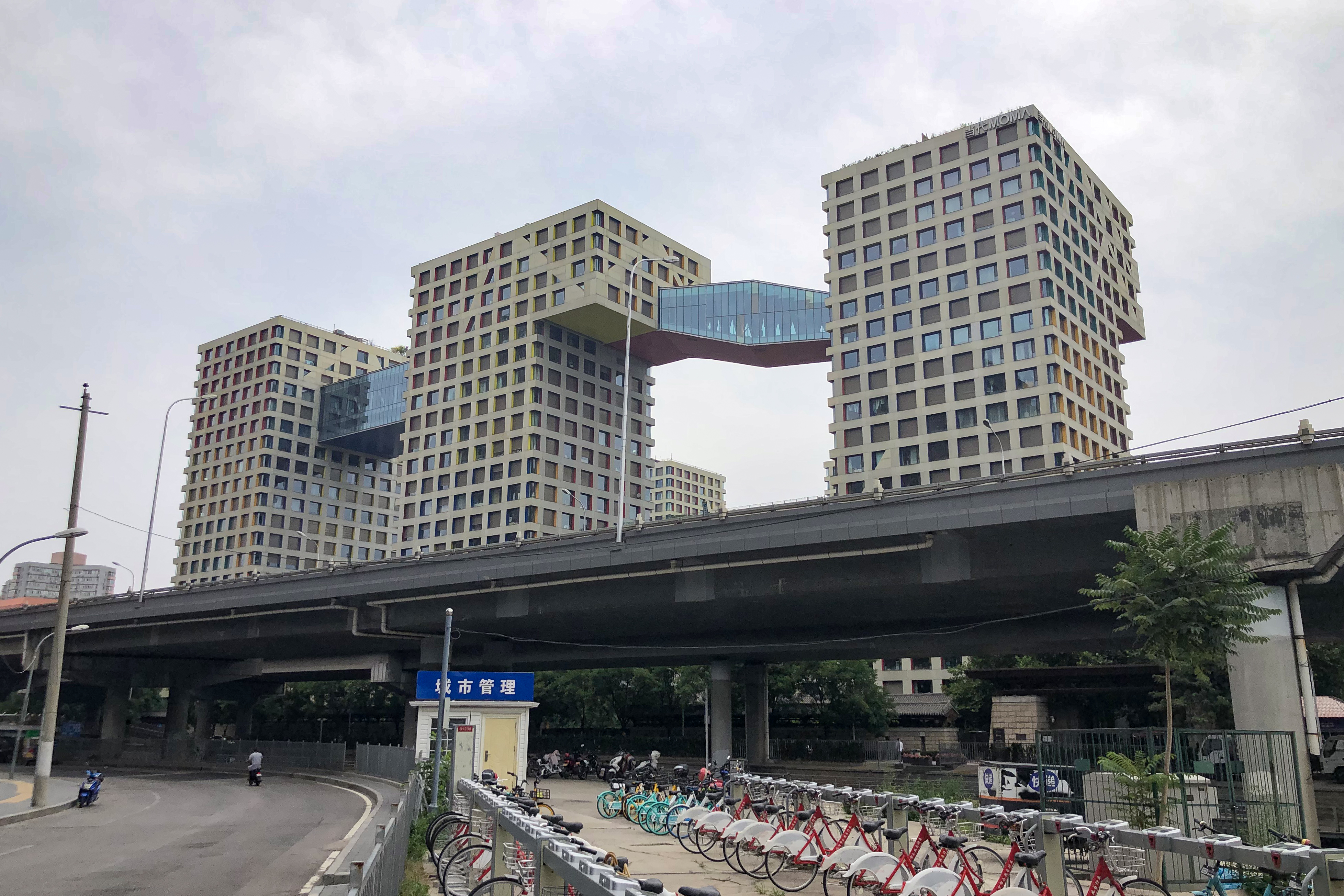
Linked Hybrid
Six hundred and fifty-five wells, each drilled 100 meters below the basement foundation, do most of the work of keeping 750 apartments comfortable year-round. Linked Hybrid, designed by Steven Holl Architects near the remnants of Beijing's old city wall, is not merely a building complex. It is an argument, built in concrete and glass, that urban density and environmental responsibility can occupy the same footprint. The Council on Tall Buildings and Urban Habitat named it the Best Tall Building Overall in 2009, and the award was not for aesthetics alone.
Invisible Infrastructure
The most ambitious feature of Linked Hybrid is the one visitors never see. Beneath the complex, a ground-source heat pump system shoulders 70 percent of the yearly heating and cooling load. The 655 geothermal wells eliminate the need for above-ground cooling towers, freeing that space for gardens and walkways. The system also removes the noise pollution and carbon emissions that conventional heating and cooling infrastructure would produce. Above ground, the buildings use displacement ventilation, a technique in which air slightly below room temperature is released from the floor. Cooler air naturally pushes warmer air upward and out, creating a consistently fresh breathing environment without the energy waste of traditional forced-air systems. These are not experimental technologies; they are proven methods deployed at a scale that few residential projects anywhere in the world had attempted at the time of construction.
A City Within a City
Linked Hybrid was conceived as more than apartments stacked on top of one another. The complex includes commercial space, a hotel, a cinema, a kindergarten, and a Montessori school, all oriented around pedestrian movement rather than automobile access. Skywalks connect several of the towers at upper levels, creating circulation paths that keep residents moving through shared spaces rather than retreating into isolated units. The design philosophy draws on an older idea of urban life, one in which a neighborhood provides most of what its residents need within walking distance. Positioned near the old city wall, the complex sits at a boundary between Beijing's historic core and its expanding modern periphery, a location that makes its pedestrian-first approach both a practical choice and a philosophical statement about what dense urban living could look like.
Recognition and Influence
The awards accumulated quickly after the complex's completion in 2009. Popular Science gave it an engineering award for being the largest geothermal housing complex. The American Institute of Architects' New York chapter recognized its sustainable design in 2008, even before construction finished. Architectural Record China named it the best residential project in 2010. These accolades reflected a broader shift in how architects and urban planners were thinking about buildings in rapidly growing Chinese cities. Beijing's expansion in the early 2000s was producing vast quantities of new housing, but much of it followed conventional models that paid little attention to energy consumption or community design. Linked Hybrid offered a counterexample, demonstrating that a residential development serving hundreds of families could also function as a laboratory for sustainable building techniques that might eventually become standard practice.
Seeing It from Above
From the air, Linked Hybrid's interconnected towers are distinctive against Beijing's grid of apartment blocks. The skywalks between buildings create visible geometric connections that set the complex apart from its neighbors, a web of elevated walkways linking what would otherwise be separate structures into a single organism. The old city wall remnants nearby provide historical context, marking where imperial Beijing ended and the modern city began. The complex occupies this threshold, a piece of twenty-first-century architecture anchored to a site where centuries of Beijing's growth are visible in the layers of construction surrounding it. On approach to Beijing Capital International Airport, the complex is one of many modern developments visible in the northeastern quadrant of the city, but its distinctive form makes it recognizable even at altitude.
From the Air
Located at 39.95°N, 116.43°E, northeast of the Forbidden City near the old city wall. The interconnected tower complex with skywalks is visible from 3,000-5,000 feet. Nearest airport: Beijing Capital International (ZBAA), approximately 20 km northeast.