Six Meters Too Late
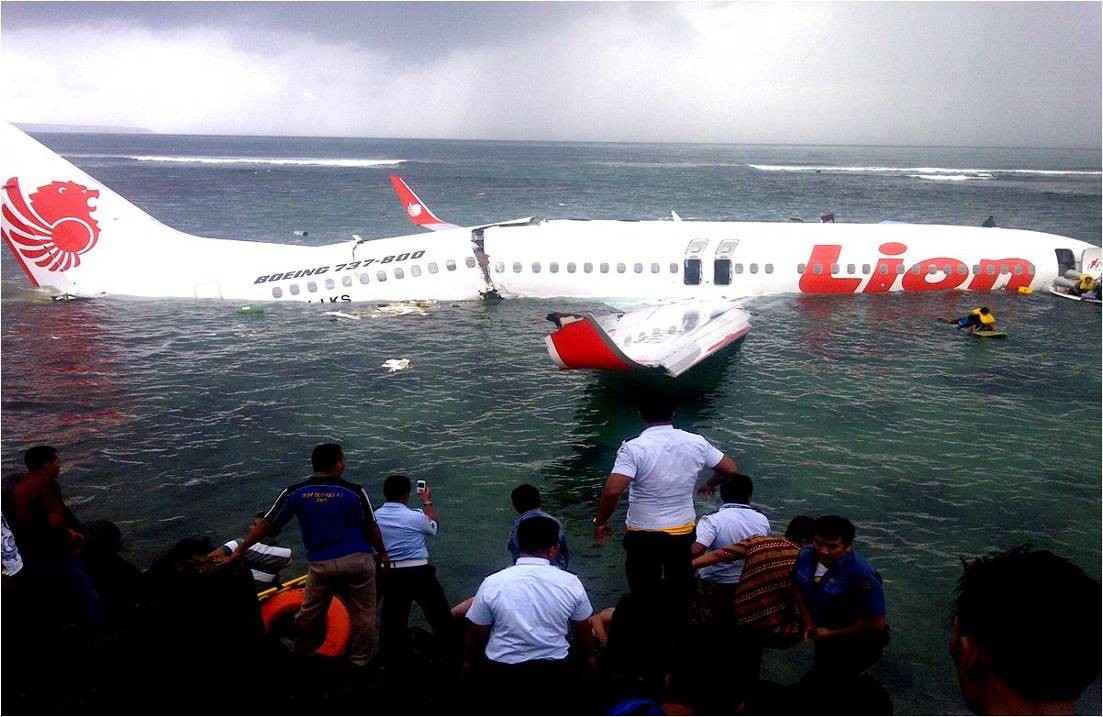
The Boeing 737-800 was fifty-three days old. Registration PK-LKS had rolled off the assembly line on 19 February 2013, logged 142 hours of flight time across 104 cycles, and still smelled of factory upholstery. On 13 April 2013, operating as Lion Air Flight 904 from Bandung to Bali, it carried 101 passengers and 7 crew on what should have been a routine Saturday afternoon arrival at Ngurah Rai International Airport. At 3:10 p.m., approximately 0.6 nautical miles short of the seawall protecting the threshold of Runway 09, the aircraft struck the water. The fuselage broke in two. Everyone survived.
Blind Below Minimums
The investigation that followed painted a precise and damning picture of the final minutes. As the aircraft descended on its approach to Runway 09, the first officer reported at 270 meters above ground level that the runway was not in sight. The minimum descent altitude for the approach was 142 meters, and standard procedure required a go-around if the runway remained invisible at that point. The crew continued descending. At roughly 46 meters, the captain confirmed again that he could not see the runway. Still, the aircraft kept sinking toward the ocean. The go-around decision finally came at approximately 6 meters above the water, an altitude so low that recovery was physically impossible. A Boeing 737 requires a minimum of 15 meters to execute a go-around, losing about 9 meters in the initial pitch-up before climbing. The mathematics left no margin. Seconds after the captain called for power, the aircraft hit the sea.
What the Weather Hid
The Indonesia National Transportation Safety Committee's final report, published in 2014, placed the cause squarely on the flight crew's loss of situational awareness. As the aircraft descended below minimum descent altitude, it entered a rain cloud on final approach. Visual references vanished. The rate of descent exceeded 1,000 feet per minute, and the flight path became unstable in ways the pilots either did not recognize or recognized too late. Critically, the NTSC found that the crew had not been provided with timely or accurate weather information. Conditions around the airport were changing rapidly, and the information available to the pilots did not reflect what was actually happening along the approach path. There was nothing wrong with the aircraft itself. Both CFM56-7B24E engines were operating normally, and no mechanical malfunction contributed to the crash. The problem was entirely human: a decision to press on through weather that demanded a retreat.
Survivors in a Broken Fuselage
That all 108 people on board survived a water impact that split the fuselage is remarkable. Forty-six passengers sustained injuries, four of them serious, but there were no fatalities. The aircraft came to rest in shallow water near the shoreline, which likely contributed to the speed of the rescue. Emergency responders reached the wreckage quickly, and the relatively warm, calm sea conditions beneath the rain clouds that had obscured the runway helped prevent the accident from becoming a catastrophe. The survival rate made Flight 904 an outlier among approach-and-landing accidents involving controlled flight into terrain or water. It also, perhaps, blunted the urgency of the lessons it should have taught.
Allegations and Aftershocks
In January 2017, nearly four years after the crash, Budi Waseso, the chief of Indonesia's national narcotics agency, alleged publicly that the pilot had been under the influence of drugs and had hallucinated that the sea was the runway. The claim directly contradicted Indonesia's transport ministry, which stated after the accident that the pilots had tested negative for drugs. The NTSC's final report made no mention of impairment. The allegation, unsupported by the official investigation, illustrates how aviation accidents can become political instruments long after the wreckage has been cleared. Lion Air itself would face far graver scrutiny five years later when Flight 610 crashed into the Java Sea in October 2018, killing all 189 people on board, in an accident involving the 737 MAX's flawed MCAS system. Flight 904's lessons about pressing approaches in deteriorating weather were, by then, overshadowed by a different and far deadlier failure.
From the Air
The crash site lies at approximately 8.749°S, 115.141°E, in the waters just west of the Runway 09 threshold at Ngurah Rai International Airport (WADD/DPS). The approach path crosses open ocean from the west. Pilots approaching Runway 09 today pass over the same stretch of water where PK-LKS came to rest. The seawall protecting the runway threshold is a prominent visual landmark. Elevation: 14 ft. Best appreciated from low altitude on a westerly approach, where the proximity of the ocean to the runway threshold becomes strikingly apparent.