Lisbon Cathedral
During the Portuguese interregnum of 1383-85, a mob suspected their bishop of conspiring with Castilian invaders. Their solution was direct: they threw him from the window of the cathedral's northern tower. This is a building where history happens violently and leaves marks. The Se de Lisboa, Lisbon's oldest church, has stood on its hillside since 1147, built on the ruins of the city's main mosque after King Afonso Henriques and a motley force of crusaders wrested Lisbon from Moorish control. In the nearly nine centuries since, the cathedral has been shaken by earthquakes, rebuilt in competing styles, excavated to reveal Roman roads beneath its cloister, and classified as a National Monument. It is not so much a building as a geological core sample of Lisbon itself.
Crusaders and a Cathedral
Lisbon had been a bishopric since the 4th century, but the Moorish conquest in the 8th century changed the character of the site. For four hundred years, a mosque stood on the hill. In 1147, during the Second Crusade, Afonso Henriques assembled an alliance of Portuguese soldiers and Northern European crusaders for the Siege of Lisbon. When the city fell, an English crusader named Gilbert of Hastings was installed as the new bishop, and the mosque was demolished to make way for a cathedral. The building that rose in its place, completed over the first decades of the 13th century, was Late Romanesque in style, with fortress-like towers flanking the entrance and crenellations topping the walls. This martial appearance was no accident. During the Reconquista, cathedrals sometimes served as defensive positions, and the Se's thick walls and commanding hilltop location made it a natural stronghold.
Layers Beneath the Stone
Archaeological excavations that began in the cloister in 1990 peeled back centuries to reveal the hill's deeper history. Beneath the Gothic arches, researchers found a Roman road lined with shops, the remains of a Roman kitchen, and a cloaca, the sewage system that kept the ancient city functional. Traces of Visigothic buildings appeared in upper layers, and a section of red walls turned out to be the remains of the 12th-century mosque that the cathedral replaced. In 2020, Portugal's Minister of Culture directed that these Muslim remains be preserved and integrated into the site, a decision that acknowledges the cathedral as a palimpsest of cultures rather than a monument to a single one.
Gothic Tombs and Painted Panels
King Dinis ordered a Gothic cloister in the late 13th century, and his successor Afonso IV converted the main chapel into a royal pantheon. The ambulatory that survives from this period contains three remarkable mid-14th-century tombs. Lopo Fernandes Pacheco, a nobleman serving Afonso IV, lies in effigy clutching his sword, a stone dog guarding his feet. His wife, Maria de Vilalobos, appears reading a Book of Hours. A third tomb holds an unidentified princess. In the 15th century, the painter Nuno Goncalves placed his famous Saint Vincent Panels in the ambulatory chapel, where they remained for over two centuries before eventually finding their way to the National Museum of Ancient Art. Machado de Castro, Portugal's greatest 18th-century sculptor, contributed a magnificent Nativity scene to the chapel of Bartolomeu Joanes, a 14th-century merchant who had built himself a funerary chapel near the entrance.
Surviving the Great Earthquake
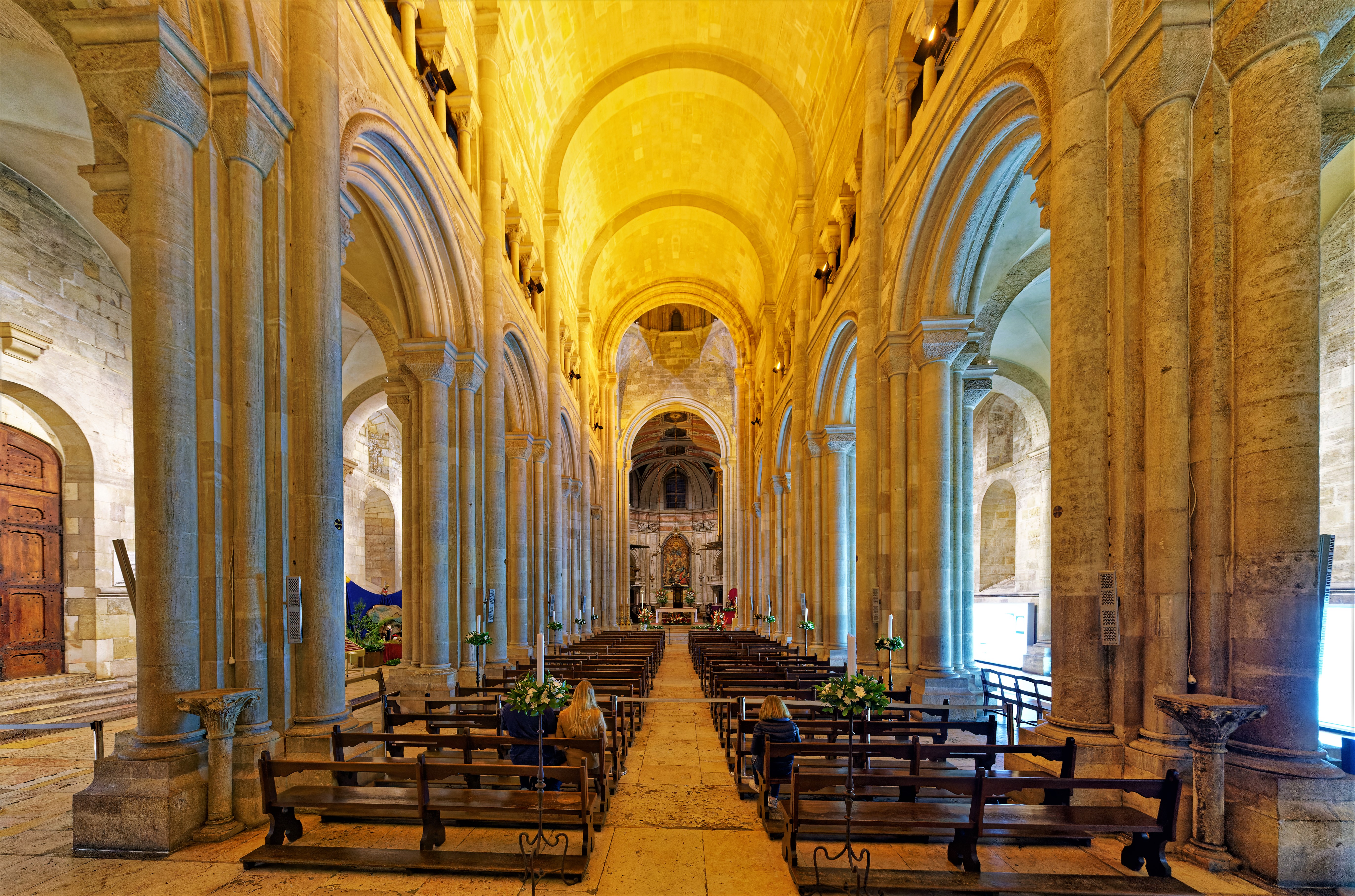
The 1755 earthquake destroyed the Gothic main chapel and the royal pantheon within it, ruined much of the cloister, and collapsed several side chapels. Fire followed the shaking. The Se was rebuilt in pieces over the following centuries, acquiring Baroque, Neoclassical, and Rococo elements. Then, in the early 20th century, restorers stripped away much of the post-earthquake decoration in an effort to return the cathedral to a more "medieval" appearance. The result is a building that defies stylistic categorization, its Romanesque nave leading to a Gothic ambulatory leading to a Baroque sacristy, each era's contribution legible but none dominant. The barrel-vaulted ceiling, the rose window reconstructed from earthquake fragments, the arched triforium gallery above the nave: they add up to a space where the passage of time is not hidden but displayed.
From the Air
Located at 38.710N, 9.133W on a prominent hillside in central Lisbon, between Sao Jorge Castle above and the Baixa below. The twin fortress-like towers of the western facade are distinctive from the air. Nearest airport is Lisbon/Humberto Delgado (LPPT), 7 km north. Best viewed at 2,000-4,000 ft AGL.