Lisse
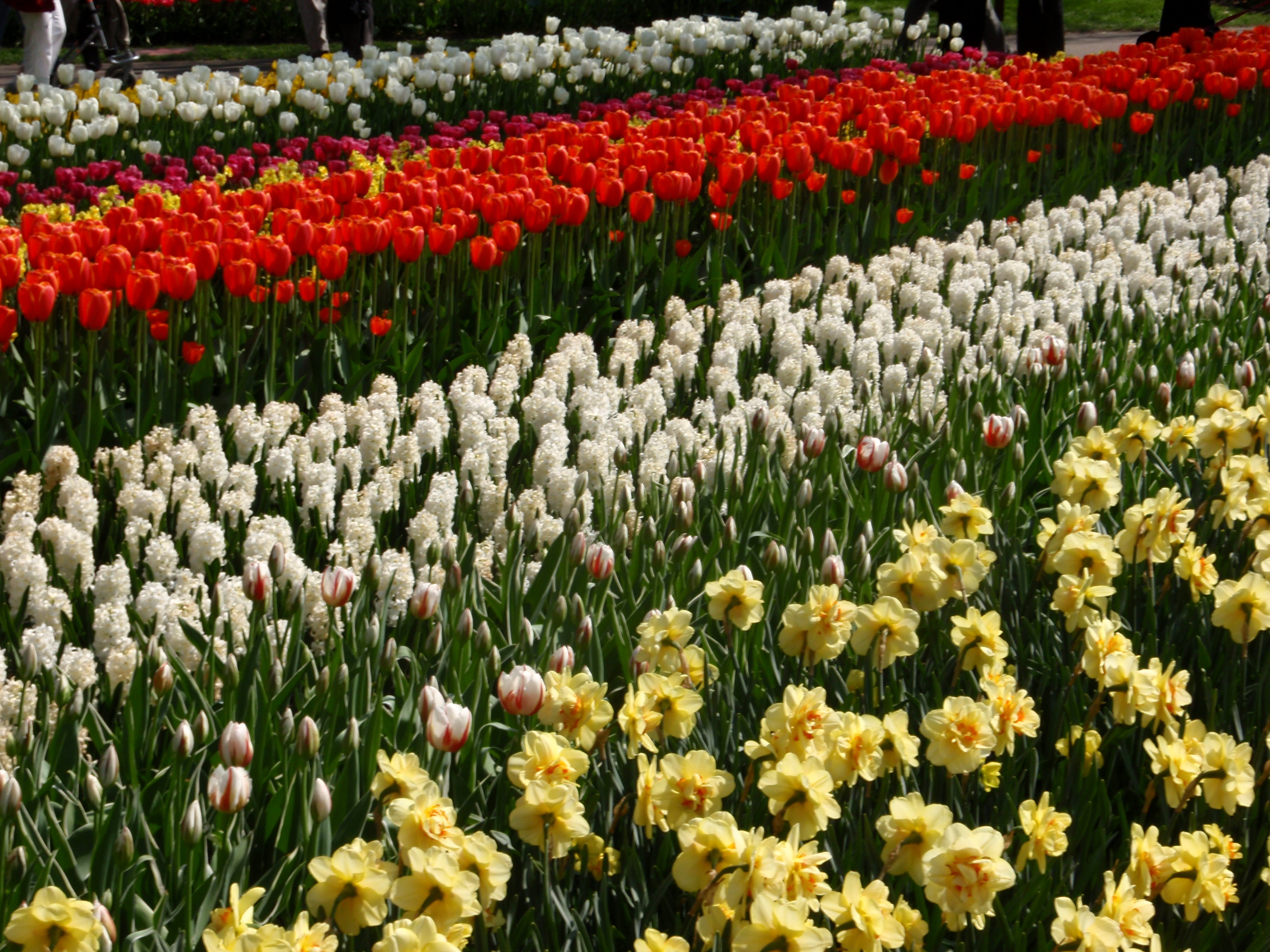
For nine weeks every spring the small South Holland town of Lisse stops being a town and starts being a colour. From mid-March to mid-May the Keukenhof gardens open across 32 hectares of paths, ponds, and beds, and more than 1.4 million visitors walk among the seven million tulips, hyacinths, daffodils, and crocuses planted by hand the previous autumn. The arrangement of the bulbs is decided each year by some of the country's most stubbornly skilled growers. The choice of when to open is decided by the weather. Open too early, the show is grey stems and green spears. Open too late and the tulips have dropped their petals in a single warm afternoon.
Soil That Suits the Bulb
Lisse was first written down in 1198, but for most of the Middle Ages it was an unremarkable village ringed by poverty. Peat cutting and farming kept people fed. What changed everything was the soil itself: a band of sandy ground running between the dune coast and the inland polders, just porous enough for bulbs to thrive without rot. Tulips, hyacinths, and daffodils all became big business here in the 18th and 19th centuries, and the wider region around Lisse acquired a name that doubled as a marketing slogan: the Bollenstreek, the bulb region. By spring the surrounding fields turn into bands of pure colour, visible from any low-flying plane and from the country roads that run north toward Hillegom and south toward Sassenheim.
The Countess and the Kitchen Garden
The Keukenhof's name comes from a kitchen. In the 15th century, the land that is now the park belonged to the gardens and hunting estate of Slot Teylingen, a castle in nearby Teylingen, of which only ruins remain. The castle's most famous resident was Jacqueline, Countess of Hainaut, a noblewoman who lost a Hapsburg power struggle and was kept under guard by her cousin Philip the Good. Local legend has it that the herbs for her kitchen, in Dutch keuken, were gathered in these fields, which became known as the keukenhof, the kitchen courtyard. Whether or not the countess ever ate dill grown here, the name stuck. In 1642 Adriaen Maertensz Block, a captain and commander for the Dutch East India Company in the Maluku Islands, built Keukenhof Castle opposite the modern park's entrance. In 1840 the landscape architects Zocher and son, who also designed Amsterdam's Vondelpark, redrew the castle's grounds. Their layout still shapes the paths visitors walk today.
A Garden Built by Mayors and Growers
The Keukenhof as a flower exhibition is comparatively young. It was the idea of Lisse's mayor and a circle of prominent local bulb growers, who wanted a permanent place to show off Dutch horticulture to the post-war world. They opened the garden in 1949 and admitted the first paying visitors in 1950. Numbers climbed steadily through the 1950s and 60s as Schiphol Airport, just half an hour south, made the Netherlands a stop on the international tourist circuit. Today around a hundred growers, breeders, and product groups stage rotating shows during the nine-week season. The bulbs are not the same week to week. Crocuses appear first, then daffodils and hyacinths, then the great tide of tulips. By the time the final weekend arrives in May, the early beds have already been emptied for next year's planting.
How to Arrive
Most international visitors come the same way: Schiphol airport, train or bus to either Schiphol Plaza or Leiden Centraal, then bus to Keukenhof. Bus 858 from Schiphol Plaza takes 35 minutes. Bus 854 from Leiden takes 25. The Connexxion Combi-ticket bundles the bus and entrance and lets you walk straight past the queue. The local trick is to arrive at 08:00 sharp, when the gates open. The park is quiet then, the light is low and slanting, and the tulips have not yet been pushed open by the warmth of bodies and cameras. By midday the paths are dense; by mid-afternoon the queue at the ticket gate stretches across the parking lot. A second, slower option is the bike. From Leiden it is roughly 15 kilometres on cycle paths through the bulb fields themselves, which during peak bloom are arguably more striking than the formal garden.
Beyond the Famous Park
Lisse itself is small enough to walk in twenty minutes. Its centre, around the Heereweg and a square called 't Vierkant, holds a string of cafes and restaurants that have learned how to feed tour-bus crowds without losing the texture of a real Dutch town. Outside the season, the bulb fields are bare and the Keukenhof closed. The Bollenstreek's other towns, Hillegom, Sassenheim, Noordwijk on the coast, then go quiet. But the region is not the only bulb belt in the country. The largest tulip fields anywhere in the Netherlands are actually in the Noordoostpolder, the reclaimed land of Flevoland, where every spring a signed bicycle route lets the few visitors who know about it pedal between bands of orange, pink, and red. The Bollenstreek is the showpiece. The Noordoostpolder is the engine.
From the Air
Located at 52.2597 degrees north, 4.5611 degrees east in the Bollenstreek bulb region of South Holland, roughly halfway between Haarlem and Leiden. Recommended viewing altitude 1000 to 2500 feet during the bloom season (mid-March through mid-May) when the surrounding fields appear as wide bands of pure colour: yellow daffodils first, then pink hyacinths and the great red, orange, and white waves of tulips. The Keukenhof itself is a 32-hectare green island with formal paths visible from low altitude. The North Sea dunes lie six kilometres west. Nearest airports: Amsterdam Schiphol (EHAM) about 10 nautical miles east-northeast, and Rotterdam The Hague Airport (EHRD) about 21 nautical miles south. Coastal haze can soften the colours after midday in clear weather.