Little Falls, Minnesota
Little Falls keeps its most telling detail in its sister-city relationship. Since 1987, this central Minnesota town of about 9,000 people has been twinned with Le Bourget, France -- the Paris suburb where Charles Lindbergh landed the Spirit of St. Louis on May 21, 1927, completing the first solo nonstop transatlantic flight. Lindbergh grew up on a farm at the edge of town, swimming in the Mississippi River that still bisects downtown Little Falls. The connection between a small river city in Morrison County and one of the defining moments of the twentieth century is not incidental. It is the thread that runs through everything here, from the name of the local airport -- Lindbergh Field -- to the elementary school named after him, to the state park where his restored boyhood home sits on a bluff above the water.
Built on a Drop in the River
The city takes its name from an eleven-foot drop in the Mississippi River -- modest falls that nonetheless generated enough waterpower to drive an economy. James Green, the first permanent settler, built a dam and sawmill by the falls in 1849 to supply lumber for the construction of nearby Fort Ripley. The settlement grew quickly. By the 1880s, railroad expansion and a surge in immigration created a boom. In 1889, Little Falls incorporated as a city. The Weyerhaeuser Corporation, one of the world's largest lumber companies, traces part of its origin here: the Pine Tree Lumber Company built what was reportedly the largest sawmill in the United States on this stretch of the Mississippi in 1891-92, cutting over sixty million board feet of northern pine annually and employing four hundred men during the seven-month sawing season. By 1919, the timber tributary to Little Falls was exhausted and the mill closed, having sawed an estimated 1.3 billion board feet over its lifetime.
From Lumber to Boats to Nobel Prizes
When the lumber and flour milling industries declined, Little Falls reinvented itself. The Larson Boat Company launched in the 1920s and drove the town's industrial identity for nearly a century. But the most remarkable thing about Little Falls may be its per-capita output of notable people. Charles Lindbergh is the headliner, but the list runs deep: Brian Kobilka won the Nobel Prize in Chemistry in 2012; Louise Erdrich, born here, won the National Book Award for fiction; Jim Langer entered the Pro Football Hall of Fame after anchoring the offensive line for the undefeated 1972 Miami Dolphins; Gale Gillingham earned five NFL All-Pro selections with the Green Bay Packers. Fred Zollner, who founded the Fort Wayne Pistons -- now the Detroit Pistons -- grew up here. For a town that has never topped 10,000 residents, the roster is extraordinary.
Murals and Museums Along the Mississippi
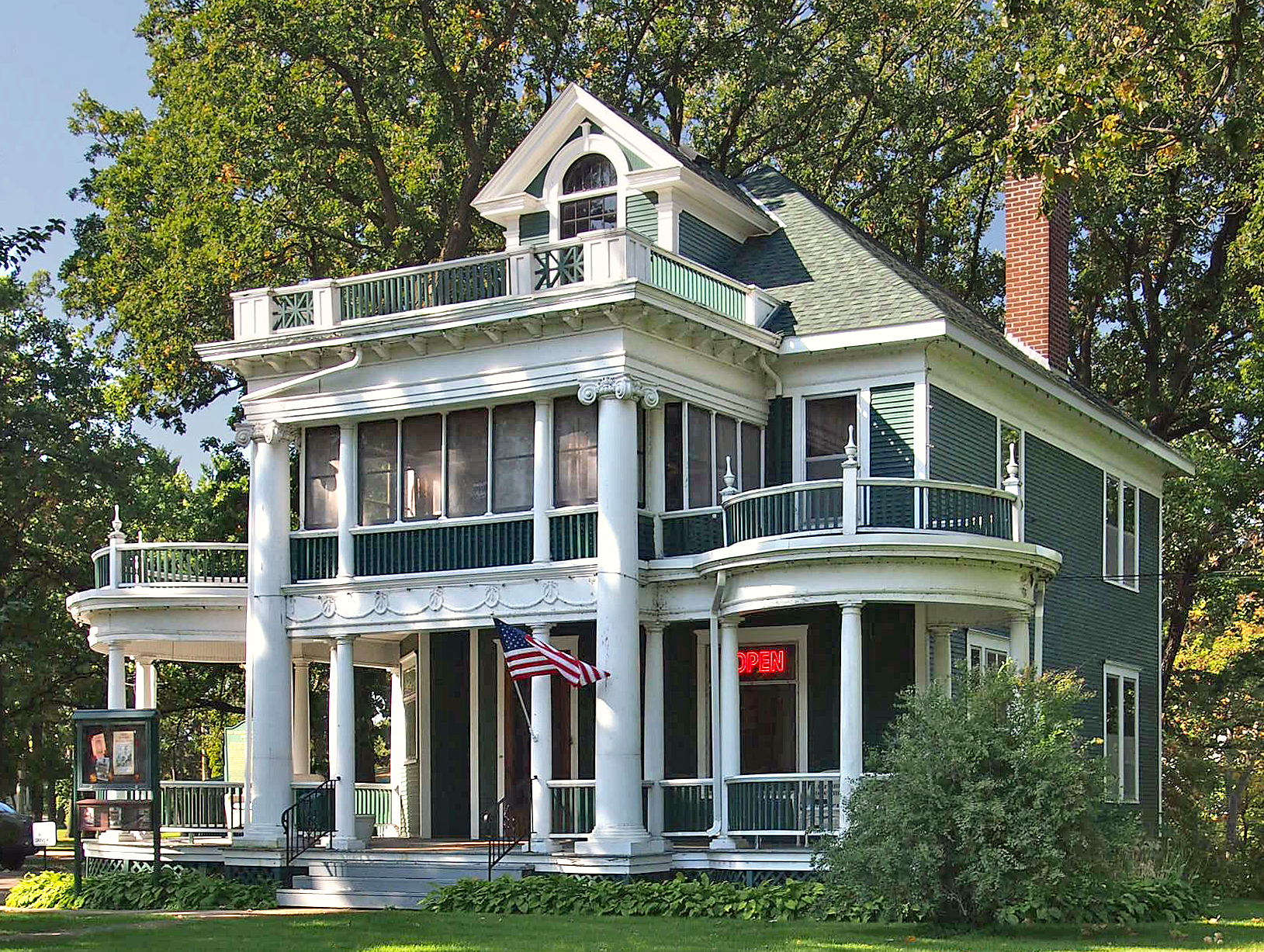
Little Falls packs its history into a walkable downtown on the east bank of the Mississippi. Two large murals by local artist Frank Gosiak on the facade of the old Hennepin Paper Company warehouse depict the logging era and Main Street in the early 1900s. A third Gosiak mural, Door Into the Past, covers a building at Broadway and Second Street. The Charles A. Weyerhaeuser Memorial Museum, operated by the Morrison County Historical Society, sits on the west side of the river above the confluence of Pike Creek, with exhibits, archives, and prairie gardens overlooking the water. The Minnesota Fishing Museum houses over 8,000 artifacts dedicated to the state's freshwater fishing heritage. Pine Grove Primeval Park and Zoo shelters cougars, timber wolves, bears, bison, and elk under old-growth pines on the town's west side. The Burton-Rosenmeier House, built in 1903 in Classical Revival style, now serves as the convention and visitors bureau.
Where the Ojibwe Sent Warriors
Before the lumber barons and the aviators, this stretch of the Mississippi had a longer history. During the Dakota War of 1862, according to the obituary of Ojibwe war chief Mou-zoo-mau-nee, the people of Little Falls asked the Ojibwe for protection. The Ojibwe sent 150 warriors. The land itself is glacial till deposited between 100,000 and 10,000 years ago, shaped by the same ice sheets that carved the thousand lakes surrounding the region. Today, the Little Falls Dam -- successor to a series of dams built since 1849 -- operates as a hydroelectric station generating power for the surrounding area. Amtrak's Empire Builder passes through town on BNSF tracks between Seattle and Chicago, though it does not stop. The city sits near the geographic center of Minnesota, connected by U.S. Highway 10 and State Highways 27 and 371 -- a quiet crossroads that keeps producing people and stories far larger than its population would suggest.
From the Air
Located at 45.986°N, 94.359°W, near the geographic center of Minnesota, straddling the Mississippi River at approximately 1,100 feet MSL. Little Falls/Morrison County Airport-Lindbergh Field (KLXL) lies 3nm northeast of downtown with a 4,004-foot paved runway. Camp Ripley military reservation and Ray S. Miller Army Air Field are approximately 9nm north -- exercise caution regarding military airspace. The city is identifiable from the air by the Mississippi River bisecting the urban area, with the dam and falls visible at the river's narrowing point. St. Cloud Regional Airport (KSTC) is 30nm south-southeast. Best viewed at 3,000-5,000 feet AGL, where the river corridor and surrounding lake-and-forest landscape are clearly visible.