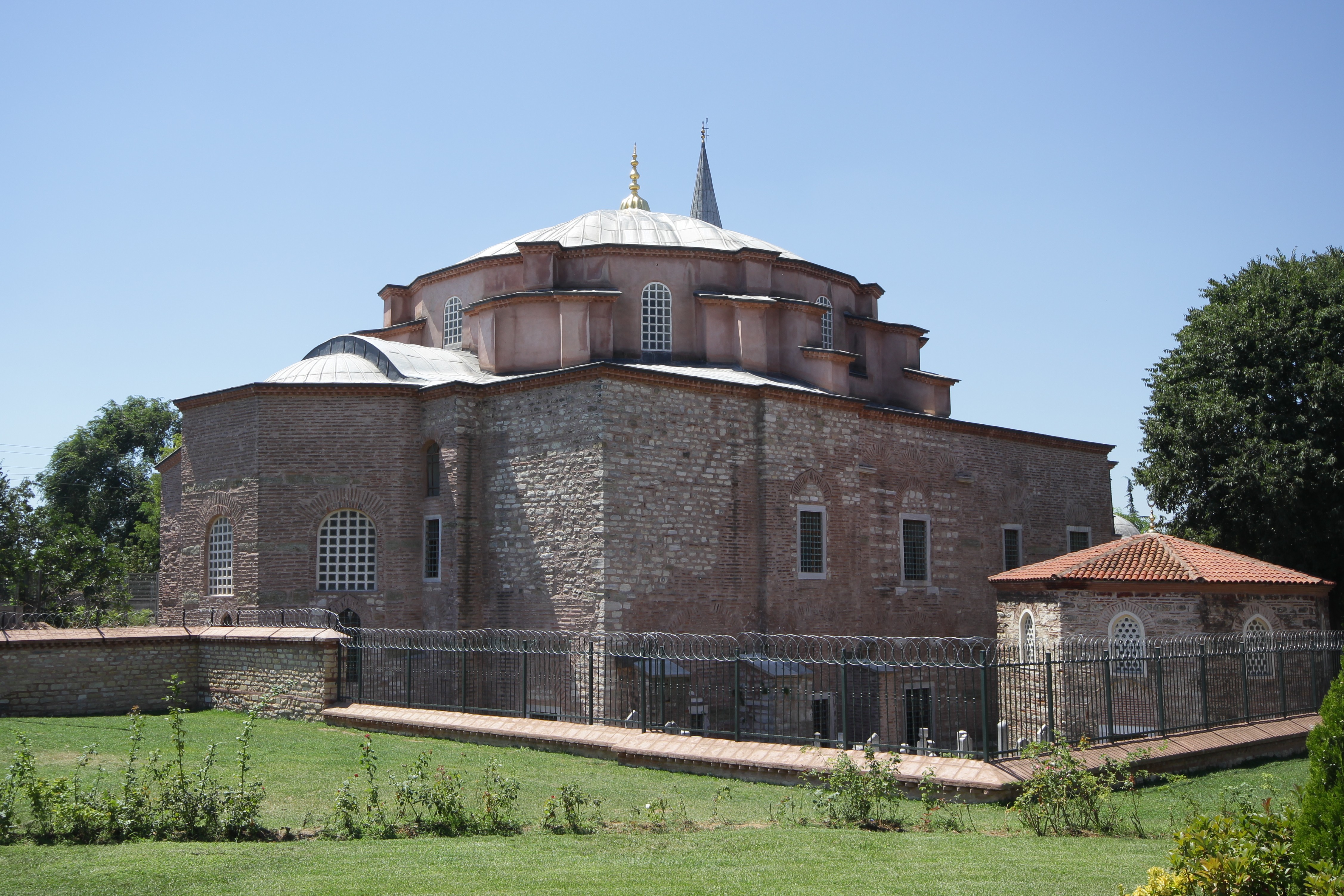
Little Hagia Sophia
Two soldiers from a Roman garrison in northern Syria, executed around 303 for refusing to make sacrifice to Roman gods, gave a Byzantine emperor his life back. According to the legend, the future Justinian I was sentenced to death for plotting against his uncle Justin I when Saints Sergius and Bacchus appeared in a vision and vouched for his innocence. Justin spared the boy. When Justinian became emperor, he kept his promise and built them a church. Construction began in the late 520s, possibly even before the Hagia Sophia, and finished by 536. The Ottomans converted it to a mosque after 1453 and Turks began calling it the Little Hagia Sophia, Küçük Ayasofya, for its resemblance to its more famous neighbor. The name stuck, but the relationship is more interesting than the nickname suggests.
Not a Rehearsal
For a long time, art historians believed the Church of Saints Sergius and Bacchus had been a kind of dress rehearsal for the Hagia Sophia, designed by the same architects, Anthemius of Tralles and Isidore of Miletus, as a smaller test of techniques they would later scale up. That tidy story has been largely abandoned. The architectural details are quite different: Sergius and Bacchus uses an irregular octagon inscribed in a rectangle, with exedrae expanding the central nave on diagonal axes. The Hagia Sophia is a basilica with a great central dome on pendentives, an entirely different geometry. What the buildings share is a certain Justinian-era confidence, an interest in dissolving solid walls into screens of columns and light. The contemporary historian Procopius described Sergius and Bacchus as an adornment to the entire city. The modern historian John Julius Norwich called it second only to the Hagia Sophia itself.
What the Capitals Still Say
Inside, the columns alternate between dark green verd antique and red Synnadic marble, sixteen on the lower storey and eighteen above. Many of the column capitals still bear the carved monograms of Justinian and Empress Theodora. These are dedications, not just decoration: they record who paid for the building and whose names should be remembered with it. Theodora is worth pausing on. Once a circus actress and according to gossip much worse, she became Justinian's empress and political partner, more powerful than most consorts of any Byzantine era. In 536-537, she gave the adjacent Palace of Hormisdas to Monophysite Christians fleeing persecution from the orthodox imperial church. The refugees lived next door to the church Justinian had built for the saints who saved his life. The arrangement was untidy in exactly the way Theodora preferred.
From Church to Mosque
Sergius and Bacchus stood as a Byzantine church for a thousand years. Pope Vigilius hid in it in 551, fleeing imperial soldiers who wanted to arrest him over a theological dispute. The riot that followed forced Justinian to back down. After the Ottoman conquest of 1453, the building remained Christian for another four decades. Around 1497, during the reign of Bayezid II, the chief eunuch of the palace, Hüseyin Ağa, converted it into a mosque. The original mosaics, which contemporary chroniclers said covered the walls along with variegated marble panels, were plastered over. The windows and entrance were modified. The floor level was raised. A minaret was added in 1762, demolished in 1940, and rebuilt in 1956. The Grand Vizier Hacı Ahmet Paşa restored the building in 1740, and earthquake damage from 1648 and 1763 was repaired under Sultan Mahmud II in 1831.
The Building Today
From the outside, Little Hagia Sophia looks modest, a low brick mass topped by a single dome, with a small Muslim cemetery to the north containing the türbe of Hüseyin Ağa, the founder of the mosque. The neighborhood, Kumkapı in the Fatih district, sits between the historic peninsula and the Sea of Marmara, separated from the water by the Sirkeci-Halkalı suburban railway and the coastal Kennedy Avenue. A major restoration in the early 2000s addressed water damage and structural concerns; the building had been on UNESCO's at-risk list. Inside, nothing remains of the original mosaic decoration, but the architecture itself, the play of light through the dome, the rhythm of columns, the surviving capitals with their imperial monograms, is enough. The light at midday catches the deep red of the Synnadic marble and the cool green of the verd antique, and you understand why Procopius wrote what he wrote.
Visiting
The mosque sits a few blocks south of the Hippodrome and the Blue Mosque, in a quiet neighborhood that visitors often skip. Walk down through Kumkapı in the late afternoon and you can have most of the interior to yourself. Standard mosque etiquette applies: shoes off, modest dress, no photography during prayer times. The contrast with the great tourist mosques nearby is instructive. This is a small, working neighborhood mosque that happens to be one of the most important surviving early Byzantine buildings in the world. The patterns of the carved cornice, the entablature with its late-antique vegetal motifs, the column capitals still bearing the names of an emperor and an empress dead for fifteen hundred years, are all here, doing what they were made to do.
From the Air
Located at 41.0028 degrees N, 28.9719 degrees E in the Kumkapı neighborhood of the Fatih district, on the south side of Istanbul's historic peninsula, just inland from the Sea of Marmara. From above, look for the small domed structure between the railway line and the Hippodrome of Constantinople. Istanbul Airport (LTFM) lies 22nm northwest, Sabiha Gökçen (LTFJ) 18nm southeast.