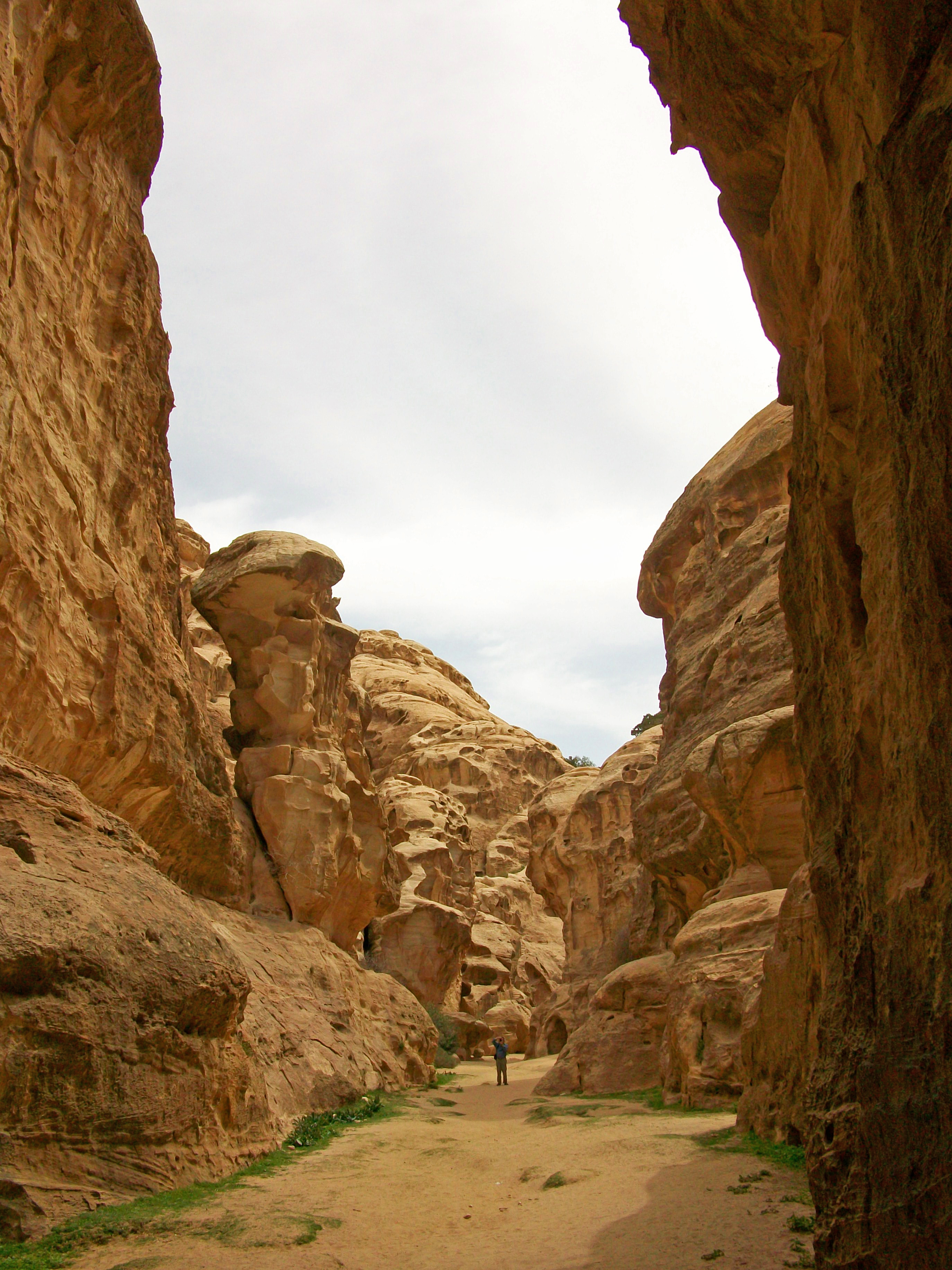
Little Petra
The famed archaeologist Nelson Glueck once tried to visit a painted dining room inside a narrow canyon north of Petra. He turned back because of, in his own words, "the hordes of fleas which infested it." What Glueck missed -- and what would remain hidden beneath centuries of soot and Bedouin campfire smoke until a major restoration project in 2010 -- were ceiling frescoes so vivid and so artistically accomplished that scholars now consider them superior to similar Roman paintings found at Herculaneum. The 2,000-year-old art depicts winged gods harvesting grapes, wild raspberry vines, field bindweed flowers, and local birds, all rendered in a palette that somehow survived two millennia in a sandstone cave.
The Cold Canyon
Siq al-Barid -- literally "the cold canyon" -- sits about 8 kilometers north of Petra's city center, at 1,040 meters above sea level. The site consists of three wider open areas connected by a 450-meter canyon, where sandstone walls have been carved into dwellings, tombs, banqueting halls, and at least one colonnaded triclinium with a projecting pedimented portico. To the east, the Arabian Desert opens into emptiness. To the west, the terrain drops precipitously toward the Jordan Rift Valley, where the Dead Sea lies 400 meters below sea level. This stark geography made the canyon a natural shelter, cool in summer and protected from desert winds -- hence its name.
Suburb of the Silk Road
Archaeologists believe Little Petra was established in the first century CE as a suburb of the Nabataean capital. Its purpose was likely commercial rather than ceremonial: a place to house and entertain visiting traders traveling the incense and Silk Road routes that made Petra wealthy. The more successful merchants may have lived here, hosting their counterparts in rock-cut dining rooms where business mixed with hospitality. The nearby settlement of Beidha, inhabited since the Neolithic era, suggests the location had attracted human settlement for thousands of years before the Nabataeans arrived. After their decline, the canyon fell silent for centuries, visited only by Bedouin nomads who camped among the ruins.
A Dining Room for Dionysus
The Painted Biclinium -- a rock-cut dining room with two stone benches flanking its entrance -- is Little Petra's masterpiece. Rock-cut stairs lead up from the canyon floor to a platform, then through two connected chambers. The outer room features stucco decoration mimicking architectural elements in a style reminiscent of Pompeian wall painting. But it is the inner chamber that astonishes. Its vaulted ceiling blooms with intertwining grape vines, flowers, birds, and insects. Small winged gods called erotes climb ladders, carry baskets of harvested grapes, wield pruning hooks, and defend the vines from scavenging birds with bows and spears. The scene is an elaborate homage to Dionysus and the culture of wine that flourished in Petra's fertile northern hinterland, where large-scale viticulture thrived alongside grain and olive cultivation.
Recovered from Smoke and Time
The frescoes were first photographed in 1906, but smoke damage and Arabic graffiti had obscured much of the imagery. For a century, scholars relied on those early photographs and could identify only the figures of Eros and Pan. Then, from 2006 to 2010, the Petra National Trust and London's Courtauld Institute of Art carried out an extensive conservation project that transformed understanding of the site. Cleaning revealed new imagery, including a figure interpreted as a Romanized Egyptian goddess, and made clear the vibrancy of color and style that had been hidden beneath grime. Radiocarbon dating of plaster and mortar by Yarmouk University placed the paintings between 40 BCE and 25 CE. These are not only the sole surviving example of interior Nabataean figurative painting in situ -- they represent one of the most complete large-scale examples of Hellenistic painting anywhere in the world.
Walking to the Monastery
Today, Little Petra draws visitors seeking a quieter counterpart to the main site. Admission is free, the crowds are thinner, and the Painted House has no equivalent anywhere in Petra proper. From the end of the canyon, a 6-kilometer hiking trail winds south through the desert landscape to Ad-Deyr, Petra's massive Monastery. The route is obvious in many places but not formally marked, and guides are recommended -- nights in the region grow cold quickly, and entering Petra without paying admission at the main gate is forbidden. The trail connects two expressions of the same civilization: at one end, an intimate cave where merchants dined beneath paintings of grape-harvesting gods; at the other, the largest carved monument in the ancient city, a structure dedicated to the deified Nabataean king Obodas I.
From the Air
Located at 30.375N, 35.451E, approximately 8 km north of Petra's main entrance. Best viewed at 3,000-5,000 feet AGL. The narrow canyon is difficult to spot from the air but the surrounding terrain of pale sandstone desert is distinctive. Nearest airport is OJMF (Ma'an Airport), about 30 nm southeast. Elevation approximately 1,040m above sea level. The Jordan Rift Valley is visible to the west.