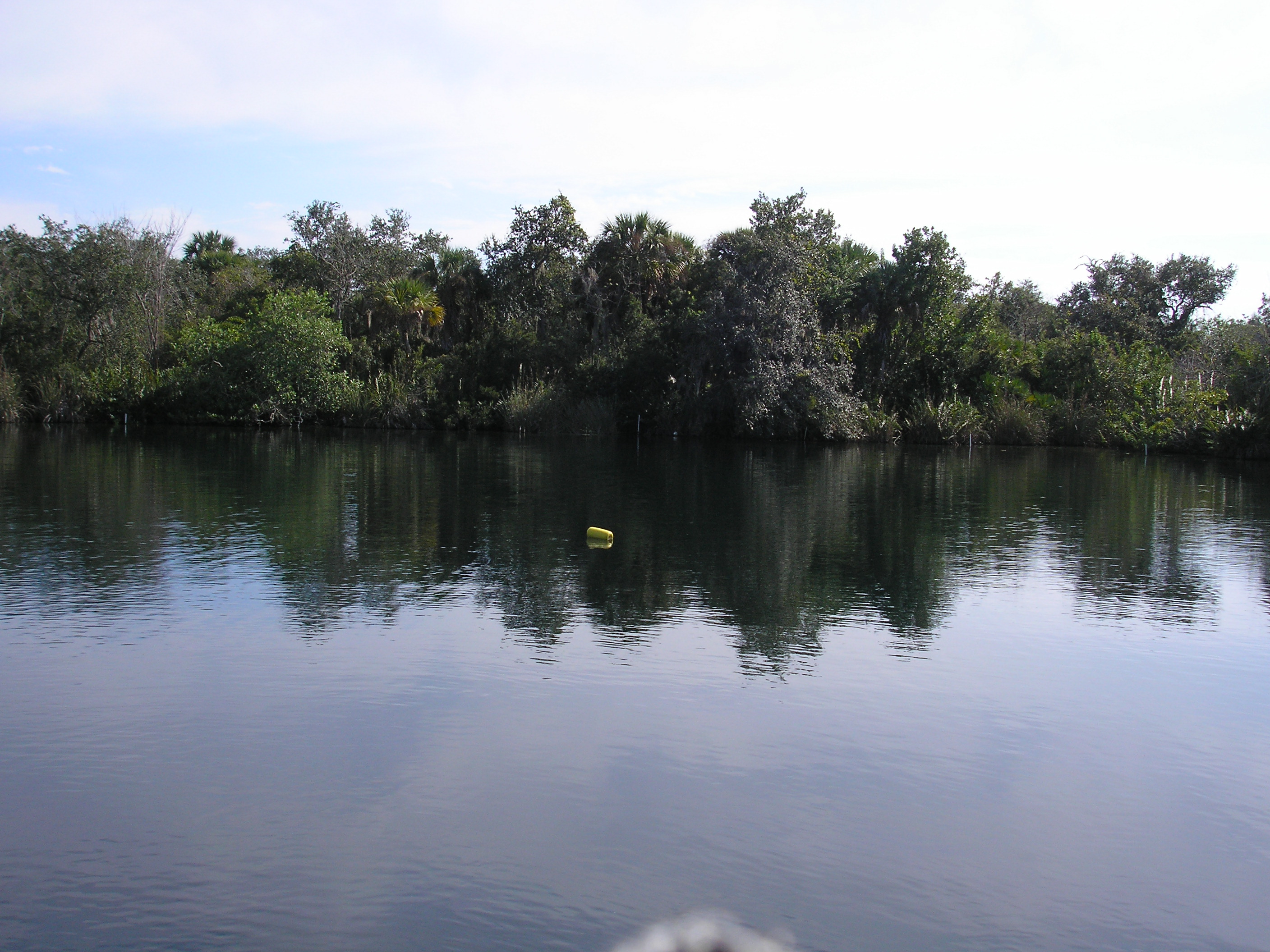
Little Salt Spring
For most of its modern history, the locals thought it was just a shallow pond. A quiet circle of dark water set in the flat scrubland of North Port, Florida, unremarkable among the hundreds of ponds and wetlands that dot Sarasota County. Then, in 1959, SCUBA divers William Royal and Eugenie Clark slipped beneath the surface and discovered something astonishing: the pond was a sinkhole, a vertical shaft plunging deep into the Florida limestone, its walls lined with ledges, its depths choked with oxygen-depleted water that had been preserving secrets for over twelve thousand years.
The Hidden Cenote
Little Salt Spring is a product of Florida's karst topography, the same geological process that created the cenotes of Mexico's Yucatan Peninsula. Groundwater dissolves the underlying limestone over millennia, and the ceiling eventually collapses, leaving a funnel-shaped void that fills with water. The surface pond is shallow, but the central shaft drops vertically into an inverted cone. Deep vents at the bottom feed oxygen-depleted groundwater into the basin, creating an anoxic environment that acts as a natural preservation chamber. Organic materials that would normally decay in decades survive here for thousands of years. It is classified as a third magnitude spring, and the basin around it extends into a peat-filled slough where the most extraordinary discoveries have been made.
Dinner from the Ice Age
The most famous artifact recovered from Little Salt Spring is also the most vivid. In the 1970s, researchers found the overturned shell of an extinct giant land tortoise on one of the cenote's submerged ledges. A wooden stake had been driven between the carapace and the plastron, and evidence of a fire was found beneath the shell. Someone, over twelve thousand years ago, had flipped this enormous tortoise onto its back, pinned it, and cooked it in its own shell. The radiocarbon date for the wooden stake came back at 12,030 years before present. A bone from the tortoise itself dated even older, to 13,450 years ago. This places human activity at Little Salt Spring among the earliest confirmed evidence of people in the Americas, contemporary with the final centuries of the last Ice Age, when sea levels were roughly 100 meters lower than today and the Florida water table had drawn down far enough that these ledges were dry land.
A Cemetery in the Peat
The slough extending away from the spring held another revelation. Hundreds of human burials dating from 5,200 to 6,800 years ago have been discovered in the soft, moist peat. The anoxic conditions preserved not just bones but, in many skulls, brain matter itself, a phenomenon also documented at the Windover Archaeological Site in Brevard County. These burials represent a sustained mortuary tradition spanning over 1,600 years, suggesting that Little Salt Spring held deep cultural significance for the people who lived near it during the middle Archaic period. Large numbers of additional human bones have been recovered from the spring itself, though many were not collected under controlled archaeological conditions, complicating the scientific record.
Science and Survival
The University of Miami purchased Little Salt Spring in 1980, and the Rosenstiel School of Marine, Atmospheric, and Earth Science has conducted research there ever since. The site was added to the National Register of Historic Places on July 10, 1979, recognizing its extraordinary archaeological value. But maintaining a remote underwater research site proved expensive. In 2013, the university considered selling the property to Sarasota County Government after funding cuts threatened the site's upkeep and facilities. The sale did not go through, and the University of Miami retains ownership, though the site's long-term future remains a question of resources and will. Little Salt Spring is not open to the public, and its treasures remain largely hidden beneath that deceptively ordinary surface.
Time Capsule Beneath the Surface
What makes Little Salt Spring irreplaceable is the combination of human history and natural preservation. The anoxic waters froze time in place: wooden tools, animal bones, human remains, and the organic traces of daily life that vanish at almost every other archaeological site. Twelve thousand years ago, when the people who cooked that tortoise were alive, Florida looked nothing like it does today. The coastline was miles farther out, the climate was cooler, and megafauna still roamed the landscape. Little Salt Spring is a window into that world, sealed by chemistry and geology, waiting in the dark water beneath a pond that most people would walk right past.
From the Air
Located at 27.075N, 82.233W in North Port, Sarasota County, Florida. The spring appears as a small dark circular pond surrounded by vegetation, easy to miss from altitude. Best viewed at 1,000-2,000 ft AGL. Nearest airports: Punta Gorda Airport (KPGD) approximately 20 nm south, Venice Municipal Airport (KVNC) approximately 12 nm northwest, and Sarasota-Bradenton International Airport (KSRQ) approximately 25 nm north. The site sits in flat residential and scrubland terrain east of Interstate 75.