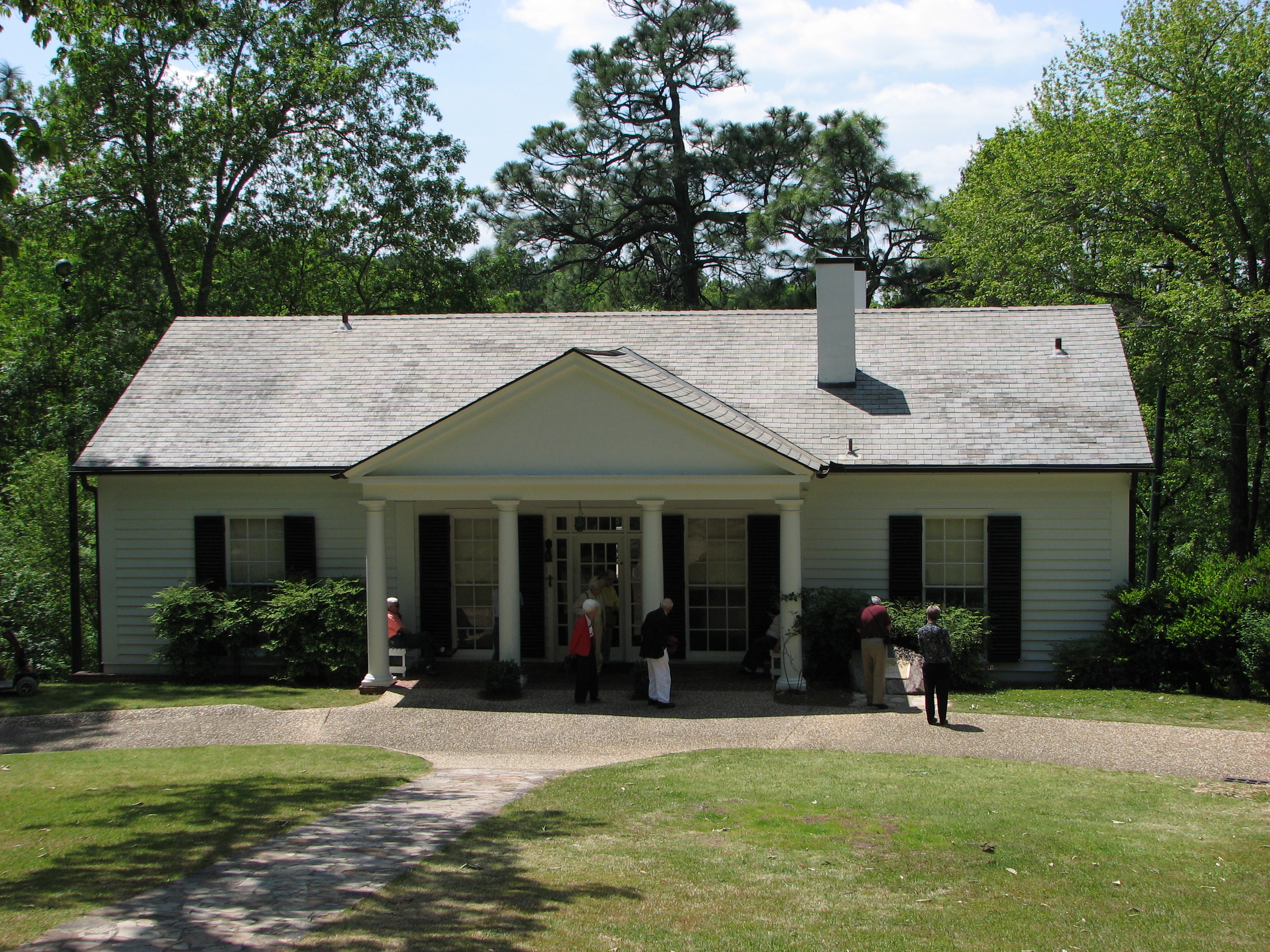
Little White House
The portrait was almost done. On the afternoon of April 12, 1945, artist Elizabeth Shoumatoff was adding watercolor to her canvas while Franklin Delano Roosevelt sat in a leather chair at his Pine Mountain retreat, reviewing documents. At 1:15 p.m., the president pressed his hand to his temple and said, "I have a terrific headache." He slumped forward, unconscious. Two hours later, the 32nd president of the United States was dead from a massive cerebral hemorrhage, three months into his unprecedented fourth term. The watercolor still sits on its easel in the Little White House, forever unfinished -- the most famous incomplete painting in American history, frozen at the exact moment a presidency ended.
The Waters That Drew a President
Roosevelt first arrived in Warm Springs, Georgia, in October 1924, a 42-year-old former vice-presidential candidate whose political future seemed destroyed by polio. Diagnosed in 1921 at age 39, he had tried every treatment available. Then he heard about a remote resort town in Meriwether County where naturally heated springs pushed 914 gallons of 88-degree water per minute from deep within Pine Mountain. The warm, mineral-rich water allowed him to exercise his withered legs with a buoyancy he found nowhere else. Roosevelt was so taken with the place that he bought the entire resort and its surrounding farm in 1927, establishing the Georgia Warm Springs Foundation for polio rehabilitation. The ramshackle resort became a beacon of hope for polio patients from across the country.
A Cottage Built for Power
After winning the presidency in 1932, Roosevelt ordered a six-room Colonial Revival cottage built of Georgia pine on the property. The house was deliberately modest -- three bedrooms, a living room, an entrance hall, and a kitchen -- but its simplicity was deceptive. From this unassuming structure, Roosevelt shaped the New Deal, entertained foreign dignitaries, and even attempted to reshape Georgia's political landscape, most notably in 1938 when he tried to unseat Senator Walter George for defying his policies. Roosevelt made 16 presidential trips to Warm Springs, each lasting two to three weeks. The journey from Washington took a full day by train, but the president considered the refuge worth every hour of travel.
The Last Visit
Roosevelt arrived at Warm Springs on March 30, 1945, exhausted and visibly diminished. Observers noted he looked "ghastly," and his trademark cheerful waves to townspeople were weak, almost perfunctory. For the first time, he avoided the swimming pool that had brought him to this place two decades earlier. The war in Europe was weeks from ending, but the toll of leading a nation through the Great Depression and a world war had ravaged his body. On April 12, while Shoumatoff painted and his cousins prepared lunch in the kitchen, the stroke came. His personal physician, Dr. Howard Bruenn, could do nothing. Roosevelt died at 3:35 p.m. in the bedroom of the cottage he loved most.
Two Portraits, One Legacy
The unfinished portrait remains the museum's most haunting artifact. Shoumatoff had captured Roosevelt in his navy cape, his expression composed and presidential. After his death, she completed a second version from sketches and memory -- identical in every detail except that Roosevelt's red tie became blue. Both paintings now hang side by side in the Little White House, which opened as a public museum in 1948. The cottage preserves an eerie sense of interrupted life: Roosevelt's desk, his belongings, the rooms exactly as they were that April afternoon. Later presidents recognized the site's symbolic power -- John F. Kennedy campaigned there in 1960, and Jimmy Carter launched his 1976 presidential bid from the property.
A Small Town's Enormous Footprint
Warm Springs itself was transformed by Roosevelt's presence. The town's population swelled from 400 to 608 between 1930 and 1940, then fell back after his death. But the legacy endures. Georgia Hall, built in 1933, still stands as the main building of what became the Roosevelt Warm Springs Institute for Rehabilitation. The Polio Hall of Fame on Founder's Hall features sculptured busts of fifteen scientists and two laymen who advanced the fight against poliomyelitis. Today the Little White House sits quietly on Pine Mountain, a six-room cottage made of local timber that held the weight of a wartime presidency and the final heartbeat of the man who guided America through its darkest century.
From the Air
Located at 32.881N, 84.688W on Pine Mountain in Meriwether County, Georgia. The Little White House complex is nestled in wooded terrain and may be difficult to spot from altitude; look for the cleared grounds and museum buildings on the southern slope of Pine Mountain. Best viewed below 3,000 feet AGL. The nearest airport is Roosevelt Memorial Airport (5A9), a small public-use facility just east of Warm Springs. Columbus Metropolitan Airport (KCSG) is approximately 35 nm to the southwest. The Flint River corridor provides a good visual reference when approaching from the south.