Liugong Island
Three families resettled this island in 1690: the Cong, the Zou, and the Jiang. They could not have imagined that within two centuries, the quiet wooded island at the mouth of Weihai Bay would become the nerve center of the most powerful fleet in East Asia -- or that the fleet would be annihilated here, changing the balance of power across the Pacific for the next half-century. Liugong Island is where China's first modern navy was born, where it made its last stand, and where its memory is kept.
Centuries of Coming and Going
Archaeological evidence suggests people have lived on Liugong since at least the Warring States period, more than two thousand years ago. During the Han dynasty, members of the Liu family settled here, giving the island its name. But Liugong's history is one of repeated abandonment and return. Pirates drove everyone off during the Ming dynasty. A rebel force sheltered here during the reign of the Jiajing Emperor and was quickly crushed. Settlers returned under the Wanli Emperor, guarded by troops against pirate raids, and shipping between northern and southern China brought the island a measure of prosperity. Then an epidemic emptied the island again in 1663. Twenty-seven years passed before anyone came back.
The Beiyang Fleet's Fortress
Everything changed during the reign of the Guangxu Emperor, when Viceroy Li Hongzhang chose Liugong Island as headquarters for China's first modern navy, the Beiyang Fleet. A telegraph center, naval academy, and fleet command post rose on the island's slopes. Over a hundred cannons were emplaced around Weihai harbor and on the islands of Liugong and Ri. Admiral Ding Ruchang took command on 14 September 1888 and made the island his official residence. Between 1889 and 1891, workers built a T-shaped 'iron dock' to service the fleet's warships. Eight of fifteen modern ships purchased from Britain and Germany were assigned to the Beiyang Fleet. For a brief moment, this small island -- just 3.15 square kilometers of black pine forest and rocky hills -- was the seat of the strongest naval power in East Asia.
Where a Navy Died
That moment ended in the spring of 1895. Following the devastating Battle of the Yalu River in September 1894, the remnants of the Beiyang Fleet retreated to Weihaiwei. Japanese forces attacked by land and sea in late January 1895. Torpedo boats penetrated the harbor at night, sinking warships at their moorings. Coastal fortifications fell one by one. Trapped behind his island fortress with a shattered fleet, Admiral Ding Ruchang surrendered and then took his own life rather than face the consequences. Japanese forces occupied Liugong Island, and with it, the infrastructure of a navy that had taken decades and vast sums of foreign currency to build.
Pine Trees and Pandas
More than half of Liugong's area -- about 1.8 square kilometers -- is now covered by forest, predominantly black pine, protected as a national forestry park. Qiding Mountain, the highest point at 153 meters, offers views of Weihai Bay from its summit, with cliffs dropping away to the north and gentler slopes falling toward the south. The island hosts a small zoo, which includes two pandas -- gifts from the Taiwanese government -- and other animals. Tourists reach Liugong only by boat from the Weihai waterfront, crossing the same waters where ironclads once anchored.
A Memorial That Teaches
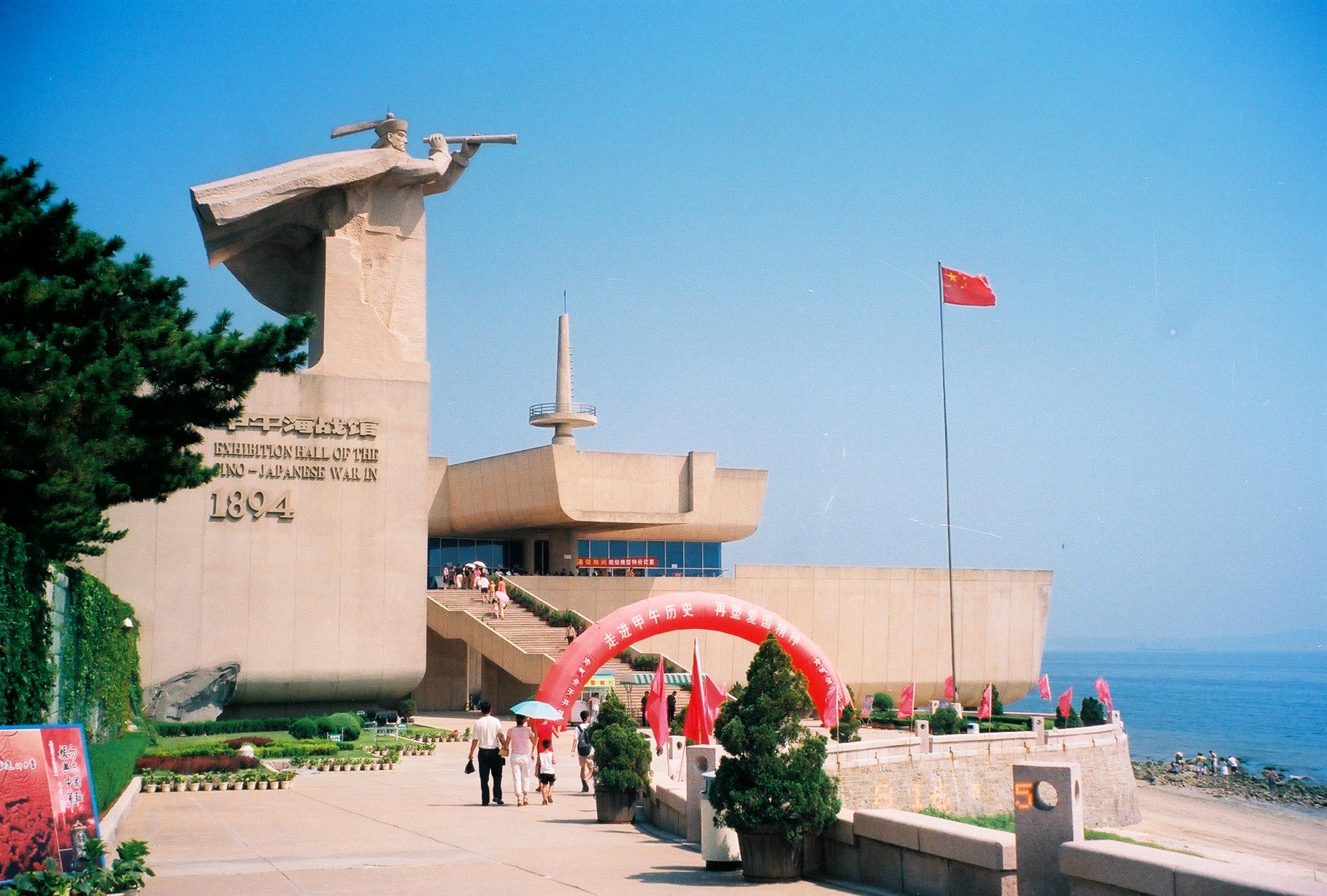
The island's primary draw is the museum documenting the First Sino-Japanese War and a memorial to the Beiyang Fleet. Walking among the restored naval buildings, visitors encounter the story of a modernization effort that came too late and was undercut by imperial politics. The museum does not flinch from the uncomfortable details: the diverted funds, the poor discipline, the technological gap that widened as China's fleet aged while Japan's grew. Naval training grounds still occupy part of the island, a reminder that Liugong retains its military significance. In the former British naval cemetery -- Weihaiwei was leased to Britain from 1898 to 1930 -- researchers have found gravestones bearing the names of sailors from HMS Poseidon, a British submarine that sank nearby in 1931 and was secretly salvaged by China in 1972.
From the Air
Located at 37.51N, 122.19E at the mouth of Weihai Bay, Shandong Peninsula, China. Liugong Island is clearly visible as a distinct forested landmass approximately 2 km from the mainland. Qiding Mountain (153 m) is the prominent high point. Nearest airport: Weihai Dashuibo Airport (ZSWH), approximately 30 km southwest. Best viewed at 3,000-5,000 ft on approach from the northeast.