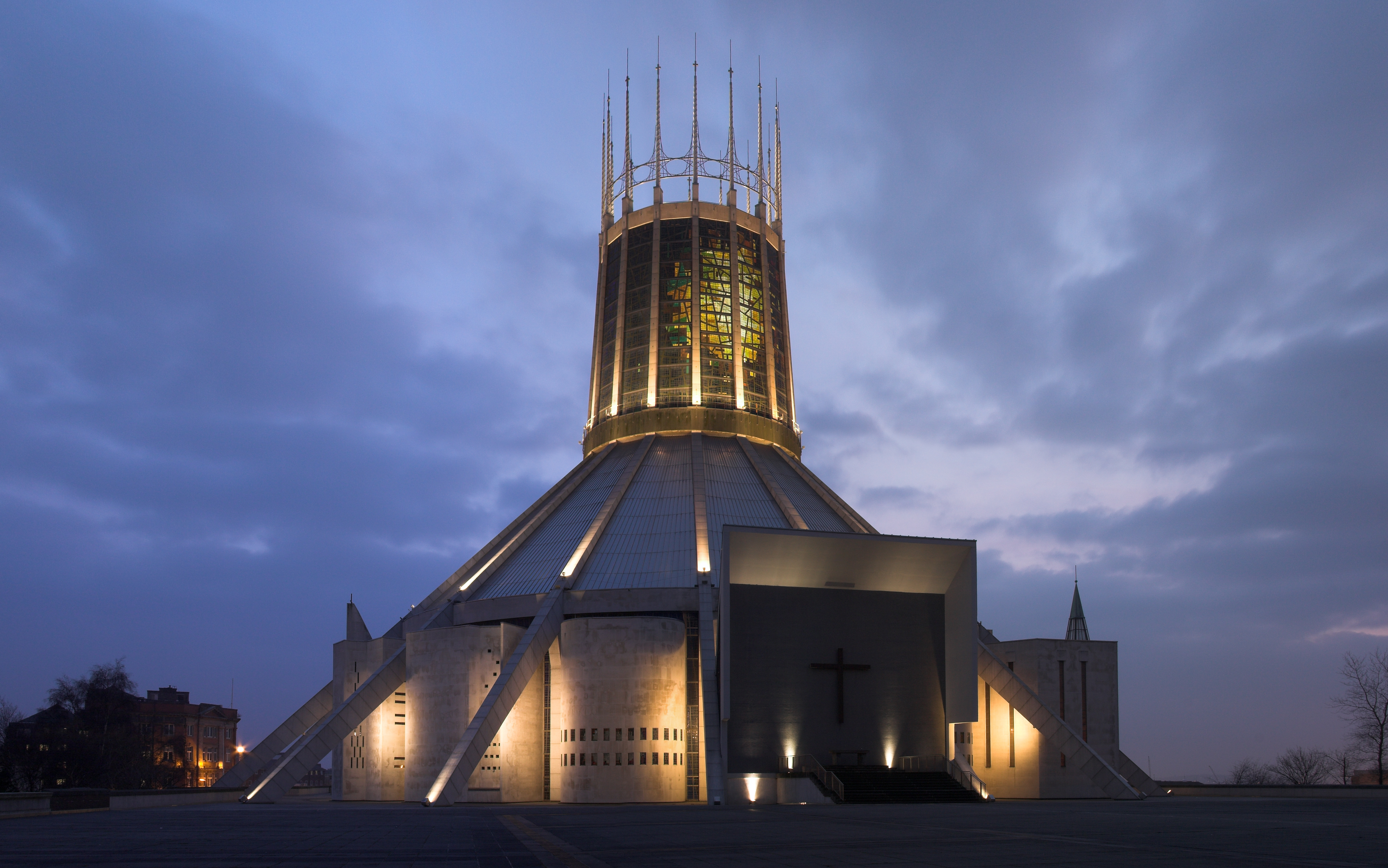
Liverpool Metropolitan Cathedral
Beneath Liverpool's Metropolitan Cathedral of Christ the King lies a crypt that belongs to a completely different building. Edwin Lutyens designed it in the 1930s as the foundation for what would have been the second-largest church in the world, with a dome wider than St. Peter's in Rome. The money ran out. A second architect tried. His plans were rejected. Finally, Frederick Gibberd won a worldwide competition in 1959 with something nobody expected: a circular concrete tent topped by a sixteen-sided lantern of stained glass. Locals, with characteristic Liverpool directness, named it Paddy's Wigwam.
The Cathedral That Never Was
The story begins with famine. During the Great Irish Famine of 1845 to 1852, Liverpool's Catholic population surged as half a million Irish fled to England, many passing through the port on their way to North America while others stayed. Bishop Alexander Goss saw the need for a cathedral and in 1853 commissioned Edward Welby Pugin to build one. Only the Lady Chapel was completed before funds were diverted to educating Catholic children. That chapel served as a parish church until its demolition in the 1980s. Then came Lutyens. His 1933 design was staggering in ambition: a dome 168 feet in diameter, dwarfing St. Peter's Basilica at 137 feet. Construction began but World War II and costs that ballooned from three million to twenty-seven million pounds killed the project. Only the crypt was finished by 1958.
A Crown of Light
Gibberd's winning design solved two problems elegantly. The competition required seating for three thousand worshippers, all with a direct line of sight to the altar, and incorporation of the existing Lutyens crypt. His answer was a circle with the altar at its centre, raised on a platform formed by the crypt's roof. Rising above the altar, the Crown of Glass is the building's glory. Designed by John Piper and Patrick Reyntiens between 1965 and 1967, the lantern is approximately 22.5 metres high with a glazed area of roughly 1,120 square metres, the largest single commission the pair ever undertook. They invented a new technique for the job, cementing dalle de verre glass components with epoxy resin within thin concrete ribs. The abstract design was inspired by Dante's Paradiso, his description of the Holy Trinity as "three great eyes of different colours each one winking at the other," rendered in shards of blue, green, red, and yellow.
Art in Every Corner
The cathedral is a gallery of mid-century British art. Elisabeth Frink created the bronze crucifix above the altar. Sean Rice designed the metal Stations of the Cross and a lectern featuring two entwined eagles. Ceri Richards contributed the reredos and stained glass in the Blessed Sacrament Chapel. A mosaic of the Pentecost by Hungarian artist Georg Mayer-Marton was rescued from a demolished church in Netherton. The organ, built by J. W. Walker and Sons, was completed just two days before the cathedral's opening in 1967. Gibberd designed its casework himself, arranging zinc pipes and brass trumpets en chamade against the concrete pillars. Even the white marble altar tells a story of unexpected connection: it was quarried in Skopje, North Macedonia.
Built Fast, Fixed Slow
Speed and economy left their marks. The cathedral leaked. Mosaic tiles on the exterior proved impossible to repair and were replaced with glass-reinforced plastic, giving the building a thicker appearance than Gibberd intended. The aluminium lantern was replaced with stainless steel during 1990s repairs. But the building endures, and its uses have expanded in ways nobody predicted. The Lutyens crypt hosts the annual Liverpool Beer Festival and serves as an examination hall for University of Liverpool students. In 2025, the cathedral's listing was upgraded to Grade I, recognizing it as a building of the highest architectural significance. The church that took three attempts to build has become, against all odds, one of England's most distinctive sacred spaces.
From the Air
Located at 53.405N, 2.969W on Brownlow Hill in Liverpool. The circular form with its distinctive conical crown is unmistakable from the air. At the opposite end of Hope Street stands the Anglican Cathedral, making the pair easy to spot together. Nearest airport: Liverpool John Lennon Airport (EGGP), approximately 7nm southeast. Best viewed from 2,000-4,000ft.