Liwonde National Park
The Shire River -- pronounced "shir-ee," not like the hobbit homeland -- is the lifeline of Liwonde National Park. Everything here orients toward the water. In the dry season, when the surrounding bush turns brown and brittle, elephants, hippos, and crocodiles gather along the river's banks in concentrations that would be remarkable anywhere in southern Africa. That this happens in Malawi, a country not typically associated with big-game safari, is one of the quieter surprises of the continent.
A River Park
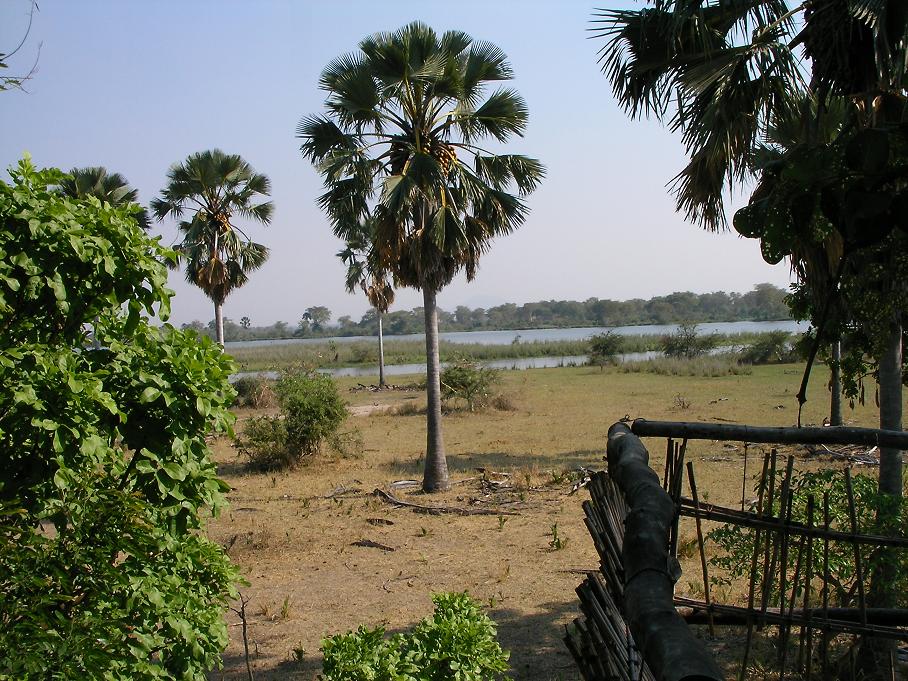
Liwonde occupies the east bank of the Shire River at the southern end of Lake Malombe. The park is long, thin, and flat -- a corridor of mopane woodland and riverine habitat stretching along the water, with hills only toward its southern tip. The landscape is dominated by mopane trees, named from a Tswana word referring to the butterfly shape of their leaves. Scattered among them are baobabs, their swollen trunks storing water against the long dry months, and fever trees with their distinctive yellow-green bark. The river itself is the park's organizing principle. During the dry season, animals that have dispersed into the bush during the rains converge on the Shire to drink, creating a wildlife spectacle that intensifies as the months without rain accumulate. This is one of the hottest, most humid corners of Malawi, and in the shimmering midday heat, the river is the only cool thing in the landscape.
The Animals at the Water's Edge
The cast of wildlife is impressive for a park of Liwonde's modest size. Elephants are the headline act, moving through the mopane woodland in herds and gathering at the river in the golden light of late afternoon. Hippos occupy the deeper pools, submerged to their eyes during the day, then emerging at night to graze -- a habit that makes after-dark walks around the lodges a genuinely hazardous activity. Crocodiles sun themselves on the banks. Zebra, impala, waterbuck, bushbuck, greater kudu, warthog, baboons, vervet monkeys, and mongoose fill out the mammal roster. Black rhinos are present but almost never seen. Lions have taken up residence in the park, though sightings remain rare. The birds, however, are Liwonde's equal draw. The African Fish Eagle, Malawi's national bird, is a common sight along the river, and the park's avian diversity draws serious birders from across the region.
Getting There Is Part of the Story
Reaching Liwonde's lodges requires a certain commitment to the journey. The main camp, Mvuu, sits on the opposite bank of the Shire from the access roads, reachable by boat from Liwonde town or by driving to the village of Ulongwe, then fourteen kilometres along dirt roads to the river's edge, where another boat carries you across. Bicycle taxis can be arranged from Ulongwe, though they are, as one travel guide understates it, "not for the faint-hearted." A southern entrance near Liwonde town leads to Bushman's Baobabs, about three kilometres inside the park, but the thirty-kilometre drive from there to Mvuu requires local advice and a capable vehicle. Walking into the park is not permitted, for reasons that become obvious when you learn what grazes the lawns at night. The MV Mangunda, a cruise boat based at Villa Liwonde, offers daily and overnight trips into the park by water -- a way of arriving that suits a place where the river matters more than the road.
Sunset on the Shire
The safari experience at Liwonde runs on three tracks. Game drives in open 4x4 vehicles cover the mopane woodland, where elephants browse and kudu watch from the tree line. River safaris in covered boats push quietly along the Shire, bringing visitors close to hippos, elephants drinking at the bank, and birdlife that is easiest to observe from the water. Bush walks with armed rangers offer something different entirely -- fewer large mammals up close, but an intimacy with the smaller textures of the bush that vehicles and boats miss. The guides carry drinks in a cooler on the boat safaris, and watching the sunset over the Shire with a cold Carlsberg or the local Kuche Kuche beer is one of those travel moments that lodges itself permanently in memory. At Bushman's Baobabs, the kitchen serves three-course meals that are a welcome change from nshima, the crushed maize that accompanies most meals in Malawi, and the prices remain reasonable by any standard.
From the Air
Located at 14.83°S, 35.33°E in southern Malawi. The park stretches along the east bank of the Shire River at the southern end of Lake Malombe, both clearly visible from altitude. The terrain is flat with mopane woodland, making the river corridor easy to identify from the air. Nearest airports include Chileka International (FWCL) near Blantyre to the south and Kamuzu International (FWKI) in Lilongwe to the north. The area is low-lying and hot; expect haze and thermals, particularly in the dry season.