Llandaff Cathedral
In January 1941, a German parachute mine detonated beside the south aisle of Llandaff Cathedral. The blast collapsed the nave roof and shattered every window. For the second time in its long history, the cathedral lay in ruins -- but this time, the rebuilding would bring something no medieval mason could have imagined. Architect George Pace designed a concrete parabolic arch to span the nave, and on it the sculptor Jacob Epstein mounted Majestas, a towering aluminium figure of Christ in Glory. The result is one of the most arresting juxtapositions in any British church: 12th-century walls framing a 20th-century vision of the divine.
Nine Centuries of Building and Collapse
The original pre-Norman church recorded in the 12th-century Book of Llandaff measured just 28 feet long, 15 feet wide, and 20 feet high. Bishop Urban ordered a grander structure in the 1120s, but it was largely replaced between 1193 and 1218 during the episcopate of Henry of Abergavenny. The western nave and front from this period survive today, their craftsmanship bearing a clear resemblance to Glastonbury Abbey and Wells Cathedral -- evidence that leading Somerset masons were brought across the Bristol Channel for the work. Then began centuries of decline. By 1594, the bishop complained the cathedral was "more like a desolate and profane place than like a house of prayer." Choral services were suspended in 1692 for fear the roof would fall. The northwestern battlements blew off in a 1703 storm, and the southwest tower collapsed entirely in 1722.
Pre-Raphaelites and Restorers
Revival came slowly. John Wood of Bath attempted a restoration in 1734 but never finished. It was not until 1840, fuelled by wealth from Cardiff's industrial boom, that a full restoration became possible. John Prichard took the lead in the 1840s and 1850s, demolishing Wood's incomplete work and rebuilding the nave. Working with John Pollard Seddon, Prichard engaged Pre-Raphaelite artists Dante Gabriel Rossetti and Thomas Woolner to contribute art and sculpture. Morris and Co. supplied stained glass in the 1860s. Prichard's dramatic redevelopment of the southwest tower between 1867 and 1869 brought the cathedral closer to the building we see today. For a few decades, Llandaff stood complete and magnificent -- until the war brought it all down again.
Bombing, Epstein, and Resurrection
The 1941 parachute mine caused devastation, but it also created an opportunity. When George Pace of York took over the restoration in 1949, he and Dean Glyn Simon chose to blend modern and medieval rather than simply replicate what had been lost. The centrepiece was Epstein's Majestas -- an uncompromising aluminium figure mounted on Pace's concrete arch, hovering above the nave with outstretched arms. The figure divided opinion then and continues to do so, but it gives Llandaff a power that a purely historical restoration could not. Elizabeth II attended a service celebrating the completion of the work on 6 August 1960. The cathedral's trials were not over: a severe lightning strike in February 2007 destroyed the organ's electrics, eventually leading to the installation of an entirely new instrument -- the first new organ for a British cathedral since Coventry in the 1960s.
Bells, Bones, and Living Tradition
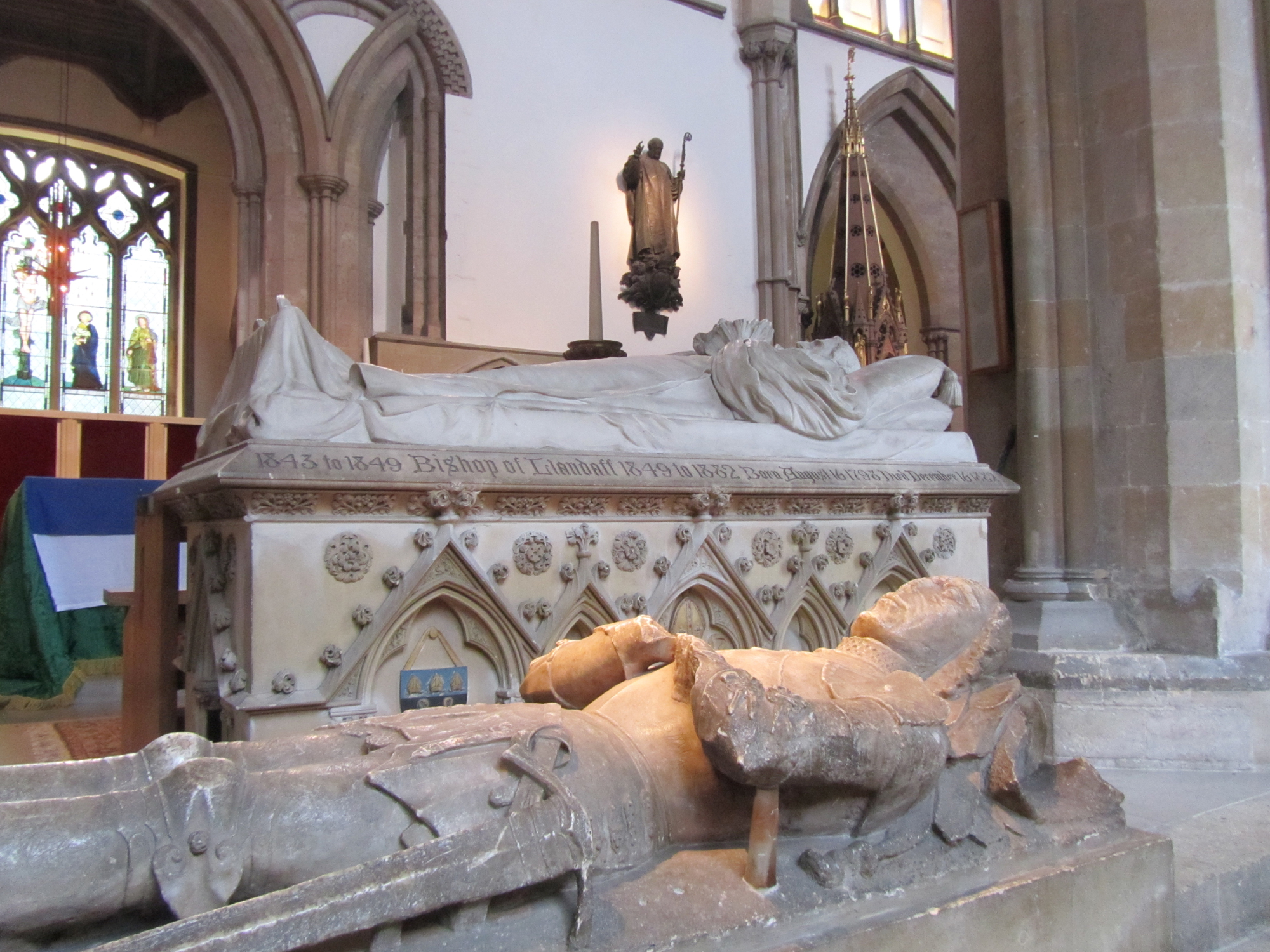
Llandaff Cathedral holds the remains of two 6th-century saints -- Dubricius, whose body was transferred here in 1120, and Teilo, the church founder. Sir David Mathew, who saved the life of Edward IV at the Battle of Towton in 1461 and was appointed Grand Standard Bearer of England, lies here too. The cathedral is the only church in Cardiff with a ring of twelve bells, and its carillon, installed in 1879 as a memorial to Dean Henry Lynch Blosse, plays seven different hymn tunes across the week. The Cathedral School remains the only dedicated choir school in the Church in Wales. Despite a financial crisis in 2013 that led to the redundancy of salaried choir members, the choral tradition continues -- boys, girls, men, and women keeping alive a practice that has echoed through this valley since the 12th century, through collapses and bombs and lightning strikes.
From the Air
Located at 51.50N, 3.22W in the Llandaff district of Cardiff, set in a shallow valley beside the River Taff. The cathedral's spire and grounds are visible from the air. Best viewed at 1,500-2,500 ft. Nearest airport: Cardiff (EGFF), approximately 9 nm southwest. The cathedral lies about 2 miles northwest of Cardiff city centre; Cardiff Castle and the Principality Stadium are visible to the southeast.