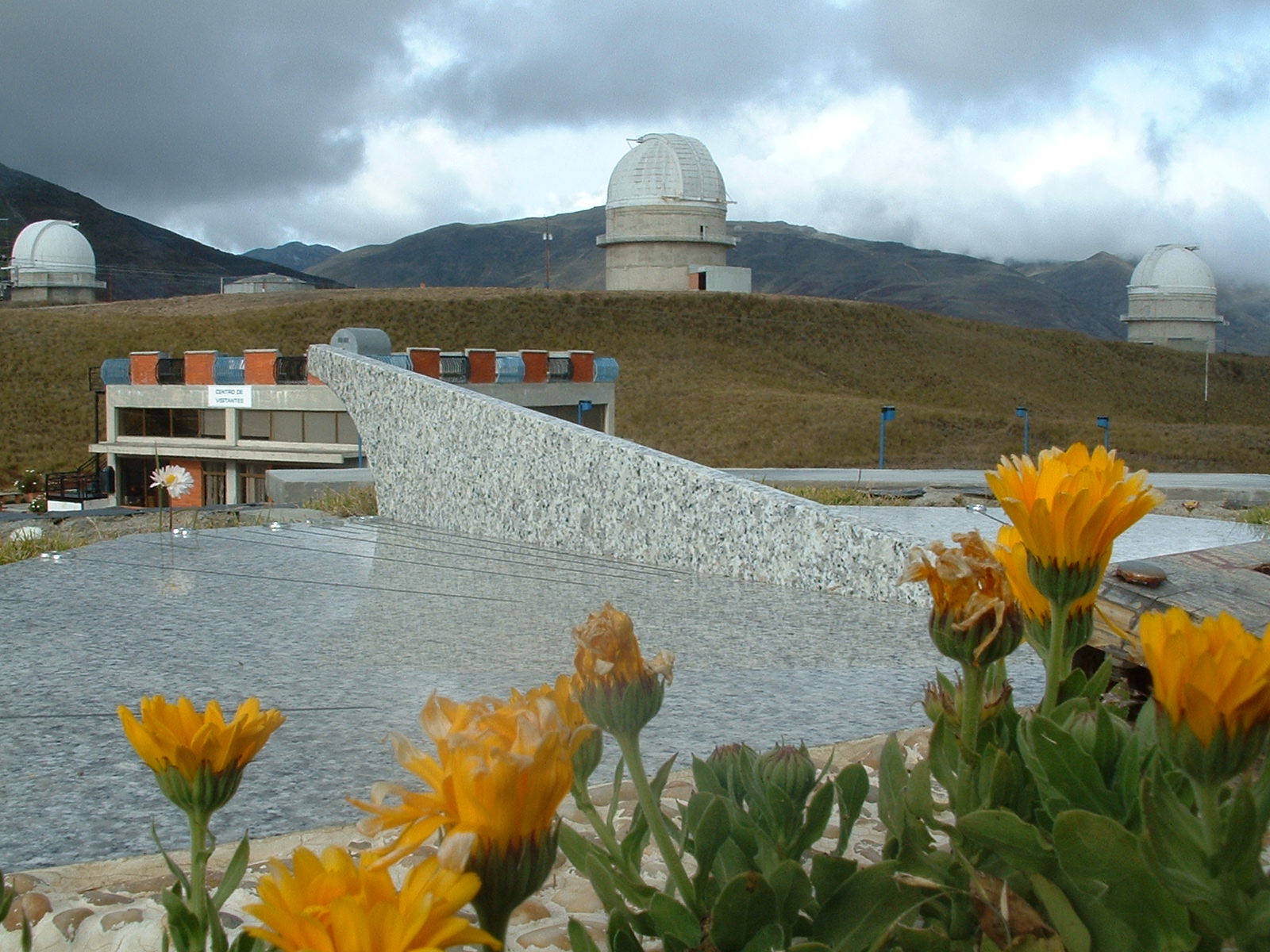
Llano del Hato National Astronomical Observatory
Most observatories choose between the northern and southern sky. The Llano del Hato National Astronomical Observatory does not have to choose. Sitting at eight degrees and 47 minutes north latitude, it is the closest major optical observatory to the equator, which means that on any clear night, astronomers here can swing their telescopes from one celestial hemisphere to the other with barely a pause. The observatory perches at 3,600 meters above sea level -- high enough to rise above much of the atmosphere's turbulence -- on a plateau in the Venezuelan Andes, above the village of Llano del Hato and about 50 kilometers northeast of the city of Merida. The site is dark. The nearest significant city light is the glow of Merida itself, softened by distance and mountain ridges. What reaches the telescope domes is starlight, and a great deal of it.
Cold War Telescopes on a Tropical Plateau
The Venezuelan government acquired the observatory's four primary instruments in 1954, at a time when Latin American nations were investing in scientific infrastructure with an ambition that would not be seen again for decades. Installation at Llano del Hato was completed in early 1955. The four telescopes sit under individual domes on the windswept plateau: a one-meter Askania Schmidt camera, one of the largest of its type in the world; a 65-centimeter Zeiss refractor; a one-meter Zeiss reflector; and a 50-centimeter Askania double astrograph. These are not the newest instruments in astronomy, but their equatorial position and the clarity of the high-altitude site give them capabilities that newer telescopes at less favorable locations cannot match. The German and Zeiss optics, designed in an era when precision was achieved through craftsmanship rather than computation, still produce sharp images seven decades after installation.
Scanning Both Hemispheres
The observatory's near-equatorial location is its greatest scientific asset. From eight degrees north, the dome of the sky tilts only slightly, granting access to stars, galaxies, and transient phenomena in both the northern and southern celestial hemispheres. Observatories in Chile see the southern sky brilliantly but lose much of the north. Mauna Kea in Hawaii commands the northern sky but cannot reach deep into the south. Llano del Hato splits the difference, making it valuable for survey projects that need to cover large swaths of sky without gaps. The Quasar Equatorial Survey Team, a joint project between Yale University, Indiana University, and Venezuela's Centro de Investigaciones de Astronomia, used the observatory's one-meter Schmidt telescope before migrating to the larger Samuel Oschin telescope at Palomar Observatory in California.
Fifty Worlds Discovered
Astronomers at Llano del Hato have discovered 50 minor planets -- small rocky bodies orbiting the Sun, most of them in the asteroid belt between Mars and Jupiter. The discoveries are credited to Orlando Naranjo, Jurgen Stock, Ignacio Ferrin, and Carlos Leal, researchers at CIDA, Venezuela's national astronomical research body. Minor planet discovery requires patience and precision: the astronomer photographs the same patch of sky on multiple nights, then compares the images to find points of light that have moved against the background of fixed stars. Each discovery adds a small piece to the solar system's inventory, and the 50 objects found from this remote Andean plateau represent a body of work that few observatories in the tropics can match. CIDA, which oversees the observatory, also conducts collaborative research with international institutions and maintains a museum and exhibition center at the site for public visitors.
Stargazing at the Edge
Reaching Llano del Hato requires a drive up the winding Trans-Andean highway from Merida toward Apartaderos, a small Andean village that serves as the gateway to the paramo highlands. The last stretch climbs above the tree line into a landscape of frailejones and bare rock, where the air thins noticeably and the temperature drops sharply. At 3,600 meters, visitors who arrive from the lowlands feel the altitude in their breathing and their pace. The observatory's museum offers a gentler introduction to the science happening in the domes above -- exhibits on CIDA's research, the mechanics of the telescopes, and the basics of observational astronomy. On clear nights, the sky from the plateau is extraordinary: the Milky Way arcs overhead with a brilliance that lowland observers rarely see, and the darkness is deep enough to reveal structure in nebulae and star clusters that brighter sites wash out. It is one of the few places in the world where cutting-edge research and public wonder share the same patch of ground.
From the Air
The Llano del Hato National Astronomical Observatory is located at 8.786N, 70.872W on a plateau at 3,600 meters (12,000 feet) elevation in the Venezuelan Andes, approximately 50 km northeast of Merida. The observatory domes may be visible from the air on the high paramo plateau above the village of Llano del Hato, near Apartaderos along the Trans-Andean highway. Nearest airport: Alberto Carnevalli Airport (SVMD/MRD) in Merida, approximately 50 km to the southwest. Caution: high terrain in all directions, with the observatory itself at FL118. Mountain weather with frequent cloud buildup, especially in afternoon hours. The plateau is above tree line and may be identifiable by its cleared, relatively flat terrain amid surrounding rugged peaks.