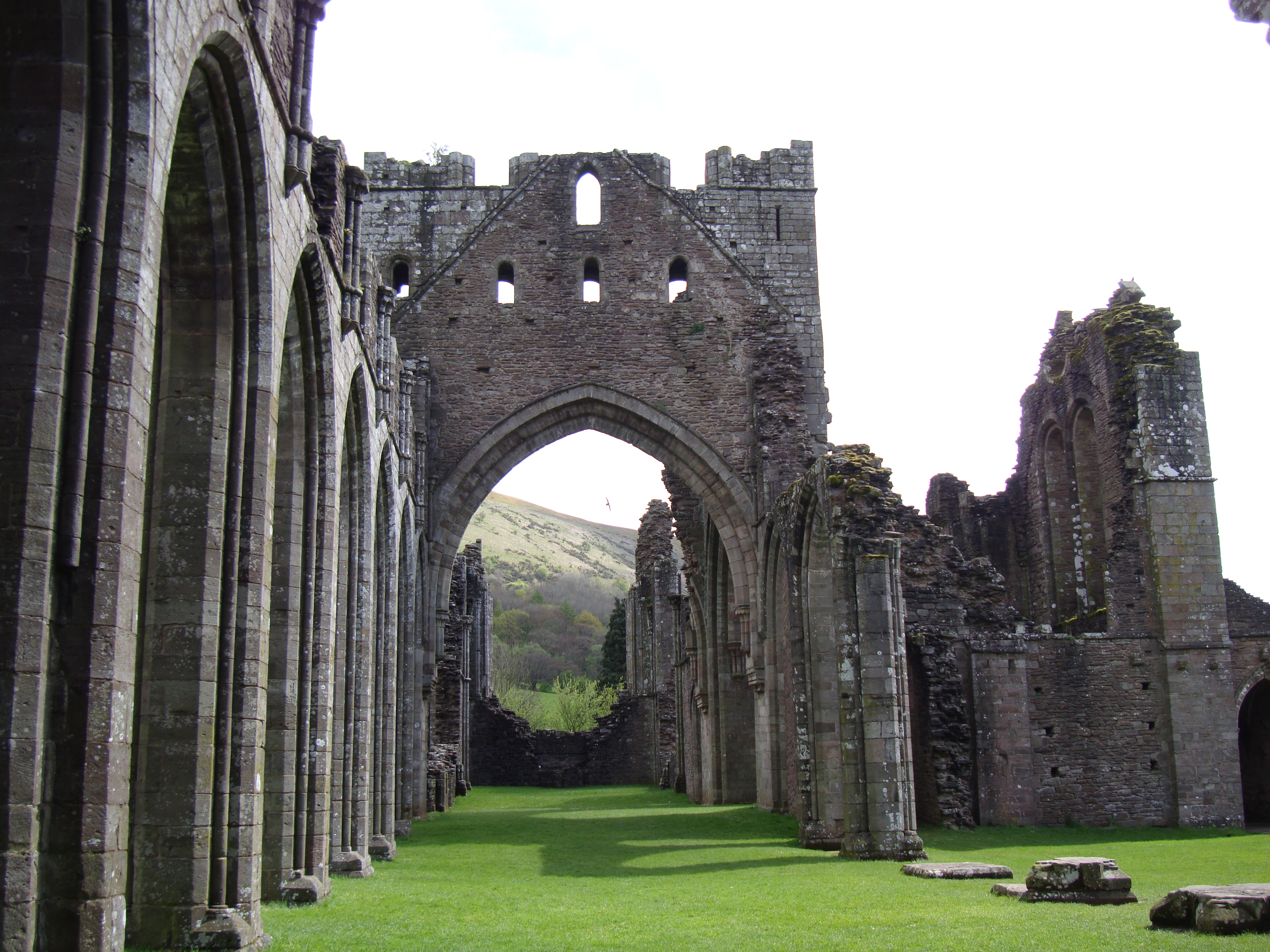
Llanthony Priory
"The sun is never visible to this gloomy recess, till between the afternoon hours of one and three; and even then, is rarely seen, except in the clearest season." That is how Giraldus Cambrensis described the Vale of Ewyas in 1188, and the observation holds today. Llanthony Priory sits at the bottom of a steep-sided, once-glaciated valley in the Black Mountains, hemmed in by ridges so high that direct sunlight is a brief daily event. It is a place that seems designed for contemplation -- or perhaps for driving poets and landowners slowly mad.
A Knight's Solitary Vow
Around the year 1100, a knight named William in the service of Hugh de Lacy stumbled upon a ruined chapel of Saint David in this remote valley. Something about the place seized him, and he abandoned his military career to devote himself to solitary prayer. He was joined by Ersinius, a former chaplain to Queen Matilda, wife of King Henry I, and then by a growing band of followers. A church dedicated to Saint John the Baptist was built and consecrated in 1108. By 1118, some forty canons had established a priory of Canons Regular -- the first Augustinian house in Wales. The location was sublime but perilous. In 1135, persistent attacks from the local Welsh population drove the monks to retreat to Gloucester, where they founded a secondary cell called Llanthony Secunda. The priory in the mountains fell silent.
An Amphitheatre of Immense Mountains
It did not stay silent long. Around 1186, Hugh de Lacy the younger endowed the estate with funds from his Irish holdings, and the priory church was rebuilt, completed by 1217 in a mixture of Norman and Gothic styles. The result was, as Gerald of Wales described it, a church standing "in the deep vale of Ewyas, which is not more than a bowshot wide, encircled with an amphitheatre of immense mountains." The cloistered monks, he wrote, could view from within their walls "the mountains rising above them and almost touching heaven with their exalted summits, and abounding with deer feeding aloft." A new gatehouse was added around 1325. On Palm Sunday 1327, the deposed Edward II stopped here on his final journey from Kenilworth Castle to Berkeley Castle, where he was almost certainly murdered. Even a king on his way to death passed through this valley.
Landor's Folly
After the dissolution of the monasteries in 1538, Llanthony decayed for centuries. Then in 1807, the poet Walter Savage Landor bought the estate, dreaming of becoming a model country gentleman. He planted trees -- the avenue still known as Landor's Larches dates from his time -- imported sheep from Spain, and set about improving the roads. He described the idylls of country life to his friend Robert Southey: nightingales singing, glow-worms lighting the darkness. But the idyll curdled quickly. For three years Landor fought with neighbours, tenants, lawyers, lords-lieutenant, and the Bishop of Saint David's. He let his farmland to a tenant named Charles Betham, whom he considered incompetent, extravagant, and unwilling to pay rent. After an expensive legal battle, Landor abandoned Llanthony to his creditors -- principally his own mother -- and left the country. The buildings continued to crumble.
Painted from the Opposite Hillside
What the poets and farmers could not sustain, the ruins themselves preserved. J. M. W. Turner painted Llanthony from the opposite hillside, capturing the arches against the mountain backdrop. In 1869, Father Ignatius founded an Anglican monastery at nearby Capel-y-ffin, naming it Llanthony Abbey; it survived until 1908 and later became home to the artist Eric Gill. The priory ruins themselves passed to the Knight family in the 20th century and are now protected by Cadw. One of the old buildings became the Abbey Hotel, where visitors can sleep within medieval walls. Four buildings on the site hold Grade I listed status. The tower and nave arches still frame the valley sky, and the mountains still rise almost to heaven, and the sun still barely reaches the valley floor. Whatever drew that knight William into solitary prayer nine centuries ago, it has not gone anywhere.
From the Air
Located at 51.94N, 3.04W in the Vale of Ewyas, within the Black Mountains of the Brecon Beacons National Park. The narrow, steep-sided valley is striking from the air. Seven miles north of Abergavenny. Nearest airports: Abergavenny (no ICAO), Cardiff (EGFF) 35nm south. Caution: mountainous terrain with peaks above 2,000ft on both sides of the valley. The Hatterrall Ridge forms the eastern wall. Best viewed at 3,000ft+ AGL for safe clearance.