_07.jpg)
Llíria
In Llíria, the question is not whether you play an instrument but which band you play for. In a town of roughly 25,000 people, several thousand are musicians, and for more than a hundred years they have divided their loyalties between two great wind orchestras that regard each other as friendly enemies. Music runs so deep here that in 2019 UNESCO named Llíria a Creative City of Music, one of a select handful worldwide. Yet the brass and woodwind are only the latest voices to rise from this hill northwest of Valencia. Beneath the modern streets lies one of the most important cities of ancient Iberia, and the town has been making itself heard for well over two thousand years.
Two Bands, One Town
The rivalry began, as rivalries often do, with a split. In 1819 a Franciscan friar named Antoni Albarracín Enguídanos founded the town's first band, the Banda Primitiva. Decades of shared music-making followed until 1903, when a faction broke away to form the Unió Musical, and Llíria has kept two orchestras - and two fiercely loyal camps - ever since. The competition is not bitter so much as bracing; each band drives the other to play better, and the whole town benefits. A public conservatory, founded by the city council in the 1990s, feeds fresh players into both. For a small inland town, the density of talent is remarkable: children grow up assuming that learning an instrument is simply what one does.
The City on the Hill
Long before the bands, this was Edeta, capital of a broad Iberian territory called Edetania that stretched between two rivers. The old city stood on the hilltop of Sant Miquel, looking down over the plain where the modern town now sits. Its life on the heights ended violently. In 76 BC, during the wars the rebel general Quintus Sertorius waged against Rome across Hispania, Edeta was destroyed - and afterward rebuilt on the lower ground it occupies today. The move from hill to plain, from defensible height to open valley, marks the moment a rebellious frontier settled into the Roman world. The bones of the older city still lie under the soil of Sant Miquel.
Hercules Underfoot
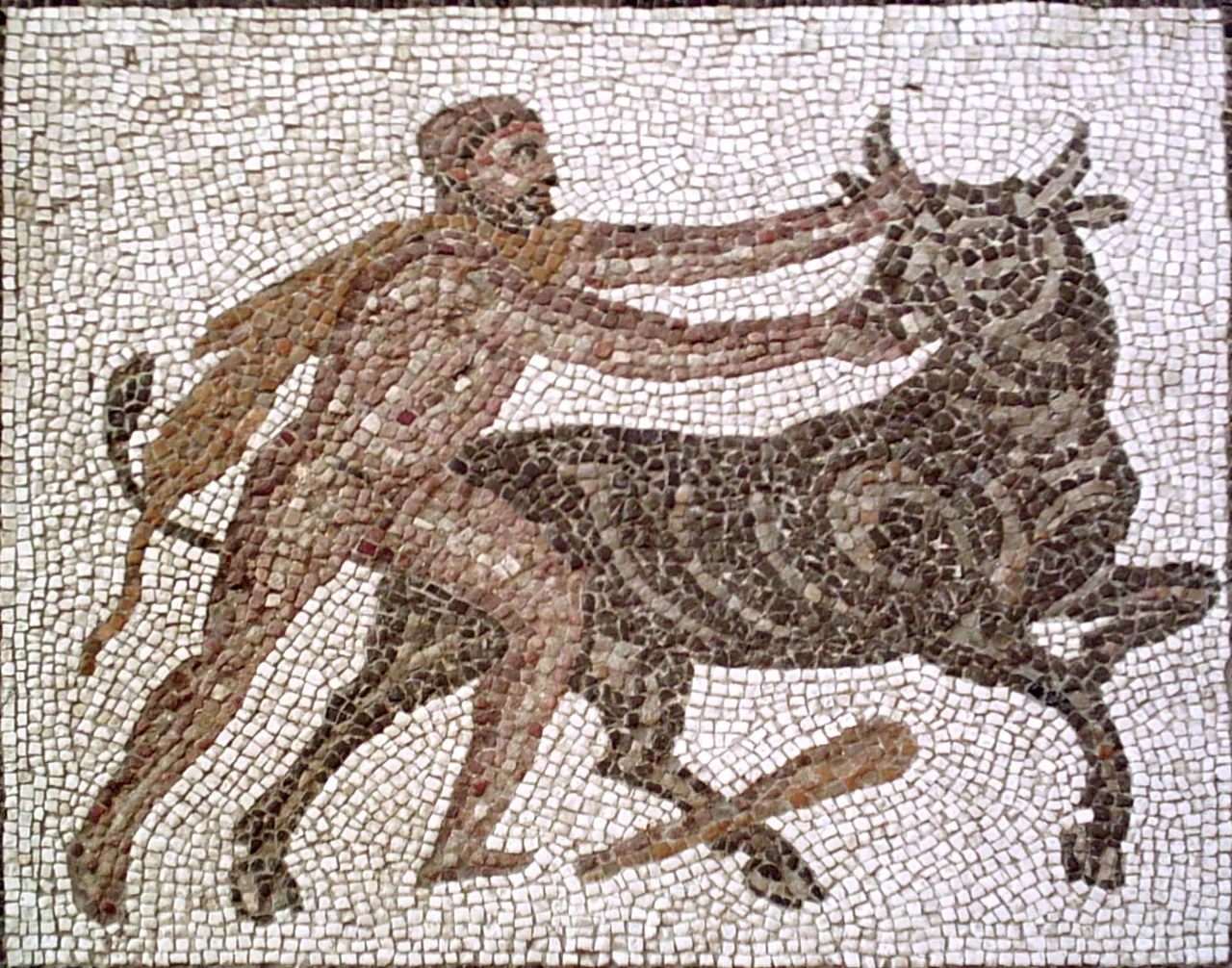
Under Rome, Llíria grew rich enough to rival Valencia and nearby Sagunt. The ground still gives up the evidence. Archaeologists have uncovered a grand Roman leisure complex here - a temple, shops, pools, and hot baths - along with one of the largest coin hoards ever found in Spain, some 6,000 silver denarii minted across the first and third centuries and known as the Treasure of Carrer Duc de Llíria. The most striking find came from a Roman house: a mosaic depicting the Twelve Labours of Hercules, its panels tracing the hero through each of his trials. That masterpiece now hangs in the National Archaeological Museum in Madrid, while Llíria's own museum keeps the story of where it came from.
The Church of the Blood
The town's medieval chapter opened in 1238, when James I of Aragon took the Valencian region and had Llíria's first church built. Raised on the site of a mosque, the Church of the Blood - the església de la Sang - is a clean example of Valencian Gothic, and fragments of the mosque it replaced can still be seen within it, a quiet reminder of the layered faiths that shaped this coast. In 1919 the church became the first religious monument in the entire Valencian Community to be declared a National Monument. Recently restored, it stands as one more chapter in a town that keeps every era of itself close - Iberian, Roman, Muslim, Christian, and the ceaseless music laid over all of them.
From the Air
Llíria sits at 39.626°N, 0.596°W, about 25 km northwest of Valencia at 164 m (538 ft) elevation in the Camp de Túria - look for the town on the plain below the hill of Sant Miquel, off the CV-35 motorway and at the end of the Metrovalencia line. Best viewed from 2,000-4,000 ft AGL; the inland setting can bring cooler, clearer air than the coast. Valencia Airport (LEVC) lies about 20 km southeast; Alicante (LEAL) is roughly 150 km south. The hill of Sant Miquel and the surrounding agricultural plain make useful visual markers.
Nearby Stories
- Battle of Alcalá (1129) 6.8 km away
- Requena 17 km away
- Festival Internacional de Benicàssim 17 km away
- Vía Verde de Ojos Negros 21 km away
- Rincón de Ademuz 28 km away
- Castle of Ayora 35 km away
- Benicàssim 47 km away
- Hēmeroskopeion 60 km away