Lobeke National Park
Every year, thousands of African grey parrots are caught within and around this park and smuggled out of the country. That illegal trade, alongside poaching for ivory and bushmeat, defines the contradiction at the heart of Lobeke National Park: a place of extraordinary biological richness that exists under constant threat. Located on the South Cameroon Plateau, Lobeke forms one-third of the Sangha Trinational, a UNESCO World Heritage Site shared with Nouabale-Ndoki National Park in the Republic of the Congo and Dzanga Sangha National Reserve in the Central African Republic. Together, these three protected areas constitute one of the largest intact forest landscapes in Central Africa.
Where Three Nations Meet
Lobeke belongs to the Moloundou arrondissement, a district described as one of the richest rubber-producing areas in Africa. The park was declared a National Park in October 1999, and that same year the Yaounde Declaration established a framework of cooperation among the three countries sharing the Sangha River basin. The Central African Forest Commission, known as COMIFAC, oversees the trinational arrangement, supported by the World Wildlife Fund, the German Cooperation of Technical Collaboration, and the Wildlife Conservation Society. In 2012, the entire Sangha Trinational received UNESCO World Heritage status, a recognition that the forests spanning these three borders constitute something irreplaceable. The home territory of multiple ethnic groups, including the Baka, the Bantu, and the Bangando, Lobeke is a landscape where human history and ecological history have been intertwined for centuries.
Saline Swamps and Unlogged Canopy
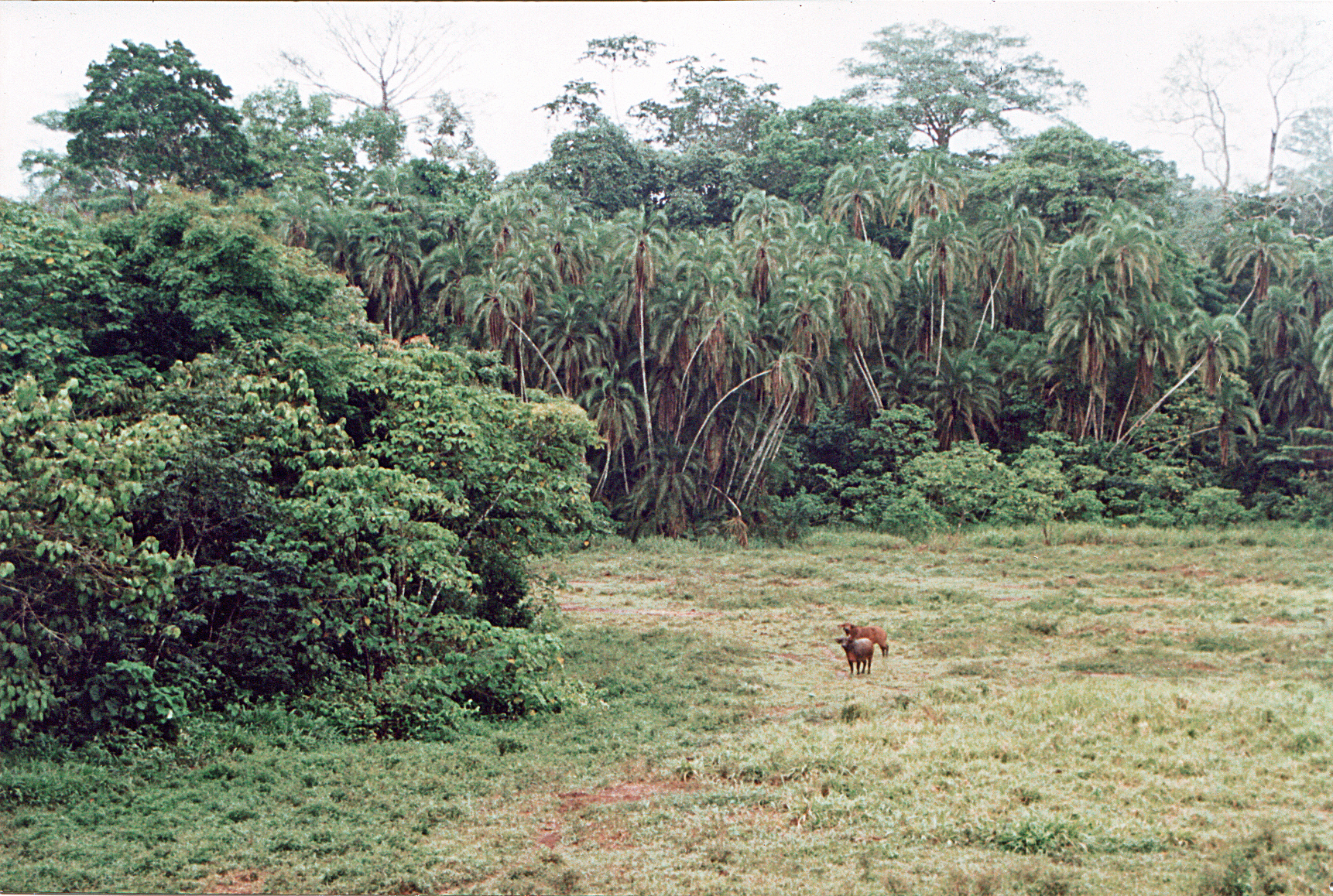
The park covers 1,839 square kilometers, with elevations ranging from 300 to 750 meters above sea level. More than twelve natural savannas punctuate the forest, characterized as saline swamps that draw animals from the surrounding woods. Sandbars line the Sangha River along the park's edge. The forest itself is predominantly semi-evergreen, and most of it has never been logged. Over 300 species of trees grow here, with dominant species including Malvaceae and Terminalia superba. The understory shifts between thickets of Marantaceae and Zingiberaceae in some areas and Ebenaceae and Annonaceae trees in others. Near streams, dense stands of Gilbertiodendron dewevrei form their own micro-ecosystems, while palm thickets and sedge marshes border the savannas. Annual rainfall averages 1,400 millimeters, with the dry season falling between December and February.
Density Beyond Expectation
Some of the highest densities of African forest elephants and western lowland gorillas anywhere in Africa occur within Lobeke. Chimpanzees, leopards, and ten species of forest ungulates share the canopy and the clearings. The park's faunal inventory extends far beyond mammals: 215 species of butterflies, 134 species of fish, 18 species of reptiles, and 16 species of amphibians have been documented. BirdLife International has designated Lobeke as Important Bird Area CM033, with over 300 bird species recorded. The African green pigeon, hornbills, yellow-throated cuckoo, sandy scops owl, and the chocolate-backed kingfisher all inhabit the park. For the Dja River scrub warbler, a species with an extremely limited range, Lobeke represents one of its few strongholds within Cameroon and Gabon.
Baka Drums and Forest Lookouts
Lobeke has received significant investment to develop eco-tourism infrastructure, an effort that reflects both conservation strategy and economic pragmatism. Furnished bungalows at campsites, trained guides who lead walks through the forest, and even internet and mobile phone coverage mark the park's transition from pure wilderness to managed visitor experience. Six named clearings, Bolo, Djangui, Ndangaye, Ngoa, Djaloumbe, and Petite Savane, have purpose-built lookouts where visitors can observe gorillas, birds, and other mammals from elevated platforms. The rivers teem with fish. Traditional Baka festivals offer visitors a window into the cultural life of the people who know these forests most intimately, while local artisans produce crafts that draw on centuries of material knowledge. The park presents itself as a place where green tourism and ethno-tourism overlap, where the ecological and the cultural are not separate attractions but aspects of a single landscape.
The Parrot Problem
For all its protections and international recognition, Lobeke faces threats that are as persistent as the forest itself. Timber exploitation continues in the surrounding region. Safari hunting, while regulated, places pressure on wildlife populations. Poaching for bushmeat, exotic animals, and ivory remains a constant concern. But the illegal capture and export of African grey parrots stands out as a particularly devastating problem, with thousands of birds taken each year from the park and its surroundings. These parrots, prized for their intelligence and ability to mimic speech, fetch high prices on the international pet trade. Every bird removed from Lobeke is a subtraction from a population that the forest depends on for seed dispersal and ecological balance. The park's World Heritage status provides a framework for action, but the daily work of protection falls to rangers and communities navigating a landscape where conservation and survival compete for the same resources.
From the Air
Located at 2.25N, 15.75E on the South Cameroon Plateau. The park covers 1,839 square kilometers. From altitude, the Sangha River provides a clear navigational reference along the eastern boundary, and saline swamp clearings appear as lighter patches within the forest canopy. The nearest airstrip is at Moloundou. Douala International Airport (FKKD) is the closest major facility. Best viewed from 15,000-20,000 feet where forest clearings and the savannah-forest mosaic become visible.