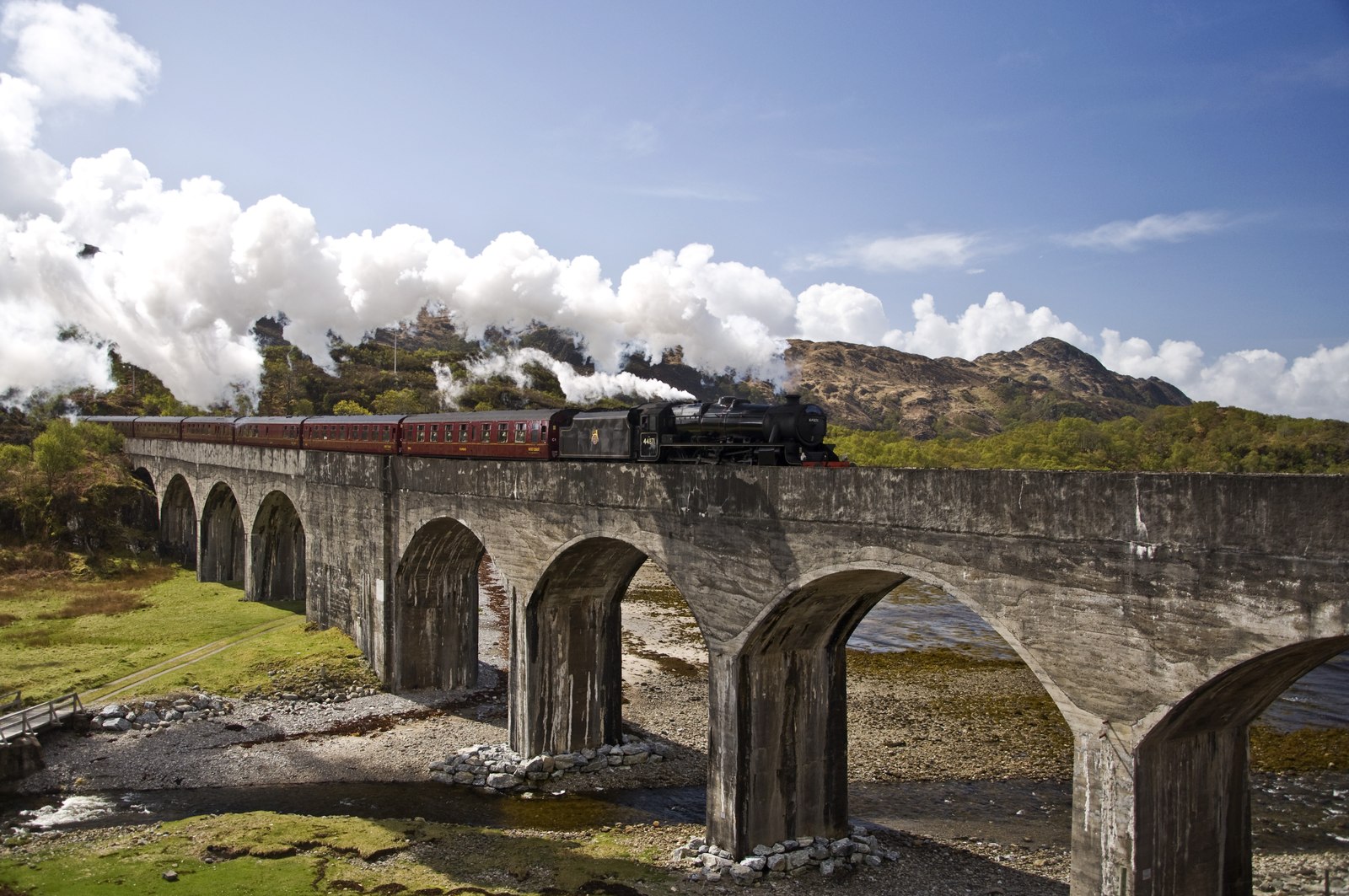
Loch nan Uamh Viaduct
For a hundred years, a horse stood inside a railway viaduct and nobody knew. The Loch nan Uamh Viaduct carries the West Highland Line across the Allt a' Mhama -- the Mama Burn -- just before it flows into Loch nan Uamh, a sea loch on the coast of Lochaber. Eight concrete arches of fifty-foot span, four on each side of a large central pylon, stride across the burn in a design whose logic has never been fully explained. What was explained, eventually, was why the central pylon was built so much larger than the engineering seemed to require. Something was inside it.
The Line to the Isles
The West Highland Line is one of the great railway journeys of Britain, running from Glasgow through the mountains and along the coast to Mallaig, where ferries connect to the Small Isles and Skye. The line was built in stages during the 1890s and early 1900s, an extraordinary feat of Victorian and Edwardian engineering through some of the most difficult terrain in the British Isles. The Loch nan Uamh Viaduct was part of the Mallaig extension, completed in 1901. It stands near the shore of a sea loch whose name means "loch of the caves" -- a fitting designation for a coastline riddled with natural caverns and steeped in Jacobite history. The viaduct's neighbour on the same line, the Glenfinnan Viaduct, became world-famous after appearing in the Harry Potter films, but the Loch nan Uamh structure holds a secret that no cinematic viaduct can match.
The Search for the Horse
Local legend had long maintained that a horse fell into the wet concrete of a pier during the construction of one of the West Highland Line's viaducts. The story was specific enough to be believable but vague enough to be unfindable. In 1987, Roland Paxton, a civil engineering historian from Heriot-Watt University, set out to track down the truth. He started at the Glenfinnan Viaduct, the most famous structure on the line, drilling boreholes into the only two piers large enough to accommodate a horse and inserting a fisheye camera. He found nothing. A decade later, in 1997, acting on local hearsay that pointed to a different viaduct entirely, Paxton repeated the procedure at Loch nan Uamh. Again, the camera revealed only rubble. But Paxton did not give up. In 2001, he returned to Loch nan Uamh with ground-penetrating radar equipment and scanned the massive central pylon. This time, the equipment found what the camera had missed: the remains of a horse and cart, entombed in concrete since the viaduct's construction around 1900.
Concrete and Consequence
The discovery confirmed a story that had been passed down for a century along the west Highland coast. During construction, a horse and cart had evidently fallen or been trapped in the wet concrete of the central pylon, and the builders -- whether unable or unwilling to retrieve the animal -- simply poured more concrete on top and carried on. It was a grim pragmatism characteristic of the era's engineering culture, where the pace of construction left little room for sentiment. The viaduct itself, with its unusual split design of four arches on each side of the oversized pylon, may owe its distinctive form to this very incident -- though the official reason for the design has never been recorded. Today the Loch nan Uamh Viaduct is a Category B listed building, carrying daily train services between Fort William and Mallaig through scenery that shifts from mountain pass to sea loch within a single glance. Passengers crossing the viaduct are unlikely to know what lies beneath their carriage, sealed in a century of concrete on one of the most beautiful railway lines in the world.
From the Air
Loch nan Uamh Viaduct sits at 56.893N, 5.731W on the West Highland Line, where the railway crosses the Allt a' Mhama burn just before it enters Loch nan Uamh, a sea loch north of the Ardnish peninsula. The viaduct is visible from the air as a concrete arch structure near the loch shore. Nearest airfield is Oban Airport (EGEO), approximately 45 nm south. The Glenfinnan Viaduct lies approximately 8 nm to the east-southeast along the same railway line. Prince's Cairn is located nearby on the shores of the same loch.