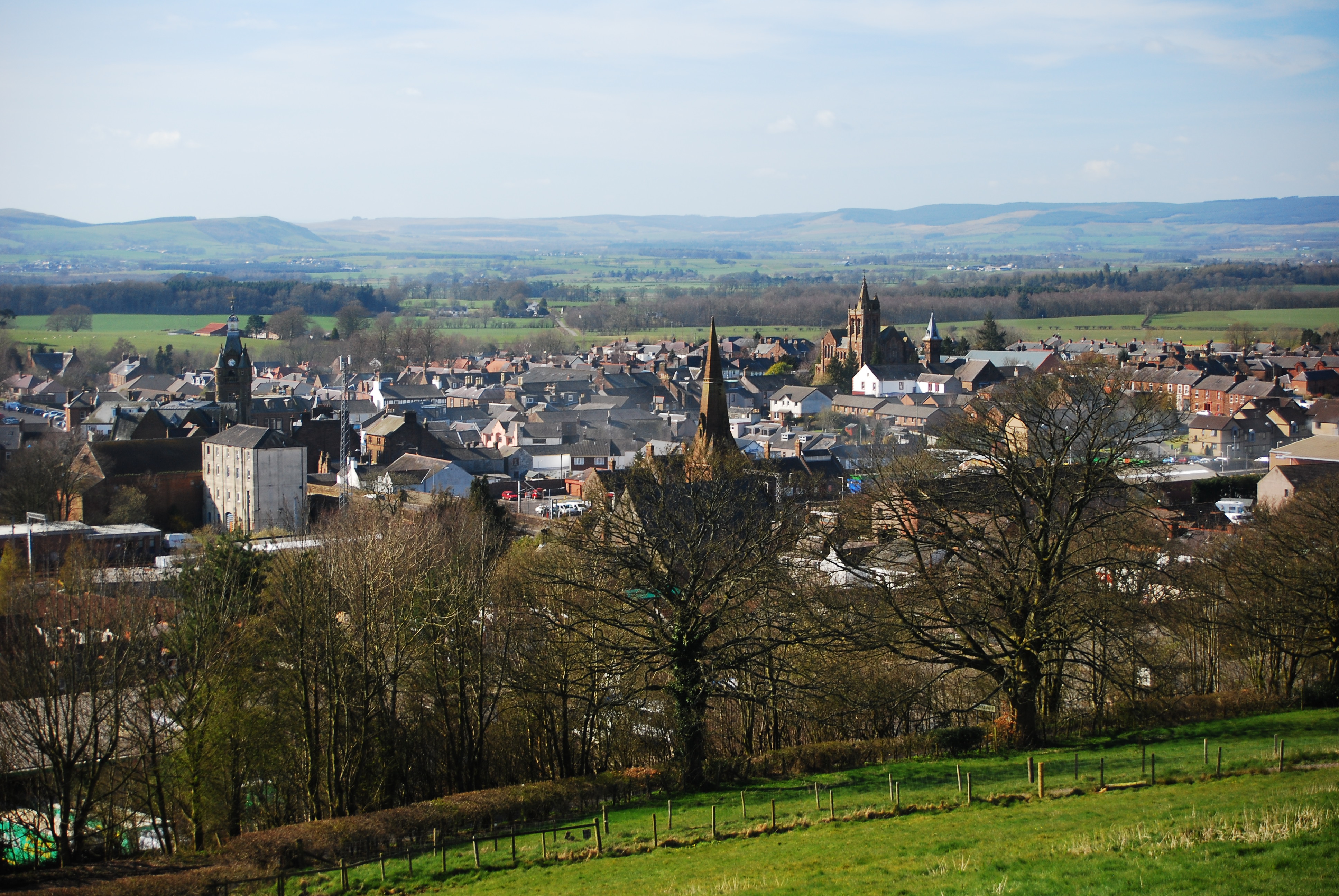
Lockerbie
The name appears in the records as Lokardebi in 1306, seven centuries before the world learned to associate it with something else entirely. Lockerbie is a town of about 4,000 people in Dumfries and Galloway, built from red sandstone, surrounded by sheep farms, and connected to the wider world by the West Coast Main Line. For most of its history, it was known for its lamb market, the largest in Scotland. Then came the evening of 21 December 1988, and Lockerbie became a word that meant something different in every language on earth.
Deep Roots in Red Stone
Lockerbie's story reaches back far beyond its medieval name. In 2006, archaeologists preparing the site for a new school uncovered a Neolithic timber hall dating to between 3950 and 3700 BC, one of only a handful found in Scotland. Flax seeds inside revealed that the inhabitants were processing textiles nearly six thousand years ago. A Bronze Age cemetery, radiocarbon dated to between 2140 and 1690 BC, yielded a rare copper alloy dagger that may have been imported from Wales. In 1593, Clan Johnstone fought Clan Maxwell two miles west of town at the Battle of Dryfe Sands, a clash so vicious that sword cuts to the head became known as the "Lockerbie Lick." The Johnstone family shaped the town's growth from the 1730s, laying out plots along the High Street. By the time Thomas Telford's Carlisle-to-Glasgow road arrived in 1816 and the Caledonian Railway followed in 1847, Lockerbie had become a prosperous market town and staging post.
The Night the Sky Fell
On 21 December 1988, Pan Am Flight 103, a Boeing 747, was destroyed by a terrorist bomb at 31,000 feet over southern Scotland. The aircraft's wings and fuel tanks struck Sherwood Crescent in Lockerbie, creating a crater and a fireball that destroyed several houses. All 259 people aboard the aircraft died, along with eleven residents of the town. The 270 victims came from twenty-one nations. It remains the deadliest terrorist attack and the worst aviation disaster in British history. The town's ice rink, built in 1966 across from Lockerbie Academy, was requisitioned to serve as a temporary mortuary. Lockerbie Academy itself became the headquarters for the massive response and recovery effort that followed.
Bonds Forged in Grief
From the wreckage, Lockerbie built connections that span the Atlantic. Syracuse University in New York, which lost 35 students on Flight 103, partnered with Lockerbie Academy to create a scholarship program. Each year, two students from the academy spend an academic year at Syracuse as Lockerbie Scholars before beginning their own university studies. The academy's rector, Graham Herbert, received Syracuse's Chancellor's Medal in 2003 for his service in building this bridge between communities. The Dryfesdale Lodge Visitors' Centre, opened in 2003, houses a permanent exhibition tracing Lockerbie's history from its prehistoric origins through the bombing and beyond. In the cemetery grounds nearby, the Memorial Garden of Remembrance provides a quiet space for reflection, visited by families and travellers from around the world.
A Town Beyond Its Name
Lockerbie has worked to live alongside its unwanted fame rather than be defined by it. South of town, the remains of Hallmuir prisoner-of-war camp include a chapel built by Ukrainian soldiers from converted army huts, now a listed building still holding services on alternate months. The town's connection to boxing history runs through John Sholto Douglas, 9th Marquess of Queensberry, whose family seat was Lockerbie House. The rules he sponsored for boxing in 1867 remain the foundation of the sport worldwide. The Georgian red sandstone Lockerbie House itself, with its 40 bedrooms and 78 acres of grounds, now serves as an outdoor adventure centre for school groups. Life continues in a town that has learned, through necessity, that remembering and moving forward are not contradictions.
From the Air
Located at 55.12N, 3.36W in Dumfries and Galloway. The town sits along the A74(M)/M74 motorway corridor between Carlisle and Glasgow. Sherwood Crescent, where the main impact occurred, is visible in the western part of town. Lockerbie railway station is on the West Coast Main Line. Nearest airports: Carlisle Lake District (EGNC) approximately 15 nm south; Glasgow (EGPF) approximately 55 nm north. Best viewed at 2,000-4,000 ft AGL.