Lod Airport Massacre
They carried violin cases. On the evening of May 30, 1972, three young Japanese men stepped off an Air France flight from Rome at Lod Airport near Tel Aviv, dressed conservatively, attracting no attention. Airport security was watching for Palestinian operatives. It did not occur to anyone to scrutinize Japanese passengers. In the arrivals hall, the men opened their cases, pulled out Czech assault rifles with the stocks removed, and began firing indiscriminately into the crowd. Twenty-six people died. Eighty were wounded. The majority of the dead were Christian pilgrims from Puerto Rico who had traveled to the Holy Land on a religious journey. They never left the airport.
An Unlikely Alliance
The attack was the product of a collaboration that seemed to defy geography and logic. The Popular Front for the Liberation of Palestine, led by Wadie Haddad, recruited members of the Japanese Red Army -- a Marxist militant group with no obvious stake in the Israeli-Palestinian conflict -- specifically because their nationality would bypass security profiling. The three attackers, Kozo Okamoto, Tsuyoshi Okudaira, and Yasuyuki Yasuda, had been trained in Baalbek, Lebanon. Haddad handled the operational planning. The strategy exploited a fundamental assumption of 1970s airport security: that threats to Israel came from Palestinians and their immediate allies. By outsourcing the violence to ideological sympathizers from the other side of the world, the PFLP created a template for transnational terrorism that intelligence agencies would spend decades trying to counter.
Ten O'Clock in the Arrivals Hall
At 10 p.m., the shooting began. The attackers sprayed automatic fire across the terminal and threw grenades as they changed magazines. Among the dead were 17 pilgrims from Puerto Rico -- church members on a journey of faith -- along with eight Israeli citizens, including Professor Aharon Katzir, a protein biophysicist who had served as president of the Israel Academy of Sciences and was a candidate for the upcoming presidential election. A Canadian citizen, Luna Sabbah, also died. The attack was chaotic even for its perpetrators. Yasuda was accidentally shot dead by one of the other gunmen. Okudaira ran onto the tarmac, firing at passengers leaving an El Al plane, before dying from one of his own grenades. Only Okamoto survived, wounded and tackled by an El Al employee as he tried to flee the terminal.
Justice and Its Limits
Okamoto was tried by an Israeli military tribunal and sentenced to life imprisonment in June 1972. During the trial, he actively undermined his own defense, protesting his lawyer's requests for a psychiatric evaluation and declaring that he acted as "a soldier of the revolution." He served only 13 years. In 1985, he was released alongside over a thousand prisoners in an exchange for captured Israeli soldiers. He settled in Lebanon's Bekaa Valley, was briefly arrested for passport forgery in 1997, and was granted political refugee status in Lebanon in 2000. Japan still seeks his extradition. The Israeli response extended beyond the courtroom. Weeks after the massacre, Mossad agents assassinated PFLP spokesman Ghassan Kanafani, planting a car bomb that also killed his 17-year-old niece. The attack's primary organizer, Wadie Haddad, died in 1978 under disputed circumstances -- officially of leukemia, though Mossad involvement has been widely alleged.
The Names That Endure
For decades, the Puerto Rican victims received little public recognition beyond their own island. That began to change in 2006, when the Puerto Rico Legislature unanimously designated every May 30 as Lod Massacre Remembrance Day. Governor Anibal Acevedo Vila signed the measure into law. In 2012, a memorial was installed adjacent to the Holocaust Memorial near the Puerto Rico Capitol -- a granite tablet listing the names of the 17 American citizens who died: Reverend Angel Berganzo, Carmelo Calderon Molina, Carmela Cintron, and fourteen others who had boarded a plane for a pilgrimage and never came home. The memorial includes a time capsule. In 2010, a U.S. court ordered North Korea -- which had provided support to the Japanese Red Army -- to pay $378 million to the victims' families. The airport itself has long since been renamed Ben Gurion International, its security transformed into one of the most rigorous systems in the world. But the names on the granite in San Juan are a reminder of the day when faith, politics, and violence converged in an arrivals hall.
From the Air
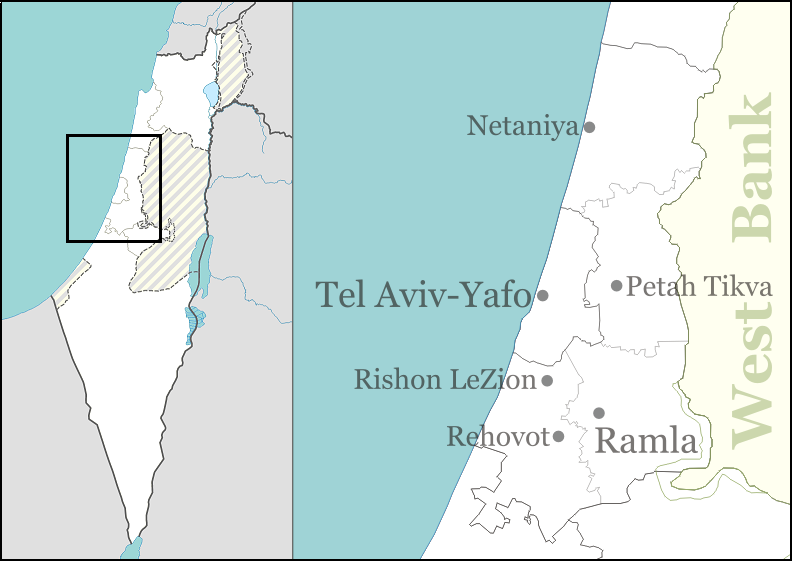
Located at 32.00N, 34.89E, the site of the massacre is now Ben Gurion International Airport (LLBG), Israel's primary commercial airport. The terminal where the attack occurred has been rebuilt and expanded many times since 1972. The airport is clearly visible from any altitude, situated on the coastal plain southeast of Tel Aviv. Runway orientation is 08/26 and 12/30. The surrounding landscape is flat agricultural and suburban terrain.