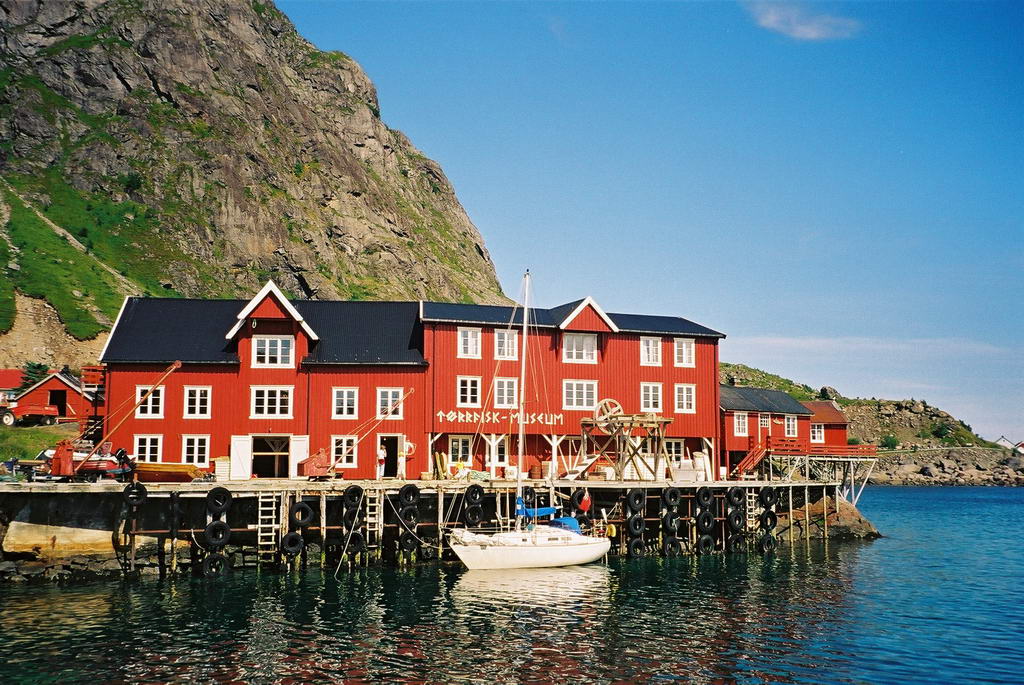
Lofoten Stockfish Museum
The village is called Å. One letter, nothing more -- the last letter of the Norwegian alphabet and the last settlement on the E10 highway before the road surrenders to the Norwegian Sea. Here at the southern tip of the Lofoten archipelago, in a cluster of red and ochre wooden buildings pressed between mountains and water, the Lofoten Stockfish Museum tells the story of a product so valuable it was once called Norway's white gold. Stockfish -- wind-dried cod, unsalted and preserved by nothing but cold Arctic air -- has been traded from these islands for over a thousand years, making it the country's oldest export commodity still in production.
A Thousand Years on the Rack
The technique is elemental. Whole cod, gutted and hung in pairs on outdoor wooden racks called hjell, dry in the wind from February through June. No salt, no smoke, no chemicals -- just the Lofoten climate doing what it does best: cold enough to prevent rot, windy enough to draw out moisture, but rarely so cold that the fish freezes solid. The result loses roughly 80 percent of its weight while retaining nearly all its protein. Properly dried stockfish can last for years without spoiling and reconstitutes quickly in water. Viking-era chieftains shipped it to Britain as early as 875 AD, according to Egil's Saga. By the twelfth century, Lofoten's cod banks had made the archipelago the center of Norway's most important industry, and Bergen -- the kingdom's medieval capital -- grew wealthy as the Hanseatic League's stockfish hub, exporting thousands of tons annually to Germany, Holland, and England.
Inside the Landing Station
The museum occupies an old fish landing station in Å, the kind of working building where boats once unloaded their catch directly into processing. Exhibitions trace the journey of a single cod from the moment it comes ashore -- weighed, sorted, paired, and hung -- through the months of drying and the final grading, packaging, and export. The displays smell faintly of what they describe. There is nothing abstract about a room full of dried fish; the product is its own best exhibit. Visitors learn to distinguish the grades by hardness and color, from the premium ragno destined for Italian kitchens to the lower grades used in West African and Caribbean cooking. Å's other museum, the Norwegian Fishing Village Museum next door, broadens the context to daily life in a Lofoten fishing community, but the Stockfish Museum stays focused on the commodity itself -- the thing that made these remote islands matter to the wider world.
Where the Road Ends
Å is less a town than a preserved idea of one. Until the 1990s, its economy ran on fishing and stockfish production; since then, tourism has become the primary livelihood. The village's oldest cod liver oil factory, established in 1850, still stands. So does the Å Bakery, where bread has been baked in a wood-fired oven since 1878. Walking the narrow paths between the red-painted rorbuer -- the seasonal fishermen's cabins that now house visitors -- you get the sense of a place where function dictated form for centuries. Every building had a purpose tied to the sea: boathouse, drying rack, processing shed, storage. The mountains rise steeply behind, and the harbor opens ahead. It is Northern Norway's best-preserved traditional fishing village, and the stockfish museum sits at its heart, a reminder that dried cod built this place, sustained it for generations, and in the form of tourist curiosity, sustains it still.
From the Air
Located at 67.88°N, 12.98°E at the village of Å, the southernmost point of the Lofoten road network on Moskenesøya. From the air, Å is recognizable as a small cluster of red and yellow buildings at the very tip of the island where the E10 highway terminates. Wooden fish-drying racks (hjell) are visible seasonally. Nearest airport: Leknes Airport (ENLK), approximately 65 km northeast. Bodø Airport (ENBO) on the mainland provides the main commercial connection. Recommended viewing altitude: 2,000-4,000 ft for the village detail.