Lofotr Viking Museum
A farmer plowing his field near the village of Borg on Vestvågøya in 1983 turned up something that did not belong to his century. Archaeologists arrived, and what they found beneath the soil rewrote assumptions about Viking-era power in northern Norway: the foundation of a chieftain's longhouse measuring 83 meters long and 9.5 meters wide, the largest Viking Age building ever discovered in Scandinavia. The site had been occupied from roughly 500 AD to 950 AD -- four and a half centuries of continuous habitation by a ruling family whose wealth came from the sea, from trade, and from the control of the Lofoten fishing grounds that made this archipelago one of the most valuable territories in the Norse world.
Unearthing a Chieftain
The joint Scandinavian research project that excavated the Borg site from 1986 to 1989 revealed not just a building but a society. The longhouse was no ordinary dwelling. At 83 meters, it was a statement of dominance -- a structure designed to impress visiting chieftains, house retainers and servants, shelter livestock, and host the feasts that cemented political alliances in the Viking world. The interior was divided into functional zones: living quarters, a great hall for feasting and ceremony, workshops, and animal stalls. Artifacts recovered from the excavation included glass beads, gold foil figures, pottery fragments from the British Isles and the continent, and remnants of iron-working -- evidence of a household connected to trade networks stretching from the Arctic to southern Europe. The chieftain who built this hall commanded the kind of wealth that came from controlling both the cod-rich waters and the sea routes.
The Longhouse Rebuilt
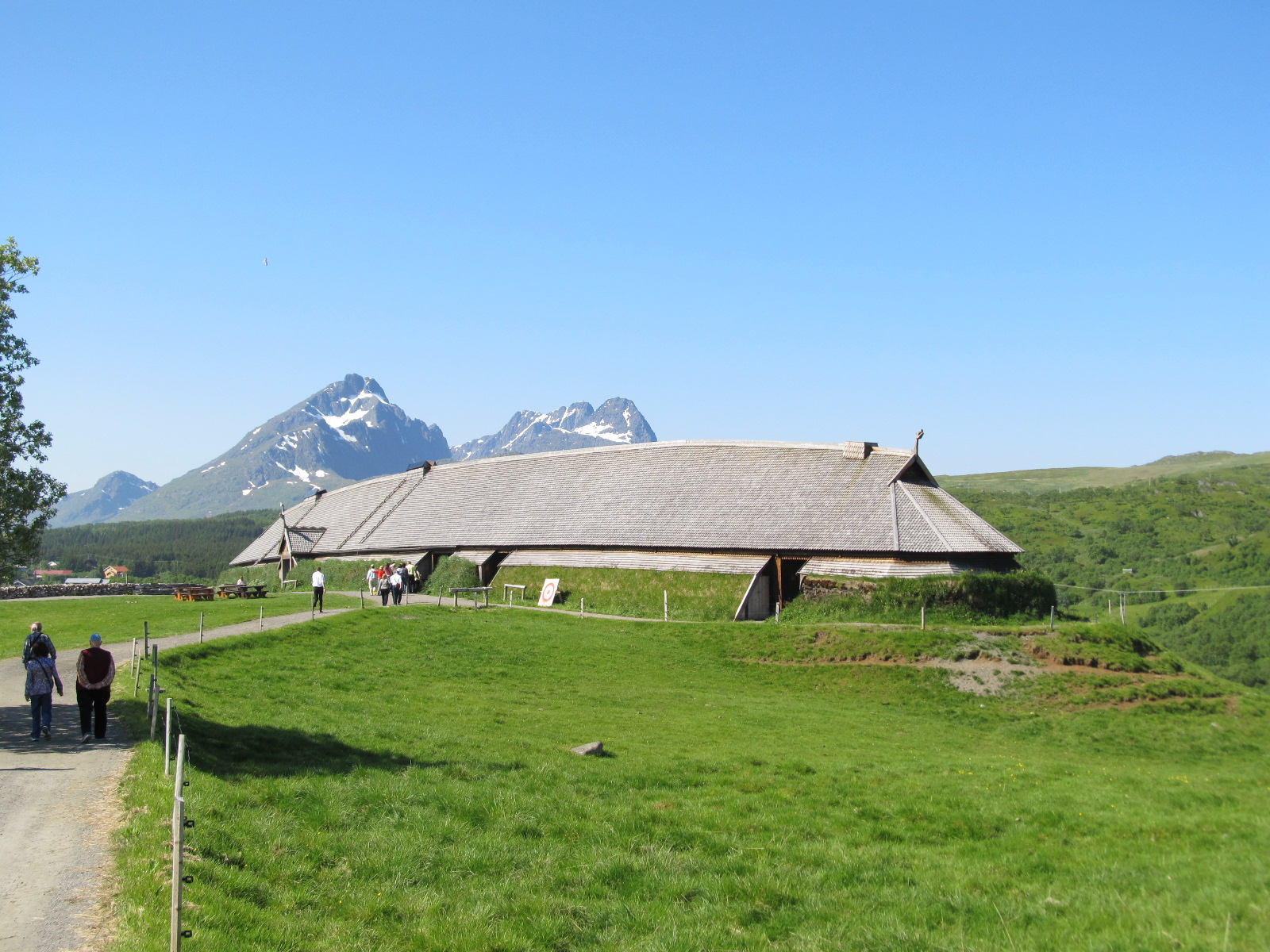
In 1995, the Lofotr Viking Museum opened with its centerpiece: a full-scale reconstruction of the chieftain's longhouse, built slightly north of the original excavation site. Standing 9 meters high and stretching 83 meters from end to end, the rebuilt longhouse is an arresting presence on the hilltop above Borg. Its turf-and-timber walls enclose a smoky interior lit by oil lamps and a central hearth, where costumed interpreters demonstrate Viking-era crafts, cooking, and daily routines. The main building was designed by Norwegian architect Gisle Jakhelln. Beyond the longhouse, the museum campus includes a blacksmith's forge, a reconstructed boathouse sheltering two replica ships -- one a full-scale copy of the celebrated Gokstad ship -- and exhibition halls displaying the actual artifacts recovered from the site. In 2006, plans to build an amphitheater between the reception building and the longhouse were delayed when construction workers uncovered 2,000-year-old cooking sites and post holes, proving that human activity at Borg predates even the Viking Age.
Where Power Met the Sea
What makes the Borg site extraordinary is its location as much as its scale. Vestvågøya sits in the heart of the Lofoten archipelago, surrounded by the fishing grounds that have drawn people north since prehistory. The chieftain who ruled from this hilltop did not govern a backwater; Lofoten in the Viking Age was a source of tremendous wealth. Cod, dried as stockfish on wooden racks, was the export commodity that connected Arctic Norway to the markets of Europe. Controlling Lofoten meant controlling that trade. The longhouse's hilltop position offered commanding views of the surrounding sea and farmland -- a vantage point that was strategic as much as scenic. Today, the museum sits in that same landscape, and visitors walking the gravel paths between the longhouse and the boathouse look out over the same water, the same mountains, the same light that a Viking chieftain surveyed a thousand years ago. The museum is part of the Museum Nord consortium and was nominated for the European Museum of the Year Award in 2013.
From the Air
Located at 68.24°N, 13.76°E on the island of Vestvågøya in the central Lofoten archipelago, near the village of Borg. The reconstructed longhouse is visible from the air on a hilltop as a long turf-roofed structure. Nearest airport: Leknes Airport (ENLK), approximately 15 km southwest. Svolvær Airport (ENSH) is also nearby. Bodø Airport (ENBO) provides the main mainland connection. Recommended viewing altitude: 2,000-4,000 ft for the museum campus and surrounding landscape context. The flat agricultural land around Borg contrasts distinctly with the surrounding mountain terrain, making the site identifiable from altitude.