Logan Memorial
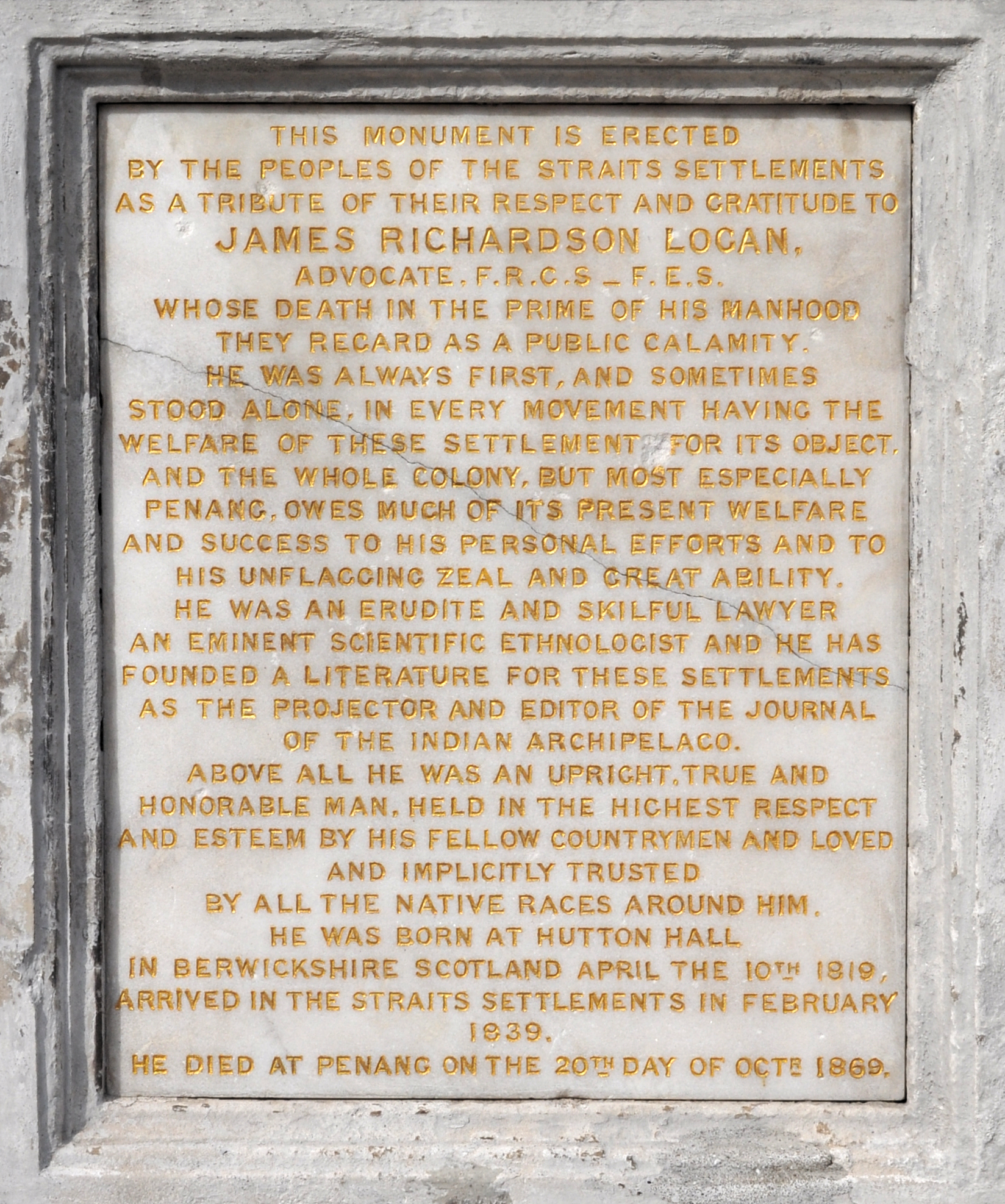
The inscription carved into its marble base wastes no time with pleasantries. It calls the death of James Richardson Logan "a public calamity" -- strong words for a Scottish lawyer who spent twenty years in Penang defending people the colonial system was not designed to protect. Standing before the Penang High Court on Light Street in George Town, the Logan Memorial has watched judges and advocates file past since 1872, its four allegorical figures silently posing the question that Logan spent his career answering: what does justice look like when it extends to everyone?
The Advocate Who Charged Nothing
James Richardson Logan arrived in the Straits Settlements trained in Scottish law, but his practice in Penang looked nothing like Edinburgh's courts. Between 1839 and his death in 1869, Logan made himself the legal champion of non-Europeans in a colonial system that rarely bothered with their rights. He defended them without charge -- an extraordinary commitment in an era when the legal profession was as much commerce as calling. But Logan was more than a courtroom advocate. He founded and wrote extensively for the Journal of the Indian Archipelago and Eastern Asia, a publication that became one of the most influential scholarly journals in Southeast Asia. He also owned and ran the Penang Gazette, the settlement's leading newspaper. Scholar, publisher, and advocate -- Logan wore all three hats in a colony where most Britons were content with just one.
A Colony in Mourning
Logan died on 20 October 1869, at the age of fifty. Within five weeks, prominent citizens gathered at the Exchange Rooms in George Town to decide how to honor him. The answer was clear: a monument, erected in Penang, where he had lived and worked for two decades. A committee was formed to collect subscriptions from all three Straits Settlements -- Penang, Malacca, and Singapore. The Singapore Bar held its own meeting at the Court House in December, resolving to contribute funds. That the legal profession across three territories would rally to memorialize a single advocate speaks to the scale of Logan's impact. By January 1872, word reached Penang that the memorial was complete, and it was likely unveiled later that year.
Four Virtues in Stone
The monument itself is built in the Gothic style, an architectural choice that gives it the feeling of a small cathedral spire rising from the tropical streetscape. Four female allegorical statues represent the Cardinal Virtues -- Temperance, Wisdom, Fortitude, and Justice -- each holding symbolic items that would have been immediately legible to the Victorian viewer. Their placement before the High Court was no accident. Every judge and lawyer walking into the building had to pass these stone figures, a daily reminder of the principles Logan embodied. Around the base, a marble plaque bears a carved side-profile of Logan's head and shoulders, accompanied by a lengthy inscription honoring his life. The monument is now protected as a Gazetted Monument under Malaysia's Antiquity Act of 1976, ensuring that the virtues Logan championed continue to stand watch over George Town's legal district.
Light Street's Quiet Sentinel
George Town's UNESCO World Heritage Site is dense with colonial architecture, but the Logan Memorial occupies a particular kind of space -- not a grand building or a busy market, but a pause in the streetscape that asks passersby to consider a single life well lived. Light Street itself is named for Captain Francis Light, who founded the Penang colony in 1786, and the memorial sits in a corridor of history that stretches from the founding of British Malaya to the present-day Malaysian judiciary. Unlike many colonial monuments that celebrate conquest or commerce, the Logan Memorial celebrates service. That a man who defended the rights of non-Europeans in 19th-century British Malaya was honored so publicly, by people across three settlements, remains a testament to how deeply his work was felt by the communities he served.
From the Air
Located at 5.4211N, 100.3399E on Light Street in central George Town, Penang Island. The monument sits in front of the Penang High Court, near the waterfront district. Best viewed from low altitude. Nearest airport is Penang International Airport (WMKP/PEN), approximately 16 km to the south. The George Town UNESCO Heritage Zone and its colonial-era buildings are visible landmarks along the northeastern coast of the island.