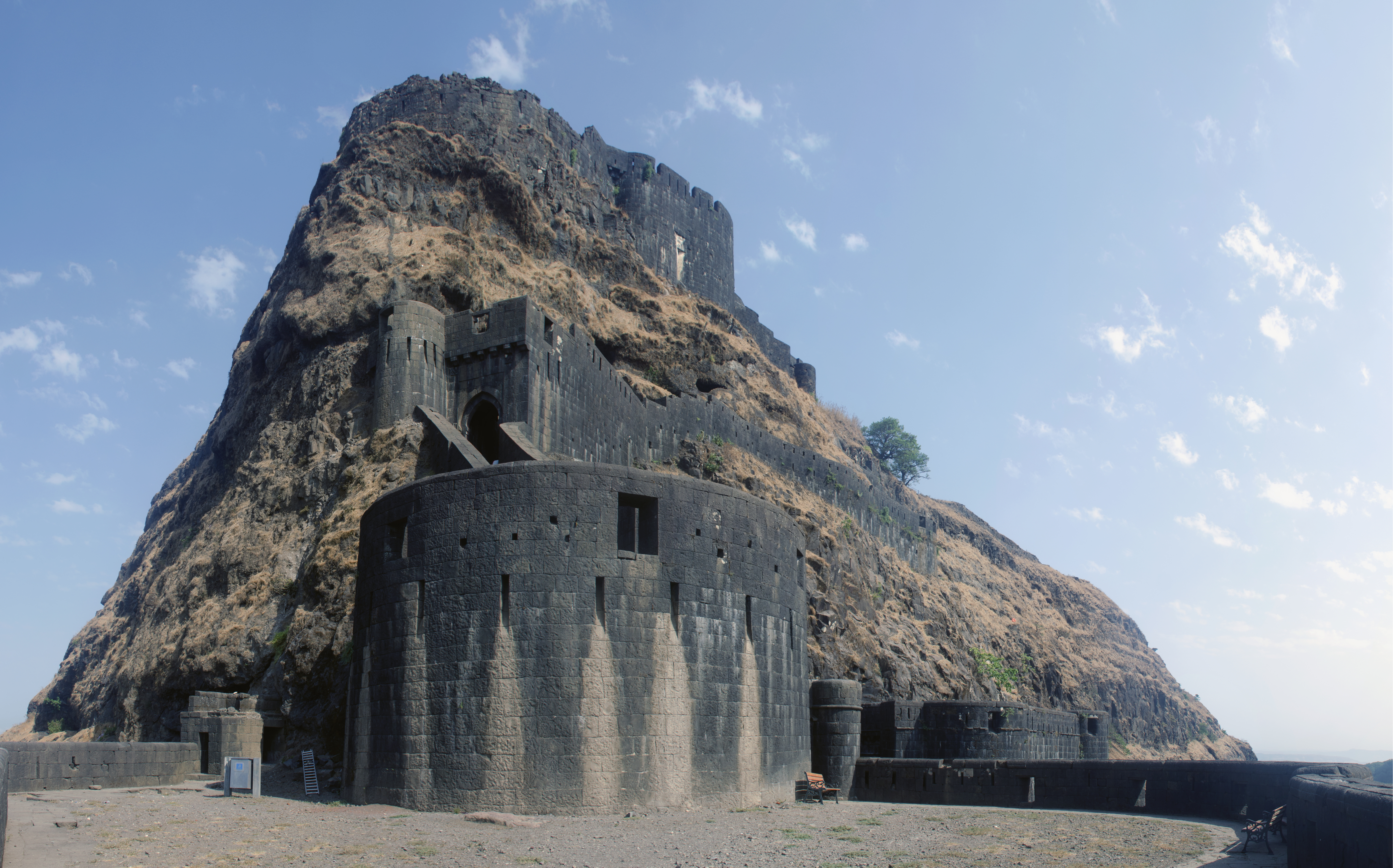
Lohagad
In September 2019, a team of trekkers from Pune found something on a cliff face of Lohagad that had nothing to do with the Maratha empire. Carved into the outer wall of a rock-cut cave on the fort's eastern side, an inscription in Jain Brahmi script and Prakrit-influenced Sanskrit began with the words "Namo Arihantanam" -- the opening of the Jain Navakar Mantra. It dated to the 1st or 2nd century BCE, more than a thousand years before Shivaji ever set foot on the ramparts. Lohagad's visible history is dramatic enough, but the fort sits on layers of time far deeper than its most famous chapter.
The Scorpion's Tail
Lohagad rises to 1,033 meters above sea level in the Western Ghats, 52 kilometers northwest of Pune and close to the hill station of Lonavala. The fort is connected by a small range to the neighboring Visapur Fort, and together they divide the basins of the Indrayani River and the Pavana Lake. What gives Lohagad its distinctive silhouette is a fortified spur extending to the northwest, called Vinchukada -- the Scorpion's Tail -- for its curving, tapering shape. Four large gates, still in good condition, guard the approaches. During the monsoon, the summit disappears into mist and cloud, moss creeps across every surface, and the trails leading up become slippery enough to demand real caution. This is precisely when trekkers love it most.
Every Dynasty's Fort
The roster of Lohagad's occupiers reads like a syllabus of medieval Indian power: Satavahanas, Chalukyas, Rashtrakutas, Yadavas, Bahmanis, Nizams, Mughals, and Marathas. The initial construction is attributed to the Lohtamia dynasty, who ruled the region during the 10th century CE. Shivaji captured the fort in 1648, but was forced to surrender it to the Mughals in 1665 through the Treaty of Purandar -- the same treaty that cost him Sinhagad. He recaptured it in 1670 and put it to a very specific use: Lohagad became the vault for the treasure seized from Surat. The fort's strategic value was not just defensive but financial. Later, during the Peshwa era, the statesman Nana Phadnavis lived here for a time and built several structures, including a large water tank and a step-well.
Written in Stone Before the Forts
The Jain inscription discovered in 2019 was studied by Dr. Shreekant Pradhan of Deccan College Post Graduate and Research Institute. Written in six lines across a surface 50 centimeters wide and 40 centimeters long, it mentions a donor named "Ida Rakhita" -- Indra Rakshita -- who donated water cisterns and rock-cut benches to settlements in the area. The inscription parallels one found at Pale caves in Maval, studied by archaeologists H. D. Sankalia and Shobhana Gokhale in 1969. Both begin with the Jain salutation and mention the same donor name, suggesting an organized Jain presence in this part of the Western Ghats more than two millennia ago. The discovery reframed Lohagad: what had been understood primarily as a medieval military fortification turned out to sit atop a site of ancient religious significance.
The Trek That Draws a City
From the train station at Malavli on the Mumbai-Pune suburban line, the walk to Lohagad takes about two hours. A paved road reaches the summit, but most visitors prefer the trail, especially during monsoon season when the Sahyadri Hills turn an almost aggressive green. The nearby Bhaja Caves, once home to Buddhist monks, sit on a short diversion along the way. Karla Caves are also within reach. The fort itself has been declared a protected monument by the government, preserving its gates, walls, and bastions against the kind of decay that has claimed so many other Deccan hill forts. From the ramparts, the Pavana reservoir spreads out below, and the ridge toward Visapur Fort invites the next walk. It is the kind of landscape that rewards the effort of reaching it -- and conceals, as those trekkers found in 2019, more than it initially reveals.
From the Air
Located at 18.71N, 73.48E, about 52 km northwest of Pune near Lonavala. Lohagad is a prominent flat-topped hill fort at 1,033 m elevation in the Western Ghats, connected by a ridge to Visapur Fort. The distinctive Vinchukada (Scorpion's Tail) spur extends northwest. Pavana reservoir is visible to the south. Recommended viewing altitude: 4,000-6,000 ft AGL. Nearest airports: Pune Airport (VAPO), and the Navi Mumbai International Airport to the northwest. Malavli railway station sits at the base.