Lola ya Bonobo
The name means "heaven for bonobos" in Lingala, and for the roughly 60 great apes who live in 30 hectares of primary forest on the southern edge of Kinshasa, it is exactly that. Lola ya Bonobo is the only sanctuary of its kind on Earth -- the sole refuge for orphaned bonobos, our closest living relatives alongside chimpanzees, who share roughly 98.7% of human DNA. Founded in 1994 by Belgian-born conservationist Claudine Andre, the sanctuary exists because of a grim arithmetic: hundreds of endangered bonobos are killed each year in the bushmeat trade that persists across the Democratic Republic of the Congo, and the infants that survive are sold as pets. When authorities confiscate those infants, there is exactly one place for them to go.
Substitute Mothers and Second Chances
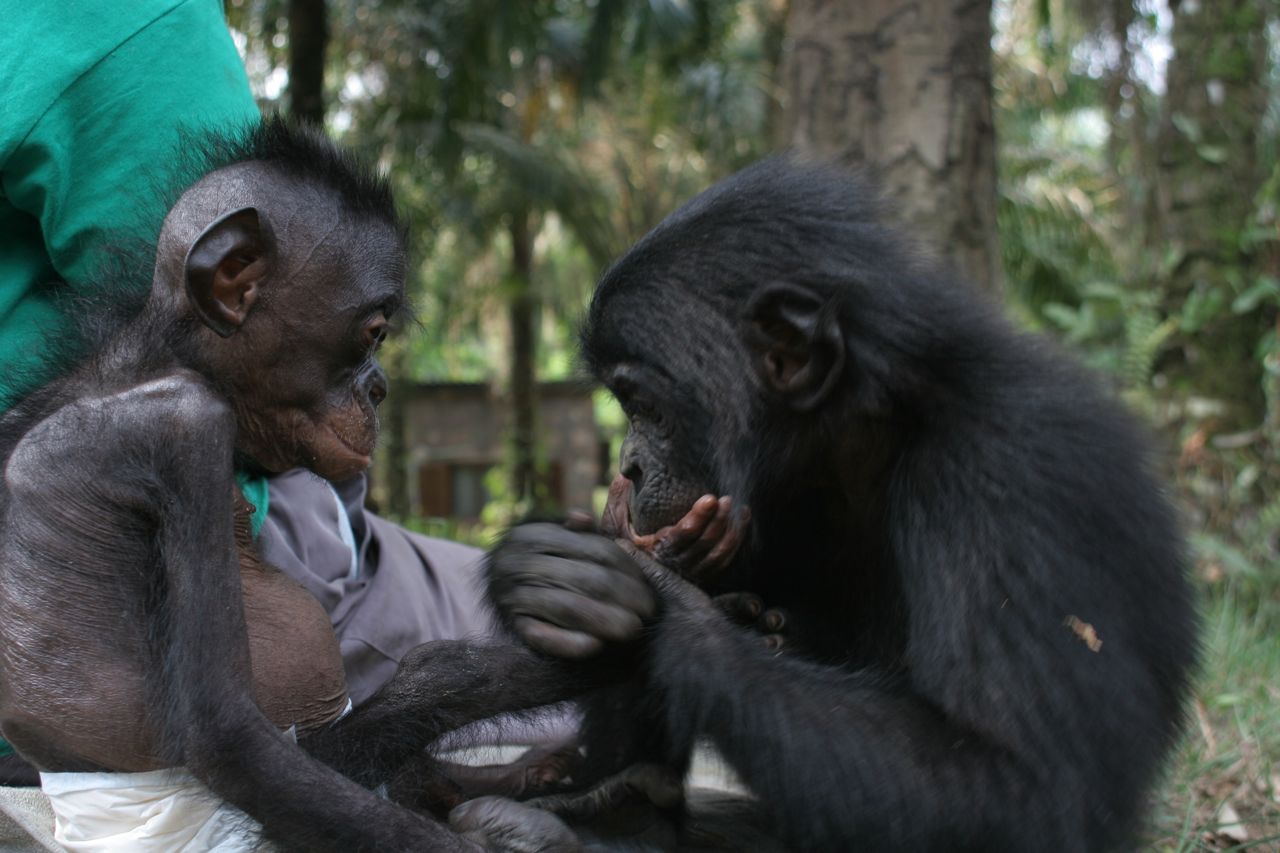
Each orphan arrives traumatized, often dehydrated, sometimes physically injured. The sanctuary's protocol begins with quarantine and a substitute human mother -- a caregiver who holds, feeds, and sleeps beside the infant around the clock. Bonobos are profoundly social animals; without this constant contact, the young ones simply do not recover. Once medically cleared, the orphans join a nursery peer group, learning to climb, forage, and navigate the social hierarchies that define bonobo life. When they mature, they are integrated into one of several large, mixed-age social groups spread across forested enclosures. The result is something remarkable: despite being captive, Lola ya Bonobo's residents display the full range of behaviors observed in wild populations. They forage among dozens of edible plants, compete for mates, and avoid venomous snakes. Researchers have even documented tool use here that has never been observed in the wild.
From Sanctuary to Rainforest
Rescue was always only half the mission. In 2008, eleven rehabilitated bonobos and their offspring were released into Ekolo ya Bonobo -- "land of the bonobos" -- a 117,000-acre community reserve in Equateur Province, roughly 666 kilometers from Kinshasa. It was the first bonobo rewilding in history. A second release followed in 2022, when fourteen more bonobos were set free after quarantine to prevent introducing illness to wild populations. By 2023, about 30 bonobos were living in the reserve, including babies born to the rewilded groups. The reserve itself is a seasonally flooded swamp forest containing peatland within the Cuvette Centrale, one of the planet's most important carbon sinks. Forest guards patrol daily because the illegal wildlife trade shows no sign of abating. In June 2023, a violent dispute with members of a local community group resulted in the deaths of four bonobos and the burning of conservation installations near Basankusu -- a brutal reminder that conservation in the Congo operates at the intersection of ecology, poverty, and politics.
Teaching a Country to See Its Inheritance
Bonobos exist nowhere on Earth except the DRC. They are, as the sanctuary's education programs frame it, a uniquely Congolese inheritance. Friends of Bonobos of the Congo runs programs for thousands of Congolese adults and children each year, bringing them to the sanctuary to learn about biodiversity, the bushmeat trade, and what extinction means in practice. A third-party study found measurable improvement in children's attitudes toward bonobos and wildlife conservation after participating. The outreach extends into provinces where the bushmeat trade is most entrenched, and the results are tangible: educated Congolese increasingly alert sanctuary staff when bonobos are captured and held in cages or sold in local markets. It is conservation that works not through enforcement alone but through shifting the way a nation understands its own natural heritage.
Science in the Forest
Lola ya Bonobo has become one of the most important research sites for understanding bonobo cognition and behavior. Studies conducted here have revealed that bonobos share food with strangers before acquaintances, exhibit delayed social development relative to chimpanzees, and respond prosocially toward members of other groups -- findings that illuminate what it means to be a social primate, including what it means to be human. Research on zoonotic pathogens, disease avoidance behavior, and population dynamics contributes directly to conservation strategy. The sanctuary also serves as a site for detecting interspecies disease transmission and novel pathogens, work with implications far beyond bonobo welfare. Every study published strengthens the scientific case for protecting a species whose wild population, scattered across the vast and often inaccessible Congo rainforest, remains poorly understood.
From the Air
Located at 4.49S, 15.27E in the Kimwenza suburb on the southern outskirts of Kinshasa. The sanctuary sits near the Petites Chutes de la Lukaya waterfalls. Best viewed from 2,000-4,000 feet AGL. Nearest major airport is Kinshasa N'Djili International Airport (ICAO: FZAA), approximately 20 km to the northeast. Maya-Maya Airport (FCBB) in Brazzaville lies across the Congo River to the northwest. The 30-hectare forest enclosure is visible as a dense green patch amid the expanding suburban development.