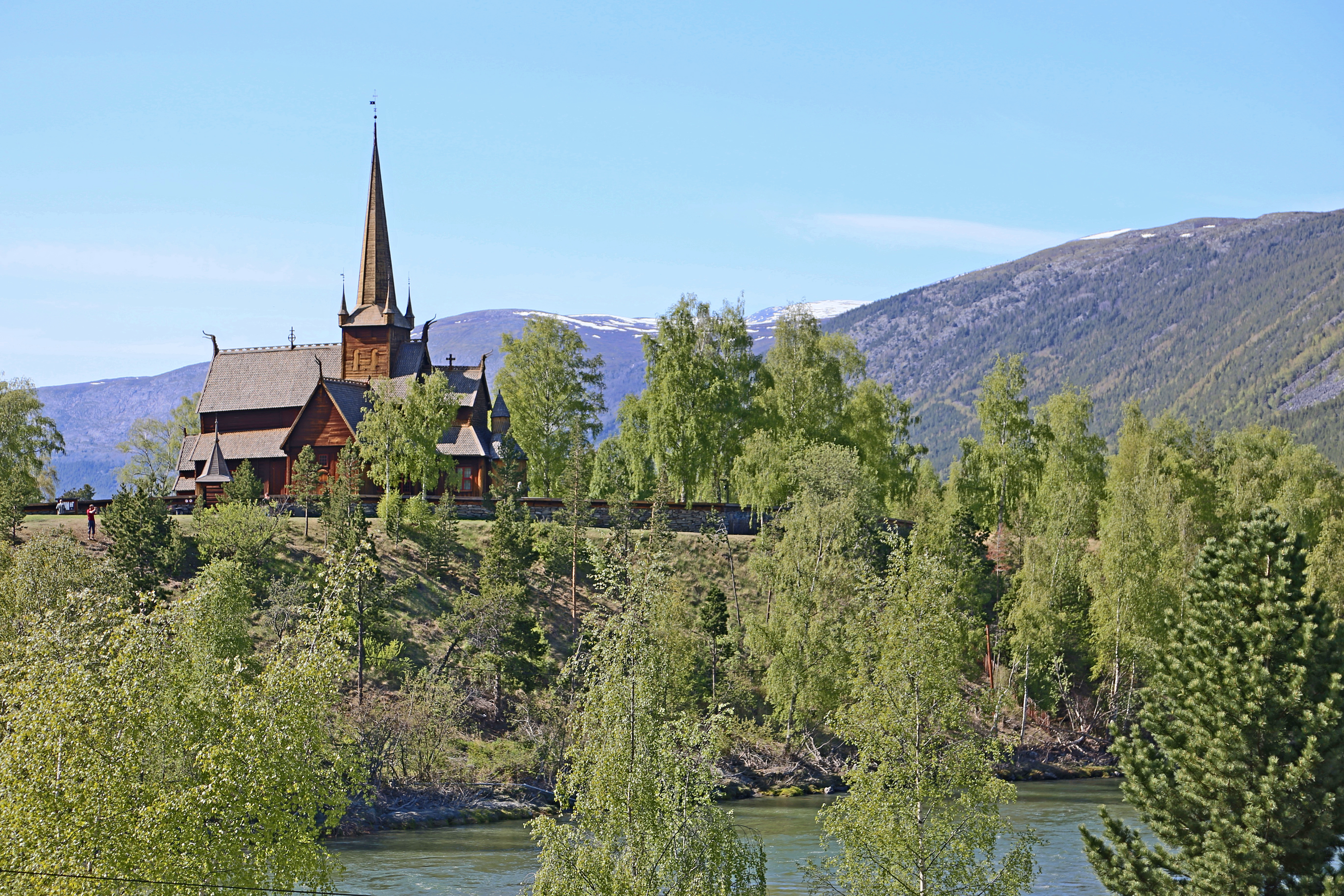
Lom Stave Church
Dragon heads still guard the roofline. They have been doing so, in one form or another, since the twelfth century, when builders raised Lom Stave Church from timbers cut around 1157-1158 in the forests of the Gudbrandsdal valley. Dendrochronology pins the date with scientific precision, but the building itself speaks in a language older than measurement -- the dark, tarred wood, the steep roof pitches designed to shed snow, the carved creatures that merge Christian architecture with something unmistakably Norse.
Older Than the Oldest
The church visitors see today is not the first to stand on this site. An 11th-century post church preceded it, a smaller wooden structure whose existence was confirmed during archaeological excavations in 1973. That earlier building had a rectangular nave with a narrower choir -- modest by any standard, built during the initial wave of Christianization across Norway's interior valleys. Around 1160-1170 it was torn down and replaced with the current stave church, a triple-nave design using free-standing inner columns to support a raised central ceiling. This construction type is among the oldest of Norway's stave churches, and Lom is one of the very few where the original medieval ridge crest with its carved dragon head survived intact. The original was removed in the 1950s for preservation and replaced with a copy, but for roughly eight centuries, those carved jaws stared out over the valley.
A Church That Kept Changing
Medieval buildings rarely stayed frozen in time, and Lom is no exception. The chancel was redecorated in 1608. By 1634, the growing congregation demanded more space, and a timber-framed extension was added to the west end -- a stopgap that lasted only three decades. In 1663, master builder Werner Olsen undertook a major renovation, removing the open-air corridors that had originally surrounded the church and adding transept wings to the north and south, transforming the floor plan from a simple rectangle into a cruciform shape. Olsen, who had previously worked on Vaga Church and Ringebu Stave Church, built the additions using the old stave construction methods, ensuring the new work matched the centuries-old original. Larger windows flooded the interior with light, and a flat ceiling was installed over the nave, concealing the vaulted ceiling above.
Coins, Constitutions, and Coal Tar
In 1814, Lom Stave Church served as an election church -- one of more than 300 parish churches across Norway where citizens voted for electors to the Norwegian Constituent Assembly at Eidsvoll Manor, which would draft the nation's constitution. It was Norway's first democratic election, and the stave church, by then already more than six centuries old, played its part. A complete restoration followed in 1933. Then in 1973, another major renovation aimed at thermal insulation required removing the floors entirely. Before rebuilding them, archaeologists seized the opportunity to excavate, uncovering more than 2,000 coins and evidence of the 11th-century predecessor church beneath. In 2010, the exterior was freshly tarred, deepening the building's color to the near-black that gives Norwegian stave churches their brooding, elemental character.
Still Standing, Still Serving
What makes Lom remarkable among Norway's surviving stave churches is not just its age but its continuity. This is not a museum piece or a ruin. It remains an active parish church in the Diocese of Hamar, seating about 350 people for services in the village of Fossbergom. The building has absorbed every era it has passed through -- Viking-age construction techniques, medieval dragon carvings, Reformation-era renovations, Enlightenment-era democracy, modern archaeological science -- and emerged as something greater than the sum of its centuries. The Gudbrandsdal valley stretches away on all sides, much as it did when the first timbers were raised. The dragons on the ridge still face outward, watchful against whatever comes next.
From the Air
Located at 61.84N, 8.57E in the Gudbrandsdal valley, approximately 60 km west of Otta. The church is in the village of Fossbergom in Lom Municipality, Innlandet county. The dark, tarred wooden structure is distinctive from the air, set among the buildings of Fossbergom with mountain terrain rising on all sides. Nearest airports include Fagernes Leirin (ENFG) approximately 80 km south. Best viewed at 2,000-3,000 feet AGL. The Jotunheimen mountains are visible to the southwest.